
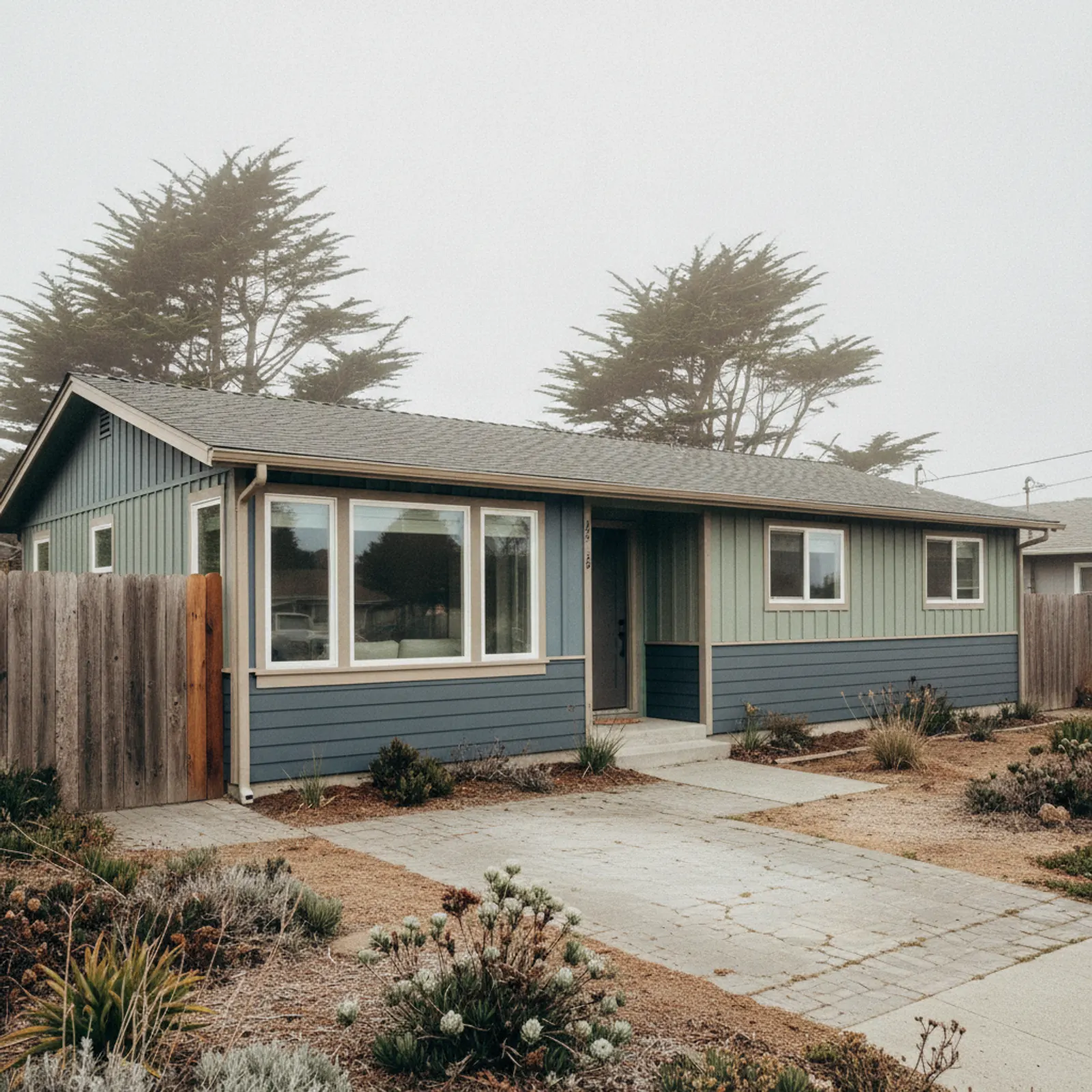
Exterior Contractor in Del Rey Oaks
Del Rey Oaks is a small, quiet Monterey Peninsula city tucked into an oak-shaded basin off Highway 218 between Monterey and Seaside, built almost entirely of modest mid-century single-family homes. Its sheltered hollow breaks the open-bay wind but holds marine damp under a dense tree canopy, so the exterior priority is a drying-managed, moisture-tuned envelope rather than the open-Pacific salt armor a shoreline city demands.
A Del Rey Oaks exterior contractor's role is to deliver that drying-capable, corrosion-aware envelope as one coordinated project — fiber cement with appropriate fastening, an integrated window package, and clean trim — scoped to a sheltered basin and a value-minded small-city market rather than an estate or shoreline spec the parcel does not need.
What an integrated Del Rey Oaks exterior includes
On a typical Del Rey Oaks mid-century home an integrated scope strips the failed cladding, corrects the weather-resistive barrier with a drainage-plane detail tuned for slow shade-drying, installs corrosion-aware fastening sized to the hollow's lingering salt, integrates window replacement, and re-clads in fiber cement with factory finishes chosen for shade-held marine humidity. The whole assembly is detailed by one crew so wall, window, and trim transitions all read as a single drying-capable system.
Where the split-trade exterior fails in Del Rey Oaks
In this basin the failure mode is moisture that sits too long on shaded walls finding the seams between separately-flashed trades. A siding crew that never coordinates with the window installer leaves head and sill laps that trap fog-driven damp, and on a north elevation that barely dries under the oaks, that lingering water rots bottom courses and corrodes hidden fastening within a few years. An integrator scopes the WRB, window flashing, and cladding as one drying-managed assembly so there is no orphaned seam holding water.
Materials and detailing we specify for Del Rey Oaks
Fiber cement with corrosion-aware fastening rated for the salt the slow hollow air retains, factory finishes selected to hold up in shade-held marine humidity, a rigorous drainage plane that lets shaded elevations dry between damp cycles, and trim detailing matched to a modest mid-century home rather than a premium-peninsula restoration. We grade the spec to the parcel's actual exposure inside the basin instead of importing a shoreline city's worst-case recipe.
Mid-century stock and how it shapes a whole-exterior scope
Most of Del Rey Oaks dates to the postwar decades, and when an exterior contractor opens up cladding on these homes the recurring finds are consistent: thin or aging building paper standing in for a proper water-resistive barrier, first-generation aluminum or single-pane windows that have weathered in the damp, and trim that was never detailed to shed the moisture the canopy holds against it. The right approach treats the wall as a system rather than swapping siding cosmetically — correcting the WRB and flashing laps, replacing the window package so new openings tie cleanly into the drainage plane, and choosing fastener and trim details suited to a sheltered, value-conscious parcel without gold-plating it. Because these are compact single-story homes on tree-canopied lots, the integration work is straightforward to stage, but it has to respect the mature oaks and the close-set neighboring walls along the narrow streets. The goal is a durable, drying-managed shell matched to what these mid-century basin homes actually need, not an estate budget they were never built to carry.
Reading the basin microclimate instead of the peninsula worst case
Del Rey Oaks sits between very different environments, and that shapes how we spec an exterior here. Just downhill toward Seaside the homes take direct bay salt, so those neighbors need the full corrosion-resistant assembly; up in the sheltered hollow the wind drops but the canopy holds damp on shaded faces far longer. For a Del Rey Oaks exterior contractor that means we cannot lift one fixed recipe off a shoreline job. A home on an open, sunnier basin edge dries faster and can lean on standard coastal detailing, while a north-facing lot deep under the oaks needs the drainage plane, kickout flashing, and back-priming pushed harder so the wall can shed moisture it only loses slowly. We confirm the actual microclimate of the address rather than assuming a city-wide worst case, which keeps owners from overpaying for open-Pacific armor on a sheltered site. Pulling siding, trim, flashing, and the window package into one coordinated scope means the transitions get detailed by a crew that understands how the marine layer behaves in this specific hollow.
Why this matters in Del Rey Oaks
- Specified for Monterey Peninsula conditions
- fiber cement as the recommended system
- Correctly detailed weather-resistive barrier and flashing
- Installed by a crew with 20 years combined experience
Recommended systems for Del Rey Oaks
- fiber cement
- James Hardie
- engineered wood
Exterior Contractor for Del Rey Oaks homes
The full exterior contractor approach — materials, weather-resistive detailing, and the manufacturer standards we install to — is covered on the main service page, then specified for Del Rey Oaks's conditions on this one.
Our Del Rey Oaks process
- Step 1
Consultation
We listen to your goals and assess your home on site — exposure, substrate, and architecture.
- Step 2
Design & Proposal
A clear written proposal with the right system specified for your climate and a transparent scope.
- Step 3
Expert Installation
Trained crews install to manufacturer best practices with careful weather-management detailing.
- Step 4
Walkthrough & Support
A final walkthrough, full cleanup, and a clear written record of the scope completed — work we stand behind.
FAQ
Exterior Contractor in Del Rey Oaks — FAQ
Seaside takes direct bay salt on open flats, while Del Rey Oaks sits in a wind-sheltered oak hollow where slow shade-drying damp is the controlling stressor. The detailing here is drying-and-moisture focused rather than heavy open-coast salt armor.
On homes with original aluminum or single-pane windows, yes — the shade-held damp finds aged flashing fast, and integrating the window package into the drainage plane during the re-clad is far cleaner than doing it separately later.
Generally no — this is a developed, low-basin city with no significant wildland interface. The fiber cement we use is already non-combustible, so any fire benefit comes along free while the spec stays focused on moisture.
We plan staging and access on the narrow streets around the canopy, protecting mature oaks and close-set neighbor walls. The compact single-story stock here keeps that coordination manageable.
Most Del Rey Oaks single-family homes run three to six weeks of active work depending on size and scope, with the mostly single-story stock keeping access straightforward.
Keep Exploring
More for Del Rey Oaks homeowners
Nearby Service Areas
Exterior Contractor near Del Rey Oaks
Back to
Monterey County & Del Rey Oaks
Helpful Exterior Guides