Fire-Resistant Siding in Lake Wildwood
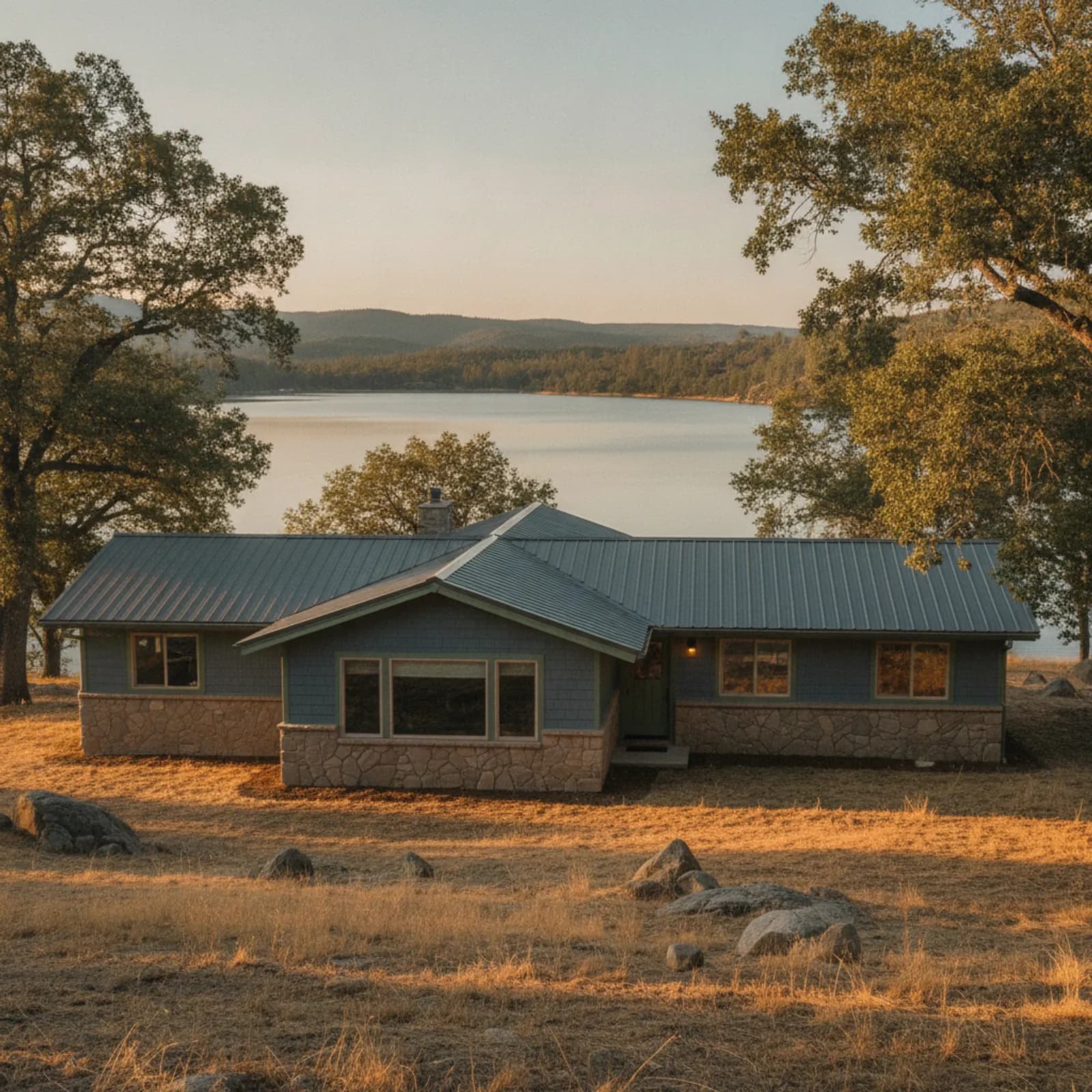
Fire-resistant siding is a primary service inside Lake Wildwood. The gated community sits in genuine high wildfire terrain — open oak-grassland and cured annual grass on the western Nevada County foothills — and it depends on a single controlled gate for access, which is a real planning constraint residents and fire officials both reckon with. Hardening the exterior here is a central decision, not a finish upgrade.
Why oak-grassland fire behavior drives the spec
Lake Wildwood's fuel is the thing to design around. Blue oak, live oak, and a dense carpet of annual grass that cures gold by June produce fast-running surface fire and a heavy, wind-driven ember cast rather than the slow crowning of a pine forest. Embers, not flame fronts, are what take homes in this kind of fuel — they ride the afternoon up-canyon wind off the surrounding hills and sift into gaps. So fire-resistant siding here means a Class A non-combustible wall plane plus the detailing that closes ember paths: ember-resistant vents, sealed butt joints over a fire-rated weather barrier, and trim that leaves no ledge for grass litter and oak leaves to pile against.
Hardening the zero-to-five-foot zone on a lake-community lot
On a Lake Wildwood lot the first five feet around the house often decides whether a Class A wall actually performs. Embers settle against the foundation in a wind event, and bark mulch, a wood deck stringer, or combustible trim at grade can ignite a wall that the cladding itself would have resisted. We carry the non-combustible plane down to a clean ignition-resistant termination rather than leaving exposed wood at the base, and we flag where attached decks, gates, and fences meet the wall plane. Many community lots back onto greenbelt or the oak edge, so that immediate perimeter — not the field of the siding — is where the hardening is won or lost.
The single gate, honestly addressed
We are straight with homeowners about what we can and cannot influence. The community's one controlled entrance is a meaningful egress factor in a fast-moving grass fire, and no exterior product changes that. What a hardened envelope does is buy a home a better chance of surviving an ember exposure on its own when conditions move faster than an evacuation, and it gives a household something concrete in the defensible-space picture the community as a whole is working on. We scope to the most resilient wall and perimeter possible and let the access reality stand as the planning fact it is, rather than implying siding solves it.
Documentation for insurance and defensible-space review
Carriers have grown sharply more selective across western Nevada County, and a Lake Wildwood policy renewal increasingly turns on demonstrable hardening. When we re-clad, tear-off usually exposes sheathing, flashing, and vents that an underwriter or a defensible-space inspector wants addressed in the same pass, so we treat that open-wall window as the moment to upgrade vents to ember-resistant assemblies and confirm the wall is non-combustible end to end. We keep written records of the materials and assemblies installed so a homeowner has something concrete for an insurer or the community's review — while staying honest that documentation supports a conversation rather than guaranteeing any underwriting outcome.
Why this matters in Lake Wildwood
- Specified for Sierra Foothills conditions
- Class A non-combustible fiber cement as the recommended system
- Correctly detailed weather-resistive barrier and flashing
- Installed by a crew with 20 years combined experience
Recommended systems for Lake Wildwood
- Class A non-combustible fiber cement
- James Hardie
- fire-aware detailing
Fire-Resistant Siding for Lake Wildwood homes
The full fire-resistant siding approach — materials, weather-resistive detailing, and the manufacturer standards we install to — is covered on the main service page, then specified for Lake Wildwood's conditions on this one.
Our Lake Wildwood process
- Step 1
Consultation
We listen to your goals and assess your home on site — exposure, substrate, and architecture.
- Step 2
Design & Proposal
A clear written proposal with the right system specified for your climate and a transparent scope.
- Step 3
Expert Installation
Trained crews install to manufacturer best practices with careful weather-management detailing.
- Step 4
Walkthrough & Support
A final walkthrough, full cleanup, and a clear written record of the scope completed — work we stand behind.
FAQ
Fire-Resistant Siding in Lake Wildwood — FAQ
High. The community sits in open oak woodland and cured annual grass on the foothills, which produces fast grass fire and heavy ember cast. Non-combustible, hardened exteriors are the baseline here, especially on perimeter and greenbelt-edge lots.
It is a real egress constraint we acknowledge honestly. A hardened exterior cannot fix access, but it can help a home survive an ember exposure on its own when fire moves faster than an evacuation.
Yes. Lake Wildwood's oak-grassland fuel drives ember and fast-surface-fire detailing rather than slow-crown-fire planning, so the emphasis is the wall plane, ember-resistant vents, and the five-foot perimeter.
It can support insurability in this fire terrain. We document materials and assemblies for your carrier and the community's defensible-space review, though insurers set their own criteria.
No. Vents, the five-foot ground zone, deck and fence transitions, and eave detailing all complete the protection. We treat the exterior and its immediate perimeter as one hardened system.
Keep Exploring
More for Lake Wildwood homeowners
More in Lake Wildwood
Other exterior services in Lake Wildwood
Nearby Service Areas
Fire-Resistant Siding near Lake Wildwood
Back to
Nevada County & Lake Wildwood
Helpful Exterior Guides