
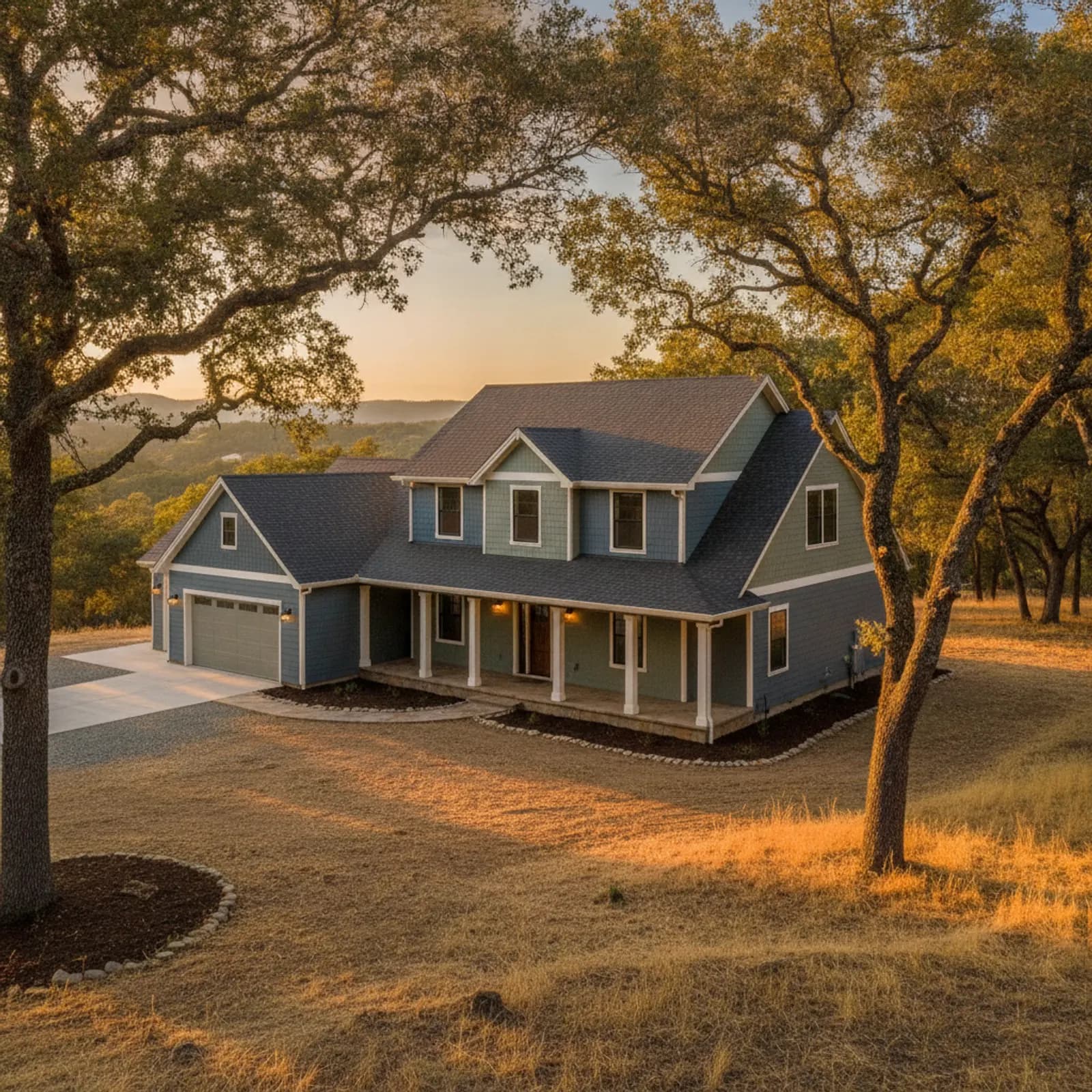
Fiber Cement Siding in Applegate
Applegate is a small oak-and-pine community strung along the Interstate 80 corridor northeast of Auburn, and its defining characteristic for exterior work is shape: a narrow, linear settlement of acreage homes where the fuel runs continuously along the corridor rather than being confined to one side of a parcel.
Fiber cement is the baseline here because the exposure is high and the community's layout offers no natural break.
A linear community in continuous fuel
Applegate does not have a centre with a defensible edge — it is strung along the corridor, with homes on acreage set into oak and pine that continues in both directions. That shape matters because it removes the buffer a clustered community sometimes provides, and because fire moving along the corridor has an uninterrupted run. For an individual owner the practical implication is that the parcel has to look after itself: non-combustible cladding, hardened openings, and cleared ground immediately around the structure, rather than relying on any neighbourhood-scale interruption of the fuel.
Access and egress on a corridor community
Interstate 80 gives Applegate genuinely good access by foothill standards, which helps a crew and helps a fire response. What it does not do is guarantee a route out during an event, since a corridor fire can close the road that everyone depends on. That is a planning reality rather than a construction one, but it bears on the specification indirectly: on a property where evacuation may be constrained, the passive resilience of the building matters more because there is less certainty about active defence. We build to that logic rather than assuming someone will be there.
Mixed oak and pine burns differently from either alone
Applegate's fuel is a genuine mix, and that matters because oak-and-grass fire and pine-timber fire behave differently. Grass and oak carry fire fast and low with heavy ember production; pine carries it into the canopy with sustained radiant load. A parcel with both gets both mechanisms, which is why we would not specify an Applegate property purely as a grassland parcel or purely as a timber one. The practical answer is a package covering both — ember-resistant openings for the fast-moving side, non-combustible cladding and hardened eaves for the radiant side.
Heat, and the finish
Summers here are hot and the canopy is patchy, so the finish is under real attack on south and west elevations. The failure pattern is the standard foothill one — chalked coating, cupped boards, opened joints, winter rain finding them. A factory-applied finish rather than field paint is the right call, and on acreage properties with outbuildings the argument compounds with the surface area. It is also worth noting that on a fire-exposed parcel, a well-maintained finish is not a fire measure — the substrate is what matters there, and the finish is about durability and cost.
Why this matters in Applegate
- Specified for Sierra Foothills conditions
- Class A non-combustible fiber cement as the recommended system
- Correctly detailed weather-resistive barrier and flashing
- Installed by a crew with 20 years combined experience
Recommended systems for Applegate
- Class A non-combustible fiber cement
- James Hardie fiber cement
- fire-hardened eave and vent detailing
- robust flashing for seasonal swings
Fiber Cement Siding for Applegate homes
The full fiber cement siding approach — materials, weather-resistive detailing, and the manufacturer standards we install to — is covered on the main service page, then specified for Applegate's conditions on this one.
Our Applegate process
- Step 1
Consultation
We listen to your goals and assess your home on site — exposure, substrate, and architecture.
- Step 2
Design & Proposal
A clear written proposal with the right system specified for your climate and a transparent scope.
- Step 3
Expert Installation
Trained crews install to manufacturer best practices with careful weather-management detailing.
- Step 4
Walkthrough & Support
A final walkthrough, full cleanup, and a clear written record of the scope completed — work we stand behind.
FAQ
Fiber Cement Siding in Applegate — FAQ
Because it is a linear community strung along the corridor rather than a cluster with a defensible edge, so the fuel runs continuously in both directions with no natural break. The practical implication is that a parcel has to look after itself rather than relying on any neighbourhood-scale interruption of the fuel.
For access and response, genuinely — it is good access by foothill standards. What it does not guarantee is a route out during an event, since a corridor fire can close the road everyone depends on. That argues for passive resilience in the building rather than assuming active defence will be available.
Both, and that is the point. Oak and grass carry fire fast and low with heavy ember production; pine carries it into the canopy with sustained radiant load. An Applegate parcel with both gets both mechanisms, so the package needs ember-resistant openings and non-combustible cladding with hardened eaves.
No — the substrate is what matters for fire, and the finish is about durability and cost. It is worth being clear because coatings marketed as fire-related come up periodically. On a fire-exposed parcel, the material of the wall and the detailing at the openings do the work.
Keep Exploring
More for Applegate homeowners
More in Applegate
Other exterior services in Applegate
Nearby Service Areas
Fiber Cement Siding near Applegate
Helpful Exterior Guides