
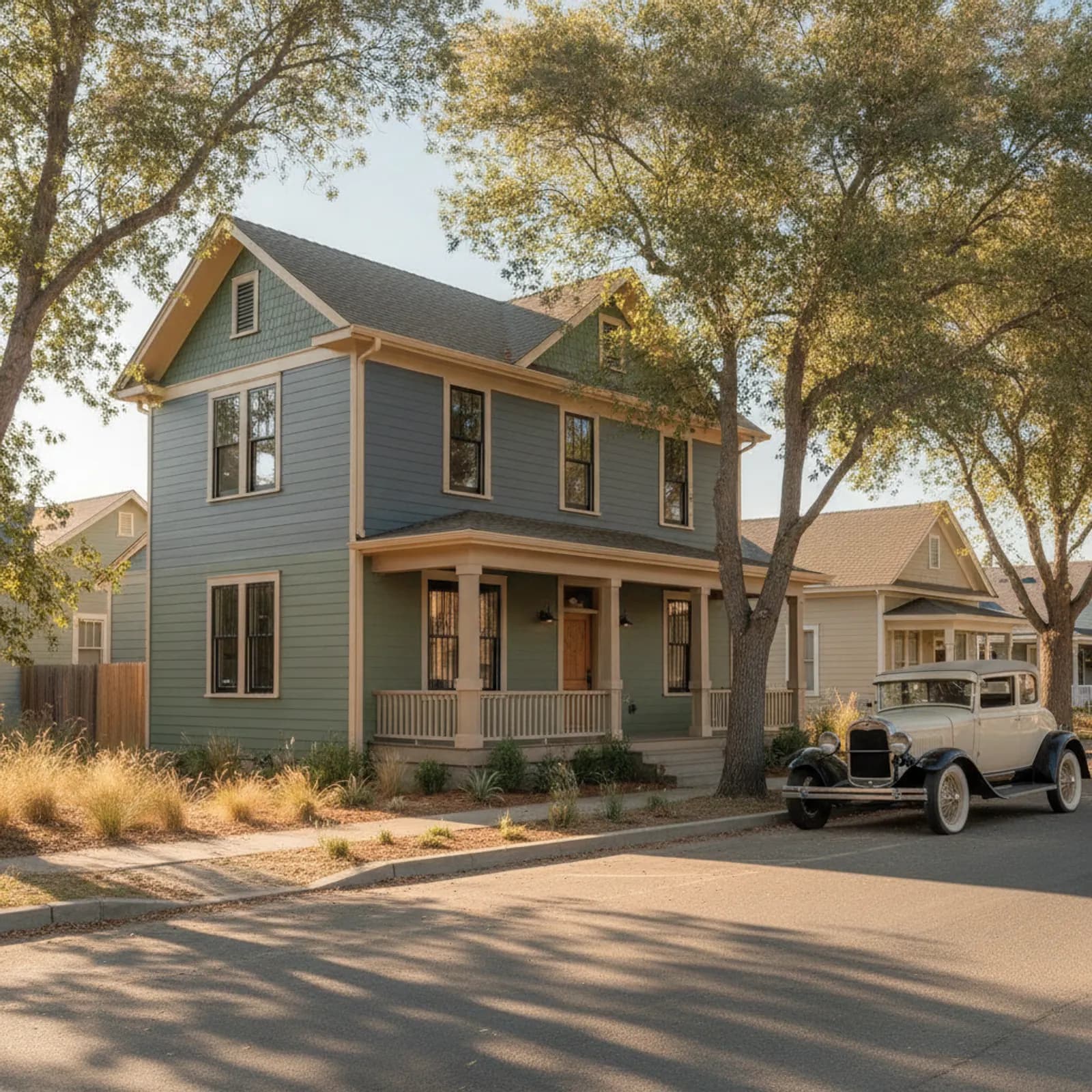
Fiber Cement Siding in Isleton
Isleton sits on a reclaimed Delta island below the level of the surrounding water, ringed by sloughs and held by levees. That is an unusual setting for a California town and it produces an unusual exterior problem: the moisture is not seasonal weather, it is the permanent condition of the ground the buildings stand on.
Fiber cement is here because it does not absorb water the way the historic wood siding it replaces does.
Below water level changes the baseline
Most moisture advice assumes a wall that gets wet and then dries. On a reclaimed island the water table is close and constant, the air over the sloughs carries humidity year-round, and the drying window that a normal climate provides is narrower. The practical result on historic wood stock is that the material rarely reaches equilibrium — paint fails from behind rather than from the sun, bottom courses soften, and end-grain at butt joints and trim wicks moisture continuously. An owner who has repainted repeatedly and watched it fail again is not looking at a workmanship problem.
Sloughs on multiple sides
Isleton's geography means water is not on one elevation, it is around the town. Slough-side and riverfront parcels take the most direct exposure, but the humidity is general rather than directional, which is different from a coastal property where a windward elevation takes the brunt. The consequence for scoping is that there is no sheltered side to economise on — the specification and the detailing should be consistent around the building rather than tuned to one exposure, which is the opposite of the advice we give on most other markets.
The base of the wall does the suffering
On raised-foundation homes behind the levee, the bottom eighteen inches of the exterior is where most failures concentrate: splash-back off damp ground, snow-free but persistent ground moisture, and skirting that traps humidity under the floor rather than letting the crawl space breathe. Clearance between the bottom course and grade matters more here than nearly anywhere in the county. It costs nothing to set correctly at installation and is effectively unfixable later without rebuilding the base of the wall, which makes it the first thing worth confirming a bidder has considered.
Historic main-street fabric
Isleton carries early-1900s small-town buildings, Delta cottages and bungalows, and the commercial structures from its asparagus-era history — genuine character that a modern wide-lap product misrepresents whatever the color. Fiber cement reproduces period profiles convincingly when board width, reveal, and trim proportion are specified deliberately, so ending the rot cycle does not require losing the town's fabric. On a designated property there may be review considerations beyond a standard permit, which is the county's determination and any applicable body's rather than ours.
Why this matters in Isleton
- Specified for Sacramento Valley conditions
- James Hardie as the recommended system
- Correctly detailed weather-resistive barrier and flashing
- Installed by a crew with 20 years combined experience
Recommended systems for Isleton
- James Hardie
- fiber cement
- engineered wood
Fiber Cement Siding for Isleton homes
The full fiber cement siding approach — materials, weather-resistive detailing, and the manufacturer standards we install to — is covered on the main service page, then specified for Isleton's conditions on this one.
Our Isleton process
- Step 1
Consultation
We listen to your goals and assess your home on site — exposure, substrate, and architecture.
- Step 2
Design & Proposal
A clear written proposal with the right system specified for your climate and a transparent scope.
- Step 3
Expert Installation
Trained crews install to manufacturer best practices with careful weather-management detailing.
- Step 4
Walkthrough & Support
A final walkthrough, full cleanup, and a clear written record of the scope completed — work we stand behind.
FAQ
Fiber Cement Siding in Isleton — FAQ
Because the town sits on a reclaimed island below the level of surrounding water, ringed by sloughs. The water table is close and constant and the air carries humidity year-round, so the drying window a normal climate provides is narrower. The moisture is the permanent condition of the ground rather than seasonal weather.
Less than you would expect. Unlike a coastal property with a windward elevation, the humidity here is general rather than directional because water surrounds the town. That means no sheltered side to economise on — specification and detailing should be consistent around the building, which is the opposite of our usual advice.
Because that is where failures concentrate: splash-back off damp ground, persistent ground moisture, and skirting that traps humidity under the floor. Clearance between the bottom course and grade matters more here than nearly anywhere in the county, costs nothing to set right at installation, and is effectively unfixable later.
Yes, if board width, reveal, and trim proportion are specified deliberately rather than defaulted. A modern wide-lap product misrepresents these buildings whatever the color. On a designated property there may be review beyond a standard permit — worth establishing with the county before design.
Keep Exploring
More for Isleton homeowners
More in Isleton
Other exterior services in Isleton
Nearby Service Areas
Fiber Cement Siding near Isleton
Helpful Exterior Guides