Fire-Resistant Siding in Orangevale
Honest answer: Orangevale is split. Interior ranch subdivisions are low-exposure where fire-resistant siding is a low-regret default; the larger wildland-adjacent acreage near the American River canyon edge and open oak-grass carries genuine moderate exposure where it is a real decision.
Subdivisions low, wildland-adjacent acreage moderate
Most interior Orangevale sits on low-exposure valley ground; the larger acreage parcels backing the canyon edge and open oak-grass carry moderate, real exposure and warrant Class A non-combustible cladding with hardened eaves, vents, and ground transitions.
Free margin inside, real reason on acreage
Interior Orangevale subdivisions get Class A as an incidental benefit of the heat-durable fiber cement they'd choose anyway. The larger wildland-adjacent acreage near the canyon edge and open oak-grass is the opposite: there non-combustibility plus hardened eaves, vents, and ground transitions is the actual scope, sized to the parcel.
Equestrian acreage off Hazel and Oak: defensible cladding for the horse-property fringe
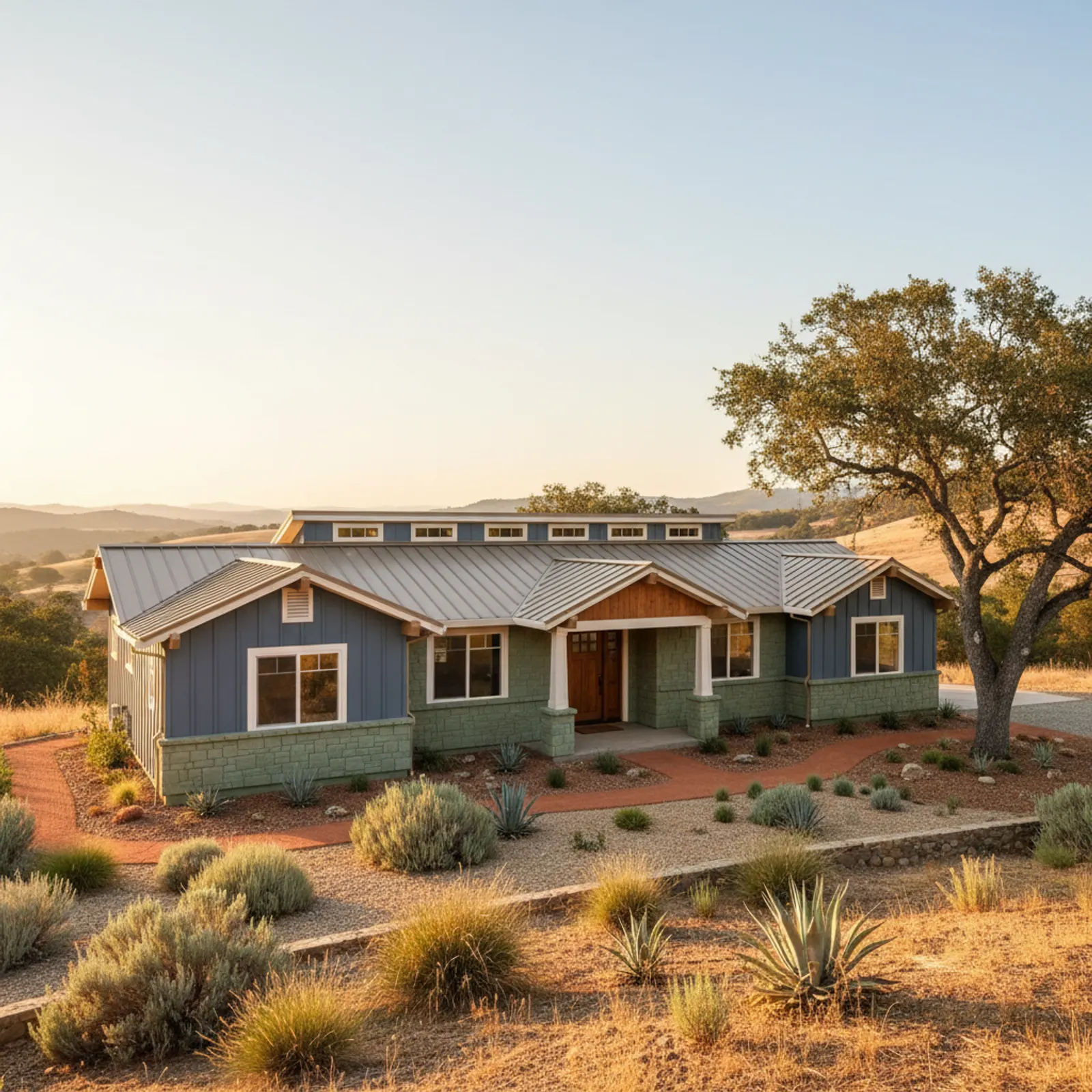
On Orangevale's equestrian-friendly acreage, the parcels stretching toward the Folsom Lake foothills off Hazel Avenue and Oak Avenue, fire-resistant siding is part of a larger ember story, not an isolated wall upgrade. These ranch homes often sit near barns, hay storage, wood fencing, and dry oak-grass that all act as ember launchers when a foothill grass fire runs. We spec Class A non-combustible cladding, typically fiber cement or mineral-based board, but the detailing is where the work actually lands. That means closing the gap at the bottom course with a noncombustible ground transition so embers cannot lodge against the wall, screening eave and gable vents to 1/8-inch mesh, and tightening trim and fascia so wind-driven embers find no fuel pocket. On a large lot the wall area is substantial, so we sequence the re-side around outbuilding access and gates rather than treating it like a tract job. The goal is a hardened envelope that holds up through valley heat and gives the home a fighting chance during a foothill ember wash.
Why valley heat, not rain, sets the fire-resistant spec here
Orangevale's defining stressor is not moisture; it is relentless Sacramento Valley heat, and that shapes how fire-resistant cladding should be specified and installed. A non-combustible exterior already shrugs off rot and termites that humid regions worry about, so the real durability question is thermal: sustained summer sun, broad day-to-night temperature swings, and the expansion and contraction that loosens fasteners and opens joints over time. We favor fiber cement and mineral board that hold a Class A fire rating without softening or warping in heat, and we use heat-stable, fade-resistant finishes rather than coatings that chalk out under valley UV. Fastening and gapping follow the manufacturer's hot-climate guidance so seams stay tight and caulk lines do not split, because an open joint is both a heat-fatigue failure and an ember entry point. For the ranch and acreage homes that dominate this market, that pairing matters: the same low-fuss, heat-durable envelope owners want for comfort and longevity is exactly the envelope that resists ignition. One specification quietly answers both the heat problem and the wildfire problem at once.
Why this matters in Orangevale
- Specified for Sacramento Valley conditions
- James Hardie fiber cement as the recommended system
- Correctly detailed weather-resistive barrier and flashing
- Installed by a crew with 20 years combined experience
Recommended systems for Orangevale
- James Hardie fiber cement
- factory finishes
- durable trim packages
Fire-Resistant Siding for Orangevale homes
The full fire-resistant siding approach — materials, weather-resistive detailing, and the manufacturer standards we install to — is covered on the main service page, then specified for Orangevale's conditions on this one.
Our Orangevale process
- Step 1
Consultation
We listen to your goals and assess your home on site — exposure, substrate, and architecture.
- Step 2
Design & Proposal
A clear written proposal with the right system specified for your climate and a transparent scope.
- Step 3
Expert Installation
Trained crews install to manufacturer best practices with careful weather-management detailing.
- Step 4
Walkthrough & Support
A final walkthrough, full cleanup, and a clear written record of the scope completed — work we stand behind.
FAQ
Fire-Resistant Siding in Orangevale — FAQ
It depends on the parcel — interior ranch subdivisions are low-exposure (low-regret only), while wildland-adjacent acreage carries genuine moderate exposure warranting hardened non-combustible detailing.
Moderate and real on larger acreage near the American River canyon edge and open oak-grass; low across the interior subdivisions. Not foothill-forest extremity.
No — the fiber cement we recommend for Orangevale's heat durability is already non-combustible, so Class A performance is included.
On moderate-exposure wildland-adjacent parcels it can support insurability; we document materials and assemblies, though insurers set their own criteria. On interior subdivisions the effect is usually negligible.
Keep Exploring
More for Orangevale homeowners
More in Orangevale
Other exterior services in Orangevale
Nearby Service Areas
Fire-Resistant Siding near Orangevale
Back to
Sacramento County & Orangevale
Helpful Exterior Guides