
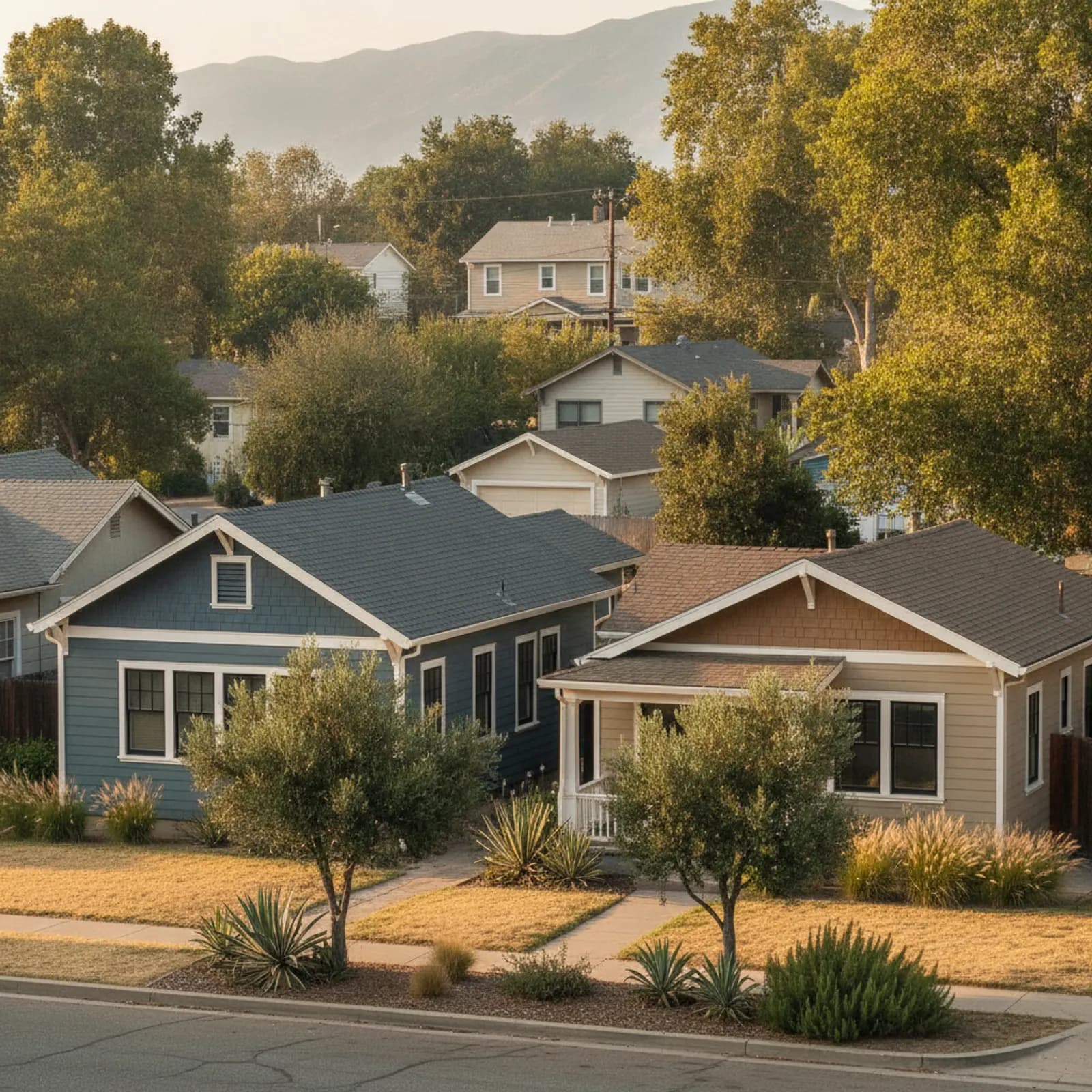
Fiber Cement Siding in Tracy
Fiber cement is the core Tracy recommendation because the city's two real loads — fierce valley heat and sustained Altamont wind — are exactly what it is built to take. It is dimensionally stable through hard interior-valley thermal swings, holds a factory finish under high UV, and, fastened to a wind-rated schedule, stays put against the open-field gusts off the pass that would rattle thinner board.
Heat-stable through the valley swing
Tracy summers don't just run hot, they swing: a west wall can bake past triple digits at four in the afternoon and shed twenty or thirty degrees once the delta and pass breezes come through after dark. That daily expansion-and-contraction is what splits caulk, cups thin cladding, and pops fasteners on a low-canopy lot with no shade to soften the load. Fiber cement barely moves with temperature, so seams stay tight and the surface stays flat — provided the install leaves the manufacturer-specified butt gaps and uses movement-rated sealant on the hot elevations.
The weight that beats the wind
The same density that gives fiber cement its dent and impact resistance is also why it suits a wind-exposed Tracy lot. A heavier, rigid panel fastened on a tightened schedule resists the uplift and chatter that lighter materials suffer when the Altamont wind runs across open ground with nothing to break it. We reinforce the edge, corner, and trim detailing on the exposed western and southern elevations and seal the laps to shed wind-driven rain, so the cladding works as a system against the gusts rather than just hanging on the wall.
Color that survives full exposure
On Tracy's open, low-canopy tracts there is little shade on any side, so a baked-on factory finish earns its keep where field paint cannot. Factory-finished fiber cement holds color through the long, bright summers far longer than a field-applied coat that chalks and fades in a few seasons, and it sheds the field dust the pass wind carries to a simple rinse. For a production-tract owner tired of repainting a sun-tired exterior, this is the practical end of the repair-and-repaint cycle. On the south and west walls that take the worst of the afternoon, that color stability is also what keeps a re-side looking new years after the work, rather than streaking unevenly the way a field coat does once the sun has worked it.
A clean install on open tract lots
Tracy's subdivision lots tend to be flat and accessible, which makes staging straightforward, but the open exposure shapes how the job runs. Cutting fiber cement raises silica dust, and the pass wind will carry it across a driveway or a neighbor's yard fast, so we cut downwind with shrouded blades and dust collection rather than letting it drift. The same wind means courses cannot be left loosely tacked overnight; each is fully fastened to the wind-rated schedule before the crew leaves. Timing the sealing steps to keep grit out of the wet bead is the difference between a clean finish and a contaminated joint.
Why this matters in Tracy
- Specified for Central Valley conditions
- James Hardie fiber cement as the recommended system
- Correctly detailed weather-resistive barrier and flashing
- Installed by a crew with 20 years combined experience
Recommended systems for Tracy
- James Hardie fiber cement
- factory finishes
- wind-aware fastening and detailing
- modern lap and board-and-batten profiles
Fiber Cement Siding for Tracy homes
The full fiber cement siding approach — materials, weather-resistive detailing, and the manufacturer standards we install to — is covered on the main service page, then specified for Tracy's conditions on this one.
Our Tracy process
- Step 1
Consultation
We listen to your goals and assess your home on site — exposure, substrate, and architecture.
- Step 2
Design & Proposal
A clear written proposal with the right system specified for your climate and a transparent scope.
- Step 3
Expert Installation
Trained crews install to manufacturer best practices with careful weather-management detailing.
- Step 4
Walkthrough & Support
A final walkthrough, full cleanup, and a clear written record of the scope completed — work we stand behind.
FAQ
Fiber Cement Siding in Tracy — FAQ
Yes — it is dimensionally stable through the hot interior-valley thermal swing, and fastened to a wind-rated schedule with reinforced edges it stands up to the open-field wind off the Altamont that rattles thinner cladding.
Minimal. A factory-baked finish holds color through Tracy's long, high-UV summers far better than field paint; a fully exposed sun face may eventually want a refresh while the substrate stays sound.
On the open western and southern edges near the pass, yes — we use a tightened, wind-rated fastener schedule and reinforced corner and trim detailing so the Altamont wind can't work the cladding loose. Sheltered interior tracts get a lighter spec.
It ends the heat-and-wind repair cycle that builder-grade cladding suffers on open Tracy lots, holds factory color through the valley sun, and rinses off pass-carried dust — strong long-term value without premium cost.
Keep Exploring
More for Tracy homeowners
More in Tracy
Other exterior services in Tracy
Nearby Service Areas
Fiber Cement Siding near Tracy
Helpful Exterior Guides