
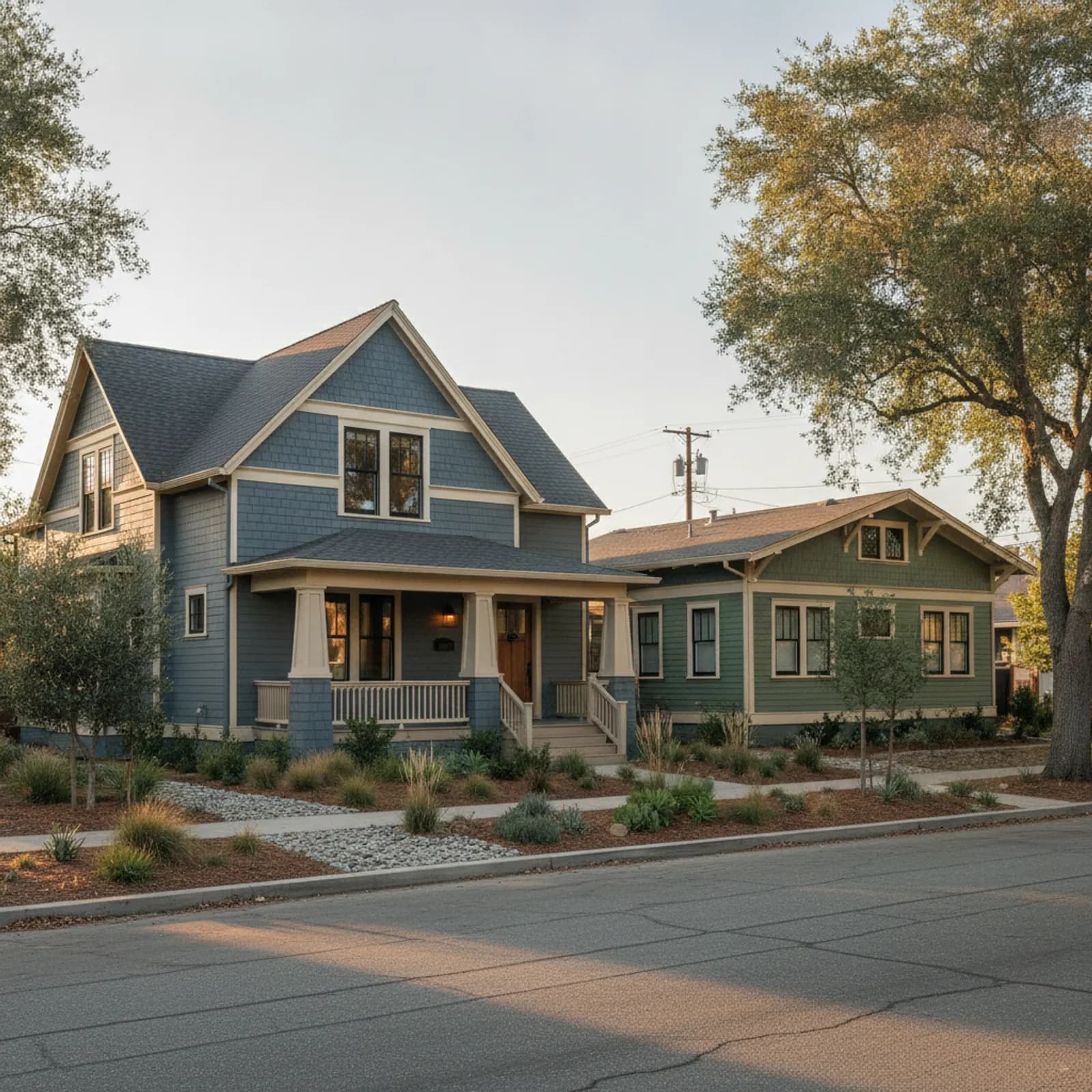
Fiber Cement Siding in Stockton
Fiber cement is the core Stockton recommendation precisely because the city throws two opposite loads at a wall: blistering Central Valley heat and UV on the sun-struck elevations, and Delta humidity on the west and north sides near the channel and sloughs. Fiber cement is dimensionally stable through hot thermal cycling and, unlike wood or hardboard, does not swell, rot, or feed mold when the damp air settles in.
Magnolia, Brookside, and the postwar tracts all share Sacramento-Valley-style summers that climb toward and past 100 degrees, then cool under Delta-influenced nights. Factory-baked ColorPlus-style finishes are effectively mandatory here for any cladding meant to last decades without an early repaint cycle.
Why the material fits Stockton's split climate
The case for fiber cement in Stockton is that one material answers both of the city's stressors. The cement-and-cellulose composition holds factory finish through intense interior-valley UV that degrades field paint and wood in a handful of seasons, and it stays dimensionally stable through the wide daily swing between baking afternoons and humid, cooler Delta nights. On the moisture side, it does not absorb and hold water the way aged wood lap and hardboard do, which is the failure mode you see along the bottom courses of older homes near the west-side sloughs. We pair the board with a properly detailed drainage plane so the assembly handles the Delta damp rather than just resisting it at the surface.
What a tract reclad actually involves here
Much of Stockton's housing volume sits in postwar tracts and master-planned communities like Brookside and Spanos Park, where homes went up in dense waves with near-identical elevations and shared builder details. That repetition shapes how a fiber cement project runs. The original cladding is usually one dominant material across a whole street, so when we strip and reclad one house, we match joint spacing, trim reveals, and lap exposure to neighbors that buyers and HOA design committees notice. Replacing builder-grade panels and field-painted lap with planks and matching trim means re-flashing window heads and the garage band that took the worst western sun. Two-story plans common to these neighborhoods drive staging and lift access along narrow side yards, and we set up cut stations to control silica dust on tight lots.
The moisture detail near the channel and sloughs
On the west and north sides of Stockton, where homes sit closer to the Deep Water Channel, Smith Canal, and the slough network, the humid air is the spec driver more than the heat. Here fiber cement earns its place by being a board that does not wick and hold the Delta moisture, but the material alone is not the whole answer. We back it with a continuous weather-resistive barrier, a drainage gap where the wall warrants one, kickout and head flashing that actually sheds, and sealed, primed end-cuts so water cannot track into the panel edges. The lower courses near grade get the most attention, since that is where damp, splashback, and poor drainage combine to rot the cheaper materials these homes often started with. Detailing the wall to dry is what makes the fiber cement last on this side of town.
Finish and color in baking valley sun
Stockton's UV load makes finish selection a durability decision, not just an aesthetic one. A factory-baked finish on fiber cement holds color far longer than any field paint applied on a hot wall, and it eliminates the short repaint cycle the valley sun otherwise forces. Darker colors read well on the newer Brookside and Spanos Park elevations but absorb more heat, so we talk through pigment behavior and thermal load before locking a selection, especially on the south- and west-facing walls. The trade-off is straightforward: spend the selection effort up front and the wall holds its look for decades, or chase a fading, chalking field-painted surface every few summers the way many older Stockton homes have had to.
Why this matters in Stockton
- Specified for Central Valley conditions
- James Hardie fiber cement as the recommended system
- Correctly detailed weather-resistive barrier and flashing
- Installed by a crew with 20 years combined experience
Recommended systems for Stockton
- James Hardie fiber cement
- factory finishes
- rigorous weather-management detailing near the Delta
- modern lap and board-and-batten profiles
Fiber Cement Siding for Stockton homes
The full fiber cement siding approach — materials, weather-resistive detailing, and the manufacturer standards we install to — is covered on the main service page, then specified for Stockton's conditions on this one.
Our Stockton process
- Step 1
Consultation
We listen to your goals and assess your home on site — exposure, substrate, and architecture.
- Step 2
Design & Proposal
A clear written proposal with the right system specified for your climate and a transparent scope.
- Step 3
Expert Installation
Trained crews install to manufacturer best practices with careful weather-management detailing.
- Step 4
Walkthrough & Support
A final walkthrough, full cleanup, and a clear written record of the scope completed — work we stand behind.
FAQ
Fiber Cement Siding in Stockton — FAQ
Yes — that's the main reason we recommend it here. It stays stable through hot thermal cycling and holds finish under intense UV, and it does not swell or rot in the humid air the way wood and hardboard do near the channel.
No — the board itself does not absorb water like wood. The key is the assembly behind it: a proper drainage plane, sealed end-cuts, and good flashing so the wall can dry, which we detail for west-side moisture exposure.
Lightly, and far slower than field paint or wood. A factory-baked finish ends the early repaint cycle the intense UV otherwise forces; only the most sun-exposed elevation may want a later refresh.
Usually — it ends the heat-and-moisture failure cycle of original cladding and can be milled to match the period reveals and trim those neighborhoods rely on, so character survives the upgrade.
Keep Exploring
More for Stockton homeowners
More in Stockton
Other exterior services in Stockton
Nearby Service Areas
Fiber Cement Siding near Stockton
Back to
San Joaquin County & Stockton
Helpful Exterior Guides