
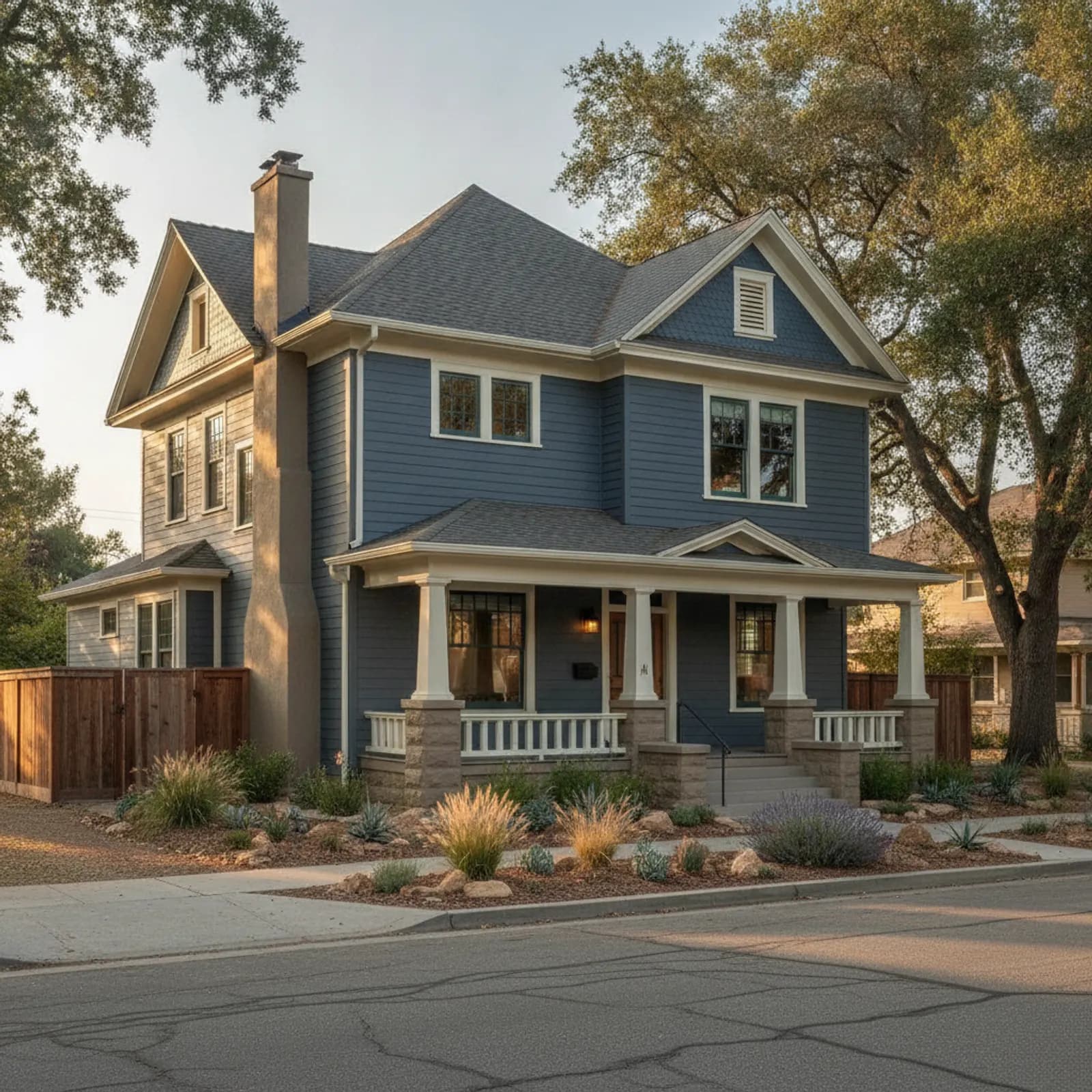
Exterior renovation in Stockton
Stockton is the largest city in the northern San Joaquin Valley — an inland port at the eastern edge of the Delta, where the San Joaquin River reaches deep into the Central Valley. Its housing has unusual depth for a valley city: an early-1900s historic core of Victorians and Craftsman homes, the elegant Miracle Mile and its mid-century neighborhoods, broad post-war ranch tracts, large newer subdivisions in Brookside, Spanos Park, and Weston Ranch, and waterfront homes along the Delta channels. Much of it is now past the service life of its original siding, weathered by some of the most intense sustained UV in the valley and, near the water, by delta humidity too.
Heat first, with a Delta-edge wrinkle
Stockton's defining stressor is the long, fierce valley summer, which chalks, cups, and fades original hardboard, T1-11, and economy cladding worst on south and west walls across the city's open, low-canopy tracts. What sets Stockton apart from the inland San Joaquin towns is the Delta. Waterfront neighborhoods and lower-lying parcels along the river and channels catch delta humidity and afternoon breezes, raising moisture exposure. The cladding answer is the same fade-resistant fiber cement citywide — but near the water, the detailing around it has to work harder.
Considering an exterior project in Stockton?
Stockton housing and architecture
Stockton's stock runs from early-1900s Victorian, Queen Anne, and Craftsman homes in the historic core, through the Miracle Mile and mid-century neighborhoods that defined the city's mid-century growth, to broad post-war ranch tracts and large 1990s–2010s subdivisions in Brookside, Spanos Park, and Weston Ranch, plus waterfront homes along the Delta. The historic homes demand narrow, period-correct profiles and accurate trim where a generic re-side reads wrong on a known street; the ranch belts take a clean lap re-side well; the newer tracts respond to a modern lap-and-batten field and refreshed palette to break builder uniformity; and the Delta-edge homes call for the most rigorous moisture detailing. We design to the era and the parcel rather than to one template.
Built for Stockton's heat and Delta moisture
Stockton behaves as valley-heat country first: long, intense, high-UV summers fade finishes and stress joints, worst on south and west elevations, so fade-resistant factory-finished fiber cement and heat-aware gapping and fastening are the baseline. What changes here is the Delta. Stockton sits at the eastern edge of the Sacramento–San Joaquin Delta and along the San Joaquin River, where delta humidity and afternoon breezes raise moisture exposure on the waterfront and lower-lying neighborhoods. The same wall has to beat the valley sun across the city and, near the water, also shed and manage more moisture through rigorous drainage-plane detailing. Wildfire is not a driving factor on this valley-floor port city.
Recommended materials for Stockton
James Hardie fiber cement with a factory finish is the core recommendation for Stockton: dimensionally stable in the fierce valley heat, color-stable under sustained UV, and well suited to the Delta-corridor moisture exposure when paired with correct detailing. The factory finish resists the chalking and fade the valley sun drives, while a continuous, properly lapped weather-resistive barrier, flashed penetrations, kickout flashings, and correct bottom-course clearances handle the added moisture near the river and channels. On the historic-core homes we choose narrow, period-appropriate lap and trim; on the Brookside and Weston Ranch tracts, modern lap-and-batten programs differentiate repeated builder elevations.
What an exterior project costs in Stockton
Stockton pricing turns on home size and stories, profile and trim complexity — markedly higher on the ornate historic-core homes — substrate and dry-rot condition once cladding is removed, window integration, and the weather-management scope. The variable specific to Stockton is moisture-detailing scope, which is heavier on the Delta-edge waterfront and lower-lying parcels and lighter on higher inland tracts. The historic and Miracle Mile homes most frequently reveal layered original siding and dry rot at demolition after decades of heat and humidity. Newer subdivisions may carry HOA design review affecting color and material. We provide a written, scoped estimate after an on-site assessment rather than a generic per-foot figure.
The historic core and Miracle Mile
Stockton's early-1900s historic neighborhoods and the Miracle Mile corridor hold the city's most character-rich and most demanding re-side stock — Victorians, Craftsman bungalows, and refined mid-century homes on established streets. These carry detailing expectations a generic re-side will visibly miss, so we match lap width, trim proportions, and finish to the era and respect existing ornamentation. They are also the most likely to hide dry rot or multiple layers of original siding behind weathered cladding, which we plan for at demolition. Getting the character right here protects both the home and a recognizable streetscape.
Brookside, Spanos Park, and Weston Ranch tracts
North and south of the city center, the large 1990s–2010s subdivisions in Brookside, Spanos Park, and Weston Ranch brought production homes now reaching re-side and refresh age. These two-story elevations respond strongly to a modern lap-and-batten program with a refined trim and color package that distinguishes one repeated builder elevation from the next, and many sit within HOAs whose design review governs exterior color and material. We confirm any overlay requirements before scoping so the approved palette is the one we install.
Delta-edge and waterfront homes
Along Stockton's channels and the San Joaquin River, waterfront and lower-lying homes carry the city's most moisture-sensitive exposure, where the heat-plus-humidity combination shows up most. On these parcels we pair the same fade-resistant fiber cement with more rigorous drainage-plane work — flashing laps, kickout flashings, and bottom-course clearances — and check carefully for the dry rot that decades of valley sun and delta humidity can leave behind. The cladding choice does not change; the detailing intensifies.
PG&E, City of Stockton MUD, and historic-district review
Working exteriors in Stockton coordinates with a few local authorities that shape scope. Electric and gas both come from PG&E. Water is served in most of Stockton by the City of Stockton Municipal Utilities Department (a city-owned utility), with Cal Water serving some areas and California Water Service the outer north; meter and backflow coordination goes through the applicable water provider. Fire response is the Stockton Fire Department. On the permit side, the City of Stockton's Community Development Department handles building permits, and the city's Cultural Heritage Board reviews visible exterior work on contributing structures within designated historic districts — including the Magnolia Historic District, the Miracle Mile historic overlay, and other named neighborhoods where material, profile, and color can be regulated. Newer HOA subdivisions in Brookside, Spanos Park, and Weston Ranch carry their own architectural review that pre-approves visible changes before permits issue. We flag utility, permit, and heritage items at the estimate stage rather than at the wall.
HZ10 climate and Stockton's Delta-edge FHSZ reality
Stockton is in James Hardie's HZ10 climate zone — the West's hot-summer, low-freeze belt — and HZ10 is the correct spec for a Stockton home; installing the alternative HZ5 line is a documented warranty misapplication. On the fire side, essentially all of Stockton sits on the flat valley floor and Delta edge in Low FHSZ territory or unmapped under California's 2025 LRA Fire Hazard Severity Zone map — the WUI Code does not typically apply. Non-combustible fiber cement remains a low-regret upgrade anyway. The controlling spec elements here are heat and UV durability (the entire reason HZ10 is engineered the way it is) and, near the water, the drainage-plane discipline that the Delta corridor demands. The code frame did change on January 1, 2026, when Chapter 7A was deleted from the Building Code and its provisions moved into the standalone WUI Code, but on a Stockton re-side the heat-and-moisture work is where the real focus lives.
Our process in Stockton
- Step 1
Consultation
We listen to your goals and assess your home on site — exposure, substrate, and architecture.
- Step 2
Design & Proposal
A clear written proposal with the right system specified for your climate and a transparent scope.
- Step 3
Expert Installation
Trained crews install to manufacturer best practices with careful weather-management detailing.
- Step 4
Walkthrough & Support
A final walkthrough, full cleanup, and a clear written record of the scope completed — work we stand behind.
Stockton rewards an exterior strategy that respects both the fierce valley sun and its Delta-edge moisture, from a historic-core Victorian to a Weston Ranch two-story or a waterfront home on the channels. We scope every Stockton project on site so the heat and moisture detailing match the actual parcel, and your written estimate governs the work.
FAQ
Stockton — Common Questions
Fiber cement with a factory fade-resistant finish — it handles Stockton's fierce valley heat and, with correct detailing, the Delta-corridor moisture on the lower-lying and waterfront neighborhoods. It holds color far longer than field-painted or economy products.
The cladding material is the same, but homes near the Delta and along the San Joaquin River get extra attention to weather-resistive barrier, flashing, kickout flashings, and bottom-course clearances because of the added moisture.
Yes. We use narrow, period-correct profiles and accurate trim proportions so the result upgrades durability without erasing the home's character — essential on Stockton's recognizable historic and Miracle Mile streets.
Original builder-grade hardboard, T1-11, and economy cladding was never specified for Stockton's intense valley UV load, and Delta humidity accelerates failure on lower-lying walls. Chalking, cupping, and fading on sun-facing elevations is the typical pattern.
Generally no — Stockton is a valley-floor port city surrounded by farmland and the Delta, with low wildfire exposure. Non-combustible fiber cement is still a sound, low-regret choice alongside its heat and moisture performance.
When feasible, yes — combining them ensures correct flashing integration and avoids duplicated trim work, which matters more on the moisture-sensitive Delta-edge homes.
Yes — the historic core and Miracle Mile, the post-war ranch belts, the Brookside, Spanos Park, and Weston Ranch tracts, and the Delta-edge waterfront homes.
A correctly installed fiber cement system commonly performs 30+ years in the northern San Joaquin Valley climate, with factory finishes and proper moisture detailing extending the time before any cosmetic refresh.
Helpful Exterior Guides