
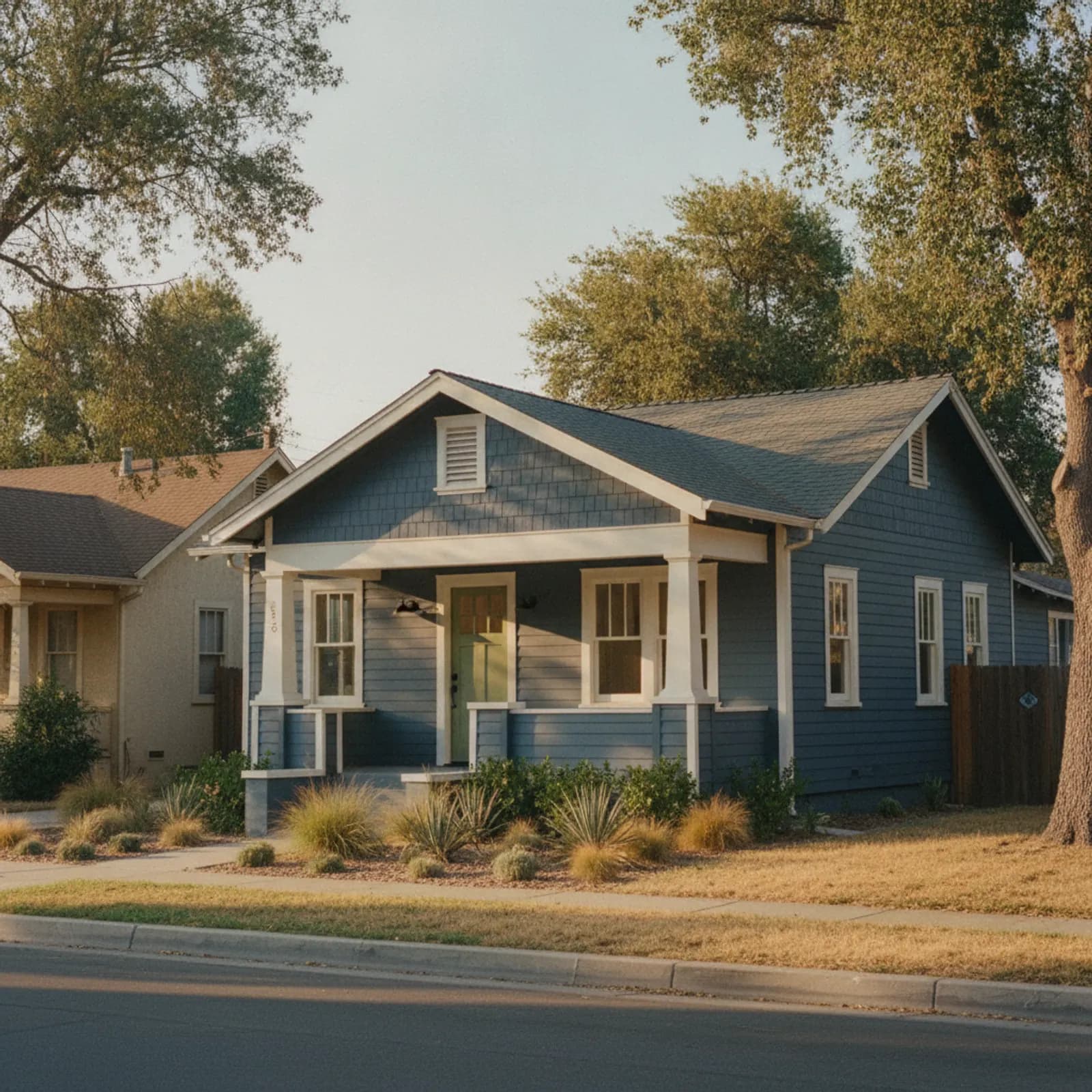
Exterior renovation in Manteca
Manteca sits in the heart of San Joaquin County at the crossroads of Highway 99 and Highway 120, ringed by the orchards and row crops that gave the area its agricultural roots. Once a small ag town, it has grown rapidly into a mid-size valley city, and the housing shows it: an older downtown core of bungalows and modest period homes, post-war ranch neighborhoods, a deep band of 1990s–2010s subdivisions, and newer master-planned tracts spreading across the open valley floor. Much of that production stock is now reaching re-side and refresh age, baked by some of the most intense sustained sun in the northern San Joaquin Valley.
Why it matters here specifically
The defining stressor is heat and UV across a long, bright valley summer — not fire or moisture. Manteca's flat terrain, fast tract growth, and open ag surroundings leave little self-shading and thin canopy on the newer subdivisions, so original hardboard, T1-11, stucco-and-siding combinations, and economy cladding chalk, cup, and fade worst on south and west walls. In a market shaped by valley and Bay-commuter demand, a thoughtful re-side is overdue protection and a real value upgrade on streets of near-identical production homes where exterior quality stands out.
Considering an exterior project in Manteca?
Manteca housing and architecture
Manteca's stock runs from older downtown bungalows and modest period homes near the historic center, through post-war ranch neighborhoods, to the large 1990s–2010s subdivisions and newer master-planned tracts that have driven the city's rapid growth on the open valley floor. The downtown and older homes reward simpler, period-sensitive profiles and durable trim, while the vast production stock — the core of Manteca's market — responds to a modern lap-and-batten field and refreshed palette that breaks builder uniformity across repeated elevations. Predictable framing on the newer tracts usually keeps the scope estimable, while the older homes call for a closer look at substrate. We design to the era and the neighborhood rather than to one template.
Built for Manteca's valley heat
The performance priority across Manteca is heat and UV durability — the long, high-sun valley summer is the single controlling stressor, and the city's flat, low-shade layout and fast tract growth intensify it on exposed walls. We specify fiber cement with factory-applied fade-resistant finishes because field-painted and economy products lose color and integrity quickly here. Detailing matters as much as the board: correct gapping and fastening for large daily and seasonal temperature swings, and finish selection tuned to elevation orientation, since south and west walls take the brunt of the afternoon sun on Manteca's open streets. Moisture and fire are minor, managed concerns rather than spec drivers on this inland valley-floor city.
Recommended materials for Manteca
James Hardie fiber cement with a factory finish is the core recommendation for most Manteca homes: non-combustible, dimensionally stable in heat, and far more color-stable than field paint under sustained valley UV. Across Manteca's vast 1990s–2010s subdivisions and newer tracts, modern lap-and-batten programs differentiate repeated builder elevations while putting a heat-stable, fade-resistant system on walls never specified for the valley's UV load. On the older downtown homes we choose simpler, period-sensitive lap and durable trim. Engineered wood remains a reasonable option on Manteca's low-fire valley-floor parcels where deep wood character is the goal, and we walk through that trade-off honestly.
What an exterior project costs in Manteca
Manteca pricing turns on home size and stories — the production tracts run heavily to two-story — profile and trim complexity, substrate and dry-rot condition once the cladding is removed, window integration, and the weather-management scope. The newer subdivisions tend to be predictable, with framing that keeps the scope estimable, while older downtown homes more often reveal substrate surprises at demolition after decades of heat cycling. Many of the master-planned neighborhoods also carry HOA design review affecting color and material. We provide a written, scoped estimate after an on-site assessment so bids can be compared on substance rather than a single headline number.
The 1990s–2010s subdivisions and newer tracts
The large subdivisions and newer master-planned tracts that drove Manteca's rapid growth are the heart of the city's market — production homes on open, low-canopy lots now reaching the age at which builder-grade hardboard and economy cladding starts failing on sun-facing walls. These two-story elevations respond strongly to a modern lap-and-batten re-side that updates a dated tract look while finally putting a heat-stable, fade-resistant system on the walls. Predictable framing usually makes for a cleaner, more estimable scope, and we confirm any HOA design-review requirements before ordering.
Older downtown Manteca
Manteca's older downtown and the neighborhoods around it hold the city's oldest stock — bungalows and modest period homes on more established lots that reward simpler, period-sensitive profiles and durable trim rather than the production-tract approach used on the edges. These homes are the most likely to hide dry rot or layered original siding behind weathered cladding, which we plan for at demolition rather than discover mid-project. A re-side here that respects the original proportions reads as deliberate rather than as a builder-grade swap.
A fast-growing market and resale
Manteca's rapid growth has produced street after street of similar production homes, which makes exterior quality a genuine differentiator at resale. A re-side that breaks builder uniformity with a refined trim and color program and puts a heat-durable, fade-resistant system on the walls protects both the structure and its market standing. In a city drawing valley and Bay-commuter buyers comparing many similar homes, a well-detailed exterior is a tangible advantage on the block.
City of Manteca, city utilities, and Manteca Fire
Working exteriors in Manteca coordinates with a few local authorities. Building permits come through the City of Manteca Community Development Department (Manteca is one of San Joaquin County's incorporated cities and one of California's fastest-growing). Electric and gas are PG&E. Water and wastewater are supplied by the City of Manteca municipal utilities under the South San Joaquin Groundwater Sustainability Agency framework, with wholesale from South San Joaquin Irrigation District (SSJID). Fire response is the City of Manteca Fire Department (city) alongside CAL FIRE Tuolumne-Calaveras Unit (TCU) on regional wildland calls. Master-planned communities in Del Webb, Mossdale, and others carry HOA-covenant design-review requirements distinct from the city permit path.
HZ10 climate on Manteca's Central-Valley setting
Manteca is in James Hardie's HZ10 climate zone; installing HZ5 is a documented warranty misapplication. On the fire side, essentially all of Manteca sits in Low or unmapped FHSZ territory under California's 2025 LRA Fire Hazard Severity Zone map — this is Central Valley suburb ground, and wildland fire is not the local threat. Chapter 7A moved into the standalone WUI Code on January 1, 2026, but does not typically drive Manteca's spec.
Our process in Manteca
- Step 1
Consultation
We listen to your goals and assess your home on site — exposure, substrate, and architecture.
- Step 2
Design & Proposal
A clear written proposal with the right system specified for your climate and a transparent scope.
- Step 3
Expert Installation
Trained crews install to manufacturer best practices with careful weather-management detailing.
- Step 4
Walkthrough & Support
A final walkthrough, full cleanup, and a clear written record of the scope completed — work we stand behind.
Manteca rewards an exterior approach that takes the intense valley sun seriously, from an older downtown bungalow to a newer master-planned two-story. We scope every Manteca project on site and put it in a written, itemized estimate, so the decision rests on substance rather than a headline number.
FAQ
Manteca — Common Questions
Fiber cement with a factory fade-resistant finish. Manteca sits in the intense northern San Joaquin Valley heat belt, and factory-finished fiber cement holds color and integrity far longer than field-painted or economy products on the city's open, low-shade tracts.
Yes — Manteca's large 1990s–2010s subdivisions and newer master-planned tracts are reaching re-side age and respond very well to a modern lap-and-batten profile and trim program that breaks builder uniformity across repeated elevations.
Original builder-grade hardboard, T1-11, stucco-and-siding combinations, and economy vinyl was never specified for Manteca's valley UV load. Chalking, cupping, swollen joints, and faded paint on sun-facing elevations is the normal end-of-life pattern.
Generally no — Manteca sits on the open valley floor surrounded by orchards and farmland, with low wildfire exposure. Non-combustible fiber cement is still a sound, low-regret choice alongside its heat durability.
When feasible, yes — it ensures correct flashing integration, avoids duplicated trim work, and produces a better-looking, better-performing exterior in one project, which matters on the production-tract homes.
South- and west-facing walls take the heaviest afternoon sun and age fastest, especially on Manteca's open, low-canopy tract streets; we account for orientation when specifying finishes and detailing.
Yes — the older downtown, the post-war ranch belts, the 1990s–2010s subdivisions, and the newer master-planned tracts on the city edges. We confirm any HOA design-review requirements before scoping.
A correctly installed fiber cement system commonly performs 30+ years in Manteca's climate, with factory finishes extending the time before any cosmetic refresh.
Helpful Exterior Guides