
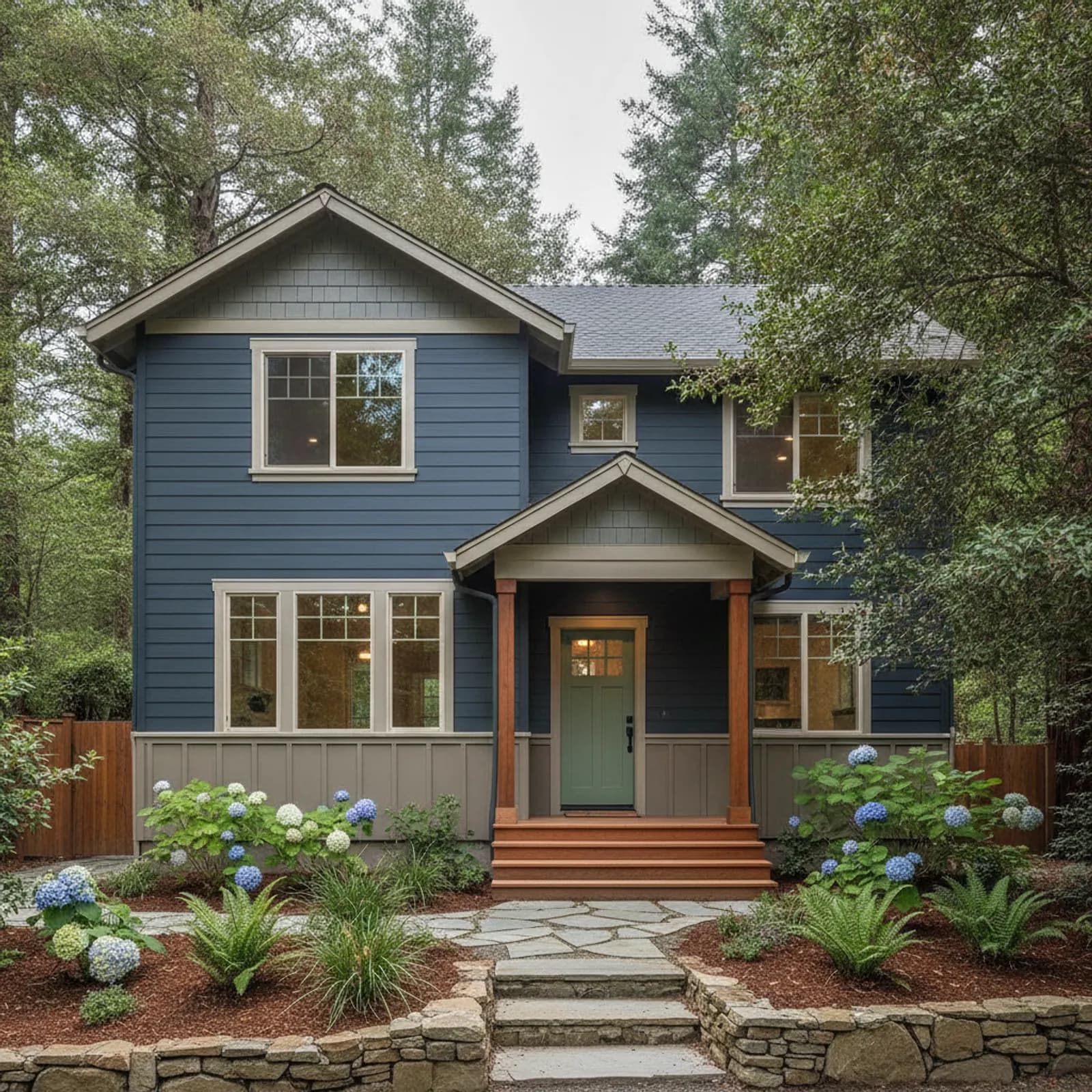
Exterior renovation in Forestville
Forestville is a small lower-Russian-River community west of Sebastopol, where the open vineyard country gives way to redwoods, oaks, and the shaded river bench. It is a town of cottages, older homes near the village center, and wooded acreage tucked under the canopy, and its exterior-renovation conversation is driven by water more than anything else. The damp, shaded, river-influenced climate keeps walls wet far longer than in the sunnier valley towns, so for most Forestville homeowners a re-side is fundamentally a moisture-management project.
Moisture first, fire awareness second
Forestville sits at a transition: it has the persistent humidity of the river corridor but also enough surrounding wildland — and proximity to the Russian River fire history just upstream at Guerneville — that fire-aware detailing belongs in the conversation. We lead with rigorous drainage and rot-resistant detailing because that is the daily stressor here, then add fire-aware eave and vent treatment for wooded and canopy-adjacent parcels. The result is an assembly tuned to Forestville's actual exposure rather than a one-size template.
Considering an exterior project in Forestville?
Forestville housing and architecture
Forestville's stock leans toward modest lower-river cottages and cabins, older town homes near the village center, and custom or rural homes set among the redwoods and oaks on the river bench. Many were built decades ago with wood lap, T1-11, board-and-batten, or shingle siding that the damp canopy is hard on, and dry rot at the base of walls and around penetrations is common in older Forestville homes. Re-cladding here usually means replacing a moisture-fatigued wood assembly on an individual, character-rich home — keeping the cottage or woodland feel while moving to a material that does not rot.
Forestville's damp, shaded river climate
Forestville's controlling stressor is moisture. The lower Russian River corridor draws marine air and fog up from the coast, the redwood and oak canopy keeps walls shaded and slow to dry, and the wet winters deliver heavy, sustained rain that the river itself underscores. Summers stay relatively mild compared with the hot inland valley towns, so heat is a minor factor here. That persistent dampness is hard on wood siding, trim, and unsealed penetrations, which is why a rigorously lapped drainage plane and rot-resistant detailing are not optional refinements in Forestville — they are the core of a wall that survives.
Fire-aware detailing on Forestville's wooded lots
Forestville's wildfire risk is moderate rather than high — the damp river corridor is less ignition-prone than the dry inland ridges — but the surrounding redwood and oak wildland, and the Russian River area's fire history just upstream, mean fire awareness still belongs in the spec for canopy-adjacent and wooded parcels. We won't overstate the risk on the sheltered, moister lots near the village, but for homes set into the woods we recommend non-combustible fiber cement and fire-aware eave and vent detailing so the same wall that manages moisture also resists ember intrusion. We scope this honestly, lot by lot.
Recommended materials for Forestville
Fiber cement over a rigorously detailed drainage plane is the core recommendation for Forestville, because it shrugs off the persistent canopy moisture that destroys wood siding while carrying fire-aware detailing where the wooded setting calls for it. Rot-resistant flashing and trim at the base of walls, around windows, and at every penetration are essential here given how slowly Forestville walls dry. Durable factory finishes hold their color in the shaded, humid environment better than field-applied coatings, and on wooded parcels we match eave and vent materials to a non-combustible standard.
What an exterior project costs in Forestville
Forestville pricing follows the usual drivers — overall size, number of stories, trim complexity, substrate condition, and window integration — but hidden dry rot is the wild card here more than in drier towns. Damp, shaded older homes frequently reveal moisture damage once the old cladding comes off, and the drainage-plane and flashing scope is where Forestville projects earn their durability. Wooded lots, narrow river-bench lanes, and canopy access can add staging cost. We provide a written, scoped estimate after an on-site assessment; in Forestville the moisture-management detailing is not where we recommend economizing.
The village center and river-bench homes
Near the Forestville village center the homes are older and closer together, often modest cottages and town homes on small lots. Here the priority is moisture management, careful substrate repair, and matching the established streetscape and the woodland character of the town. These homes have usually weathered many wet winters, so we plan for dry rot and tired flashing as a likely finding rather than a surprise, and scope the repair scope into the estimate up front.
Wooded and canopy parcels along the lower river
Out among the redwoods and oaks on the river bench, homes sit under heavy canopy that keeps walls perpetually shaded and damp while adding the wildland adjacency that makes fire-aware detailing worthwhile. These parcels demand the most rigorous drainage and rot-resistant detailing in town, plus non-combustible eave and vent treatment where the woods press close. Narrow drives and overhanging canopy shape staging and scaffold, which we walk and plan during the on-site scope.
Sonoma County, Sweetwater Springs Water, and Forestville Fire
Working exteriors in Forestville coordinates with a few local authorities. Forestville is unincorporated Sonoma County — there is no city government, so building permits come through the Sonoma County Permit and Resource Management Department (Permit Sonoma) rather than a municipal department. Electric and gas are PG&E, and the lower Russian River corridor is documented high-PSPS territory. Water is supplied by Sweetwater Springs Water District (which also serves Guerneville and Monte Rio); some rural parcels run on private wells. Fire response is the Forestville Fire Protection District alongside CAL FIRE Sonoma-Lake-Napa Unit (LNU) on wildland calls into the wooded ridges toward Occidental and Sebastopol.
HZ10 and the Walbridge-corridor FHSZ reality
Forestville is in James Hardie's HZ10 climate zone despite the damp canopy setting; installing HZ5 is a documented warranty misapplication. On the fire side, the flat village core sits in Moderate FHSZ territory under California's 2025 LRA Fire Hazard Severity Zone map, while the wooded river-bench and canopy parcels running toward Occidental, Camp Meeker, and the west county coast range carry High to Very High designations. The 2020 Walbridge Fire (part of LNU Lightning Complex, 156,000+ acres) burned into the northwestern Sonoma coast range and forced widespread evacuations along the lower Russian River. On designated wooded parcels the 2025 California Wildland-Urban Interface Code governs the exterior wall. Chapter 7A moved into the standalone WUI Code on January 1, 2026.
Our process in Forestville
- Step 1
Consultation
We listen to your goals and assess your home on site — exposure, substrate, and architecture.
- Step 2
Design & Proposal
A clear written proposal with the right system specified for your climate and a transparent scope.
- Step 3
Expert Installation
Trained crews install to manufacturer best practices with careful weather-management detailing.
- Step 4
Walkthrough & Support
A final walkthrough, full cleanup, and a clear written record of the scope completed — work we stand behind.
In Forestville, a re-side done right is a wall that finally stops rotting under the canopy — and, on wooded lots, one that resists embers too. We lead with moisture management and add fire-aware detailing where the setting calls for it, scoping every Forestville project on site. Your written estimate governs the work.
FAQ
Forestville — Common Questions
The damp, shaded lower-Russian-River climate keeps walls wet far longer than in the sunny valley, and older wood siding and flashing eventually fail. A fiber cement re-side over a rigorous drainage plane solves the underlying issue.
Fiber cement over a rigorously detailed drainage plane, with rot-resistant flashing and trim at the base of walls and every penetration. It does not rot the way wood does under the canopy.
Wildfire risk here is moderate, lower than the dry inland ridges. For wooded, canopy-adjacent parcels we still recommend non-combustible fiber cement with fire-aware eave and vent detailing.
In older Forestville homes it is common given the persistent moisture. We plan for it and scope any repair into the written estimate up front rather than treating it as a surprise.
Not significantly. Forestville's summers are mild compared with the inland valley towns, so moisture, not heat, is the controlling stressor here.
Durable factory finishes hold color well in the shaded, humid Forestville environment, generally better than field-applied coatings in these conditions.
Yes. We regularly scope canopy and acreage parcels along the lower river, planning staging and access around narrow drives and overhanging trees during the on-site visit.
A correctly installed fiber cement system with proper drainage commonly performs 30+ years here, far outlasting the wood siding it replaces in this damp setting.
Explore
Exterior Services
Helpful Exterior Guides