
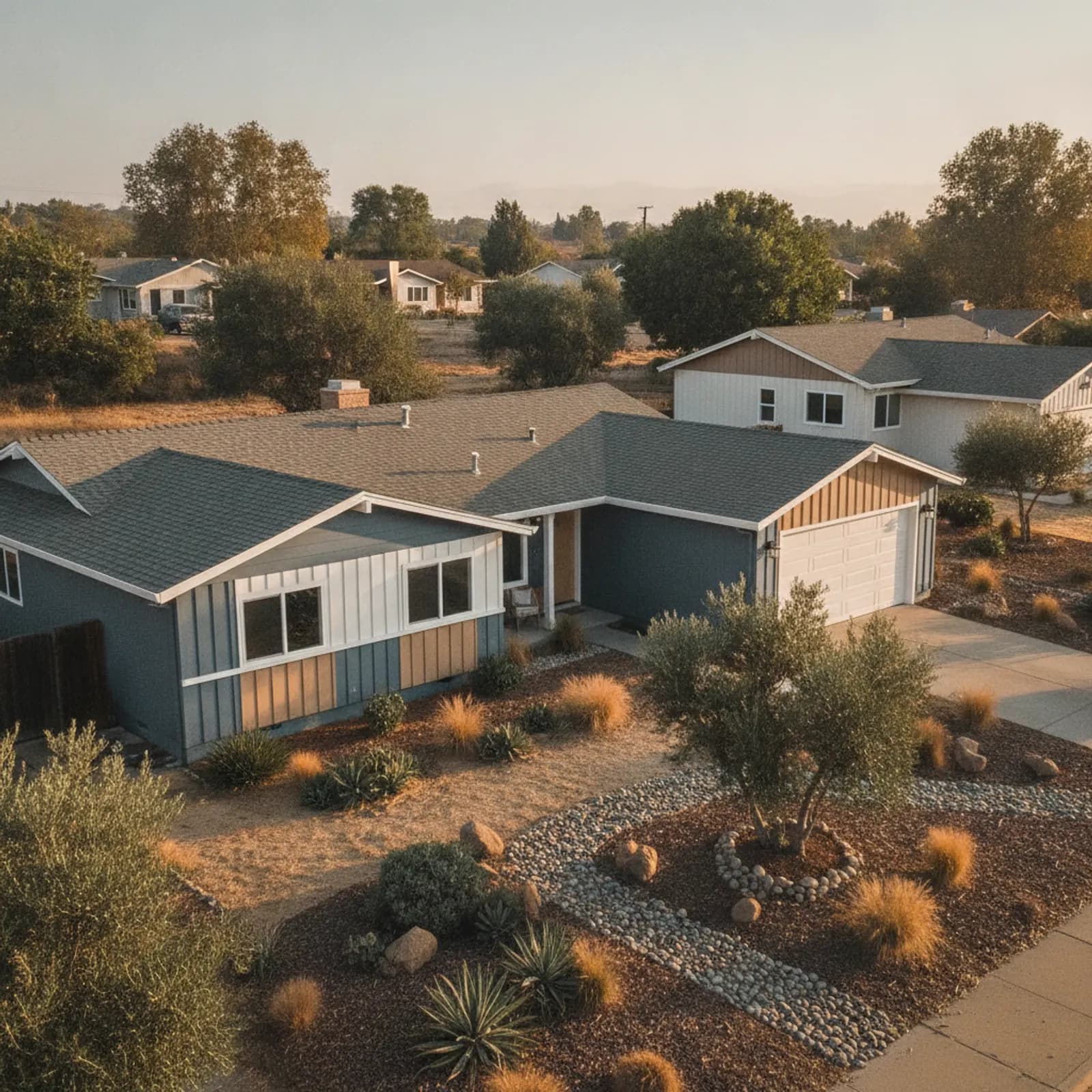
James Hardie Siding in Linda
For a Linda house the James Hardie case is essentially about not repeating the last thirty years. The hardboard and panel products on much of this housing failed the way wood-based cladding fails in a high-UV valley, and a cement-based board does not have that failure mode.
The factory finish is the other half, and in a town with no shade it is doing more work than it would almost anywhere else.
A different substrate with a different failure mode
The products that are failing across Linda's post-war and tract housing are wood-based, and their weakness is that they absorb moisture, swell, delaminate and then lose the ability to hold a coating. Fiber cement is a cement-and-fibre composite and simply does not do that. It is worth being precise about what this means: the material will not swell and delaminate, so the specific failure you are looking at across the neighbourhood is not the one you would be signing up for again. It is not a claim that nothing behind the wall can ever go wrong, which is a different subject governed by the barrier and the flashing.
HZ10, and the annual cycle this valley actually runs
Hardie manufactures to climate zones and HZ10 is the line for California's hot, dry interior. Linda is squarely in it. The stress that matters is the annual swing: months of intense dry heat followed by a wet winter, repeated. Materials that handle one end of that well and the other poorly age quickly on the cycle, and much of what is failing locally is exactly that story. Confirming that the quoted product is the HZ10 line is a reasonable question and a simple one to answer.
The finish is where the visible value sits
With no canopy, the difference between a factory-applied finish and field paint is not subtle over time. Factory finishing happens under controlled conditions rather than in valley heat or humidity, and what an owner buys is years before the repaint cycle begins. That matters more on a modest house than on an expensive one, because a repaint on a schedule is a recurring cost that a household actually feels. Color interacts with this too — deeper tones show their age first on the elevation taking the afternoon sun, and in Linda every house has one of those.
What to insist on during installation
The manufacturer's published requirements are what the product coverage depends on, and they are also simply what makes the wall last: minimum clearance at grade, clearance above roofing and hard surfaces, correct gapping at butt joints, back-priming cut ends, and proper flashing at openings. These are the details that get shortened when a job is priced tight, and in a value-conscious market that pressure is real. Asking a contractor to confirm they hold the published clearances is a fair question, and the answer tells you something about how the rest of the job will be run.
Why this matters in Linda
- Specified for Sacramento Valley conditions
- James Hardie fiber cement as the recommended system
- Correctly detailed weather-resistive barrier and flashing
- Installed by a crew with 20 years combined experience
Recommended systems for Linda
- James Hardie fiber cement
- factory finishes
- modern lap and board-and-batten profiles
- durable trim packages
James Hardie Siding for Linda homes
The full james hardie siding approach — materials, weather-resistive detailing, and the manufacturer standards we install to — is covered on the main service page, then specified for Linda's conditions on this one.
Our Linda process
- Step 1
Consultation
We listen to your goals and assess your home on site — exposure, substrate, and architecture.
- Step 2
Design & Proposal
A clear written proposal with the right system specified for your climate and a transparent scope.
- Step 3
Expert Installation
Trained crews install to manufacturer best practices with careful weather-management detailing.
- Step 4
Walkthrough & Support
A final walkthrough, full cleanup, and a clear written record of the scope completed — work we stand behind.
FAQ
James Hardie Siding in Linda — FAQ
Not in the same way. What is failing across Linda's post-war and tract housing is wood-based product that absorbs moisture, swells, delaminates and stops holding a coating. Fiber cement is a cement-and-fibre composite and does not do that. It is not a claim that nothing behind the wall can go wrong — that is governed by the barrier and the flashing — but the specific failure you are looking at is not one you would repeat.
HZ10, built for California's hot, dry interior. The stress that matters here is the annual swing — months of intense dry heat then a wet winter, repeated — and materials that handle one end well and the other poorly age fast on that cycle. Much of what is failing locally is exactly that story.
Arguably more so than on an expensive one. A repaint cycle is a recurring cost a household actually feels, and with no canopy here the cycle comes round faster. Factory finishing happens under controlled conditions rather than in valley heat, and what you are buying is years before that cost starts.
The published clearances — at grade, above roofing and hard surfaces — plus correct gapping at butt joints, back-priming cut ends and proper flashing at openings. These are what the product coverage depends on and what makes the wall last, and they are the first things shortened when a job is priced tight. Ask directly; the answer tells you how the rest will be run.
Keep Exploring
More for Linda homeowners
More in Linda
Other exterior services in Linda
Nearby Service Areas
James Hardie Siding near Linda
Helpful Exterior Guides