10 min read · Design
James Hardie's Dream Collection is the made-to-order side of its ColorPlus program — Hardie describes it as nearly 700 factory finishes, against the 19 colors in the current Statement Collection. That range is the appeal and the problem: almost any color you can imagine exists, and that makes choosing harder, not easier. This guide is about navigating the Dream palette itself — how it's organized, how to narrow hundreds of swatches to a shortlist, how sampling works, what changes about ordering, and how Northern California light treats a custom color. If you're still deciding whether to go custom at all, start with our Statement vs. Dream comparison; this page assumes you're ready to browse.
What the Dream Collection is, in brief
Per James Hardie's Dream Collection page, the collection is a made-to-order palette of nearly 700 ColorPlus Technology finishes, available in the United States only. Hardie's catalog describes the finishes as made to order in a wide array of Hardie siding and trim styles, and it is direct about the trade-off: Dream Collection products may incur additional cost and production time. Hardie doesn't publish a standard lead time on that page, so treat any number you hear as a quote for your specific order, not a rule. The finish process is the same baked-on ColorPlus Technology used for Statement colors, and Hardie's published warranty structure doesn't change for custom colors: 15 years on the finish, prorated and covering paint and labor, plus 30 years non-prorated on the substrate. In short: same product and finish, far wider color choice, more planning.
The palette by the numbers: eleven families
At time of writing, Hardie's live Dream palette listed 686 colors organized into eleven color families. The family sizes say a lot about where the palette's depth lies: Green 137, Blue 131, Brown 95, Gray 85, Neutral 70, Purple 41, Red 36, Yellow 31, Orange 27, White 22, and Black 11. Green and blue together make up more than a third of the palette — exactly the territory where the Statement Collection is thinnest, with Mountain Sage as its only green and three blues. Gray and brown are deep too, offering fine steps between the Statement grays and browns. White and black are the smallest families, which makes sense: the Statement palette already covers Arctic White and Midnight Black, and there are only so many useful variations at the extremes. Hardie updates the palette over time, so these counts will drift; treat them as a map, not a fixed inventory.
How to browse nearly 700 colors without losing a weekend
The fastest way through the Dream palette is to start from something real rather than from the color picker. Begin with the Statement color that comes closest to what you want — for example, Gray Slate if you want a cool gray, or Mountain Sage if you want a soft green — and ask what's wrong with it: too light, too cool, not enough green. Then go to the matching Dream family and look only at colors that move in that direction. Second, filter by your fixed elements: the roof, stone, and windows you're keeping already establish whether the house should be warm or cool, which eliminates half of most families. Third, set a shortlist cap of five colors from the screen before ordering any samples. Screens shift color significantly, so the screen is for eliminating, not choosing. Finally, keep a running list with exact color names — many Dream names are evocative rather than descriptive, so the name alone won't remind you what the color looked like.
Grays, blacks, and the near-neutrals
Gray is one of the deepest Dream families, and it's where most California custom orders tend to land, because the region's architecture leans toward grays and the Statement grays leave gaps between them. Hardie's Dream palette includes names such as Asteroid Gray, Robo Gray, Slate Pebble, Industrial Gray, and Hearth Gray, and its black family includes options like Black Diamond and Jet Black. Names hint at mood, but don't rely on them to describe undertone — two grays with similar names can lean very differently. The useful approach is to compare Dream grays against the Statement grays you already know: put a Dream sample between Iron Gray and Night Gray samples, for example, and you'll see immediately whether it fills a real gap or just duplicates a stocked color. If it duplicates one, the stocked color is usually the better order.
Greens, blues, and families the Statement palette barely touches
The Dream Collection's biggest advantage is in families the Statement palette covers lightly or not at all. With 137 greens, it offers everything from soft sages to deep forest tones; Hardie's catalog shows examples such as Forever Green and Topiary Green. With 131 blues, it extends well past Boothbay Blue, Evening Blue, and Deep Ocean, with examples like Blue Fish. Purple, yellow, and orange families exist too, along with reds such as Baked Clay and warm tones such as Straw Hat. These are the families where custom color genuinely changes what's possible — a historic Victorian in period colors, a cottage in butter yellow, a mountain home in deep forest green. They're also where the risk is highest: saturated colors look stronger on a full house than on a sample, and California's strong light intensifies that. When in doubt, choose a slightly grayer, less saturated version of the color you love. Our guide to color saturation on California exteriors explains why.
Choosing a custom color for California light
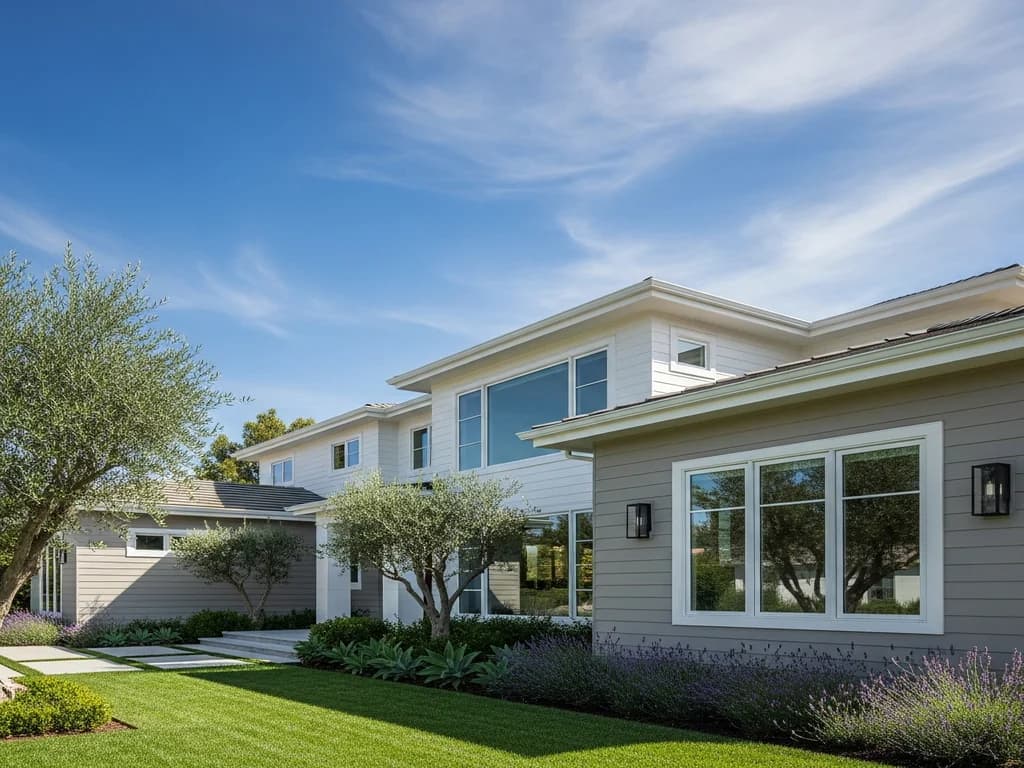
California light is not the light most color palettes are designed under. In the Sacramento Valley, intense summer sun washes out light and mid-tone colors, so a Dream color that looks right indoors may look a shade or two lighter on a sunny wall. Dark and saturated colors take more heat and UV on exposed south and west walls, as they would in any collection. Along the coast and in the Bay Area, marine layer and fog mute saturation, so a muted color can look gray and a bolder one may be needed to read as color at all. In the foothills, oak woodland and dry grass favor earthy greens, browns, and grays. In Tahoe and other high-elevation areas, snow and dark pine make light colors look brighter and dark colors look deeper. If you live near the lake, check local design rules before choosing — our Tahoe color requirements guide covers the basics.
Sampling: Select Cedarmill only
Hardie's Dream page states that Dream samples are available only in Select Cedarmill texture. That matters if you plan to install Smooth lap or panel: the wood-grain texture on Select Cedarmill creates small shadows that make colors look slightly deeper and less uniform than they will on a smooth board. Compensate by viewing samples in diffuse light (an overcast day or a shaded wall) where texture shadows are minimized, and remember the installed Smooth wall will read a touch lighter and more even. As with any color, view the sample outdoors at multiple times of day, on more than one elevation, and from the street. Compare it against at least one Statement color sample you already know — that gives your eye a fixed reference point.
Ordering realities: cost, timing, trim, and sealant
Because Dream colors are made to order, a few practical details change. Cost: Hardie says Dream products may incur additional cost, and the amount varies by dealer and order, so get it quoted. Timing: Hardie notes additional production time without publishing a figure, so lock in your color early and confirm production timing before scheduling demolition. Trim and accessories: confirm which trim, soffit, and accessory products are available in your chosen Dream color, and plan contrasting prefinished trim if a matching piece isn't offered. Sealant: the catalog's color-matched OSI QUAD MAX tubes are listed for Statement colors; for a Dream color, the same catalog footnote says to ask your local James Hardie representative. Attic stock: order and keep extra boards for future repairs, since a custom color may be hard to match later — our color matching for repairs guide explains why.
Building a scheme around a custom body color
A Dream color usually works best as the body, with trim and soffit drawn from stocked colors. Hardie's Sacramento-area availability, as of this writing, offered prefinished HardieTrim boards in ten stocked colors running from Arctic White and Cobble Stone through Evening Blue to Iron Gray and Midnight Black, and soffit in a narrower five. Choosing your custom body to sit well against one of those trims keeps the rest of the order simple and the future repairs easier. A deep custom green, for instance, pairs naturally with Cobble Stone or Rich Espresso trim; a custom warm gray pairs with Arctic White or Iron Gray. Hold your Dream samples against the stocked trim samples before finalizing, because a body you love can look wrong next to the only trim colors available.
When a Statement color gets you there
Browsing the Dream palette sometimes leads you back to a stocked color, and that's a good outcome. If your shortlist ends up within a shade of a Statement color, the stocked color is usually faster to obtain, has a broader range of matching products, and is easier to match later. Hardie names Iron Gray, Boothbay Blue, and Cobble Stone as the West's most popular colors, and the 19-color Statement palette covers whites, beiges, browns, grays, blues, a sage, a red, and a true black. The Dream Collection earns its place when the color you need genuinely isn't in that list — a specific green, a historic color, an HOA-mandated tone, or a match to existing materials. Our ColorPlus color chart is a fast way to check what the stocked palette already offers.
Navigating the Dream Collection's color families (swatch counts from Hardie's live palette at time of writing; starting points are suggestions)
| Dream family | Colors (time of writing) | Statement colors to start from | Where it tends to suit California homes |
|---|---|---|---|
| Green | 137 | Mountain Sage | Foothill oak woodland, mountain, cottage |
| Blue | 131 | Boothbay Blue, Evening Blue, Deep Ocean | Coastal, craftsman, farmhouse accents |
| Brown | 95 | Khaki Brown, Timber Bark, Rich Espresso | Foothill, wine country, mountain |
| Gray | 85 | Pearl Gray, Gray Slate, Aged Pewter, Iron Gray, Night Gray | Valley subdivisions, contemporary, transitional |
| Neutral | 70 | Cobble Stone, Navajo Beige, Monterey Taupe, Light Mist | Ranch, Spanish, Mediterranean |
| Purple | 41 | None | Historic and Victorian schemes, accents |
| Red | 36 | Countrylane Red | Barns, doors, period homes |
| Yellow | 31 | None | Cottages, period homes |
| Orange | 27 | None | Accents, mid-century details |
| White | 22 | Arctic White | Farmhouse, coastal, traditional |
| Black | 11 | Midnight Black | Modern, mountain modern, trim |
Key takeaways
- Hardie describes the Dream Collection as nearly 700 made-to-order ColorPlus finishes; at time of writing the live palette listed 686 colors in eleven families
- Green (137) and Blue (131) are the largest families — exactly where the 19-color Statement palette is thinnest
- Start browsing from the nearest Statement color, filter by your fixed roof and stone, and cap your screen shortlist at five
- Dream samples come only in Select Cedarmill texture; Smooth installs will read slightly lighter and more even
- Hardie says Dream products may add cost and production time and are US-only; get both quoted and lock color before scheduling the crew
- For sealant color-matching on Dream colors, Hardie directs buyers to their local James Hardie representative
FAQ
Quick Answers
Hardie describes it as nearly 700 ColorPlus finishes. At time of writing, the live palette on Hardie's site listed 686 colors across eleven families.
At time of writing: Green, Blue, Brown, Gray, Neutral, Purple, Red, Yellow, Orange, White and Black. Green and Blue are the largest families.
Hardie's Dream page states samples are only available in Select Cedarmill texture. If you're installing Smooth, expect the finished wall to read slightly lighter and more uniform than the textured sample.
Hardie says Dream products may incur additional production time but doesn't publish a standard lead time. Get a quote for your specific order and confirm timing before scheduling demolition.
Hardie's Dream page states that Dream Collection colors are available in the United States only.
Yes in structure — both are ColorPlus Technology, with Hardie's 15-year finish coverage and 30-year substrate coverage. Read the warranty documents for your specific products before ordering.
Hardie's catalog lists color-matched OSI QUAD MAX for stocked Statement colors. For a made-to-order Dream color, it tells buyers to contact their local James Hardie representative.
Sources
Authoritative references
- James Hardie — Dream Collection (nearly 700 made-to-order ColorPlus finishes)
- James Hardie — 2025 National Product Catalog (Statement and Dream collections, trim accessories)
- James Hardie ColorPlus Technology — finish process, 15-year finish / 30-year substrate warranty terms
- James Hardie — siding colors and regional favorites
- James Hardie — Statement Collection colors (check your area's availability)
External links to government, code, and manufacturer sources. Sierra Siding is not affiliated with these organizations; references are provided for verification.