
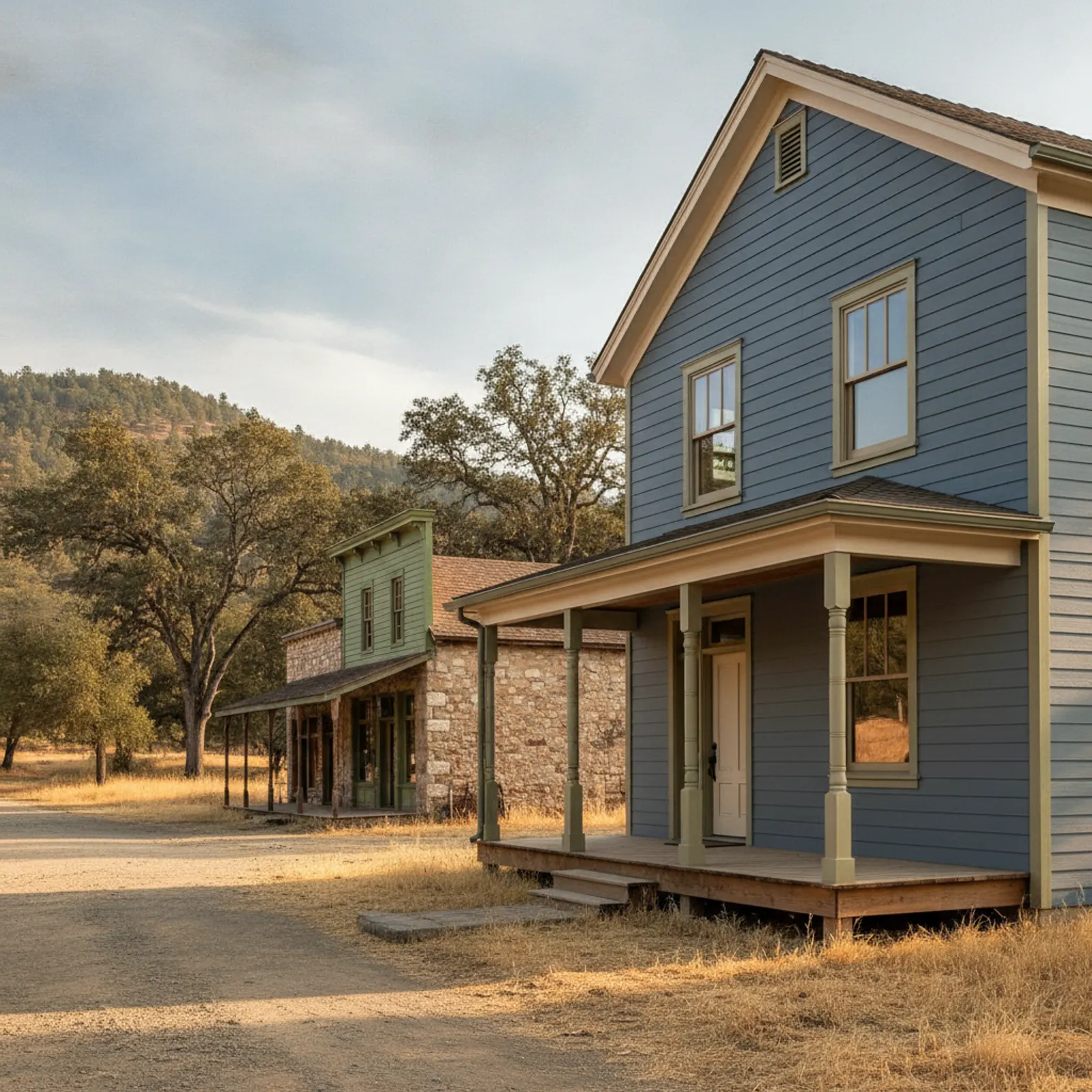
Exterior renovation in Sutter Creek
Sutter Creek is a Gold Rush town on Highway 49 widely regarded as one of the best-preserved Main Streets in the Mother Lode. Its housing is unusually rich in period stock: Gold Rush-era commercial and residential buildings lining the historic core, Victorian and Queen Anne homes, early-20th-century miners' cottages on the surrounding lanes, and post-war and newer foothill homes on the edges. That makes the re-side market here distinctive — much of the work is period-sensitive renovation, not tract refresh. But the town shares the same hot, dry foothill summers and the same wildland fire exposure as Jackson just down the highway.
Where historic character meets a fire standard
Sutter Creek's exteriors answer to two things at once: period fidelity on a closely watched streetscape, and the practical reality of foothill fire. The Victorian and miners'-cottage stock carries detailing a careless re-side will visibly ruin, while the surrounding oak-grassland cures to fuel through the long dry season, putting most of the town in the wildland-urban interface. The honest answer is that you don't have to choose: non-combustible fiber cement can be detailed to read period-correct, so one project honors the character and fire-hardens the home together.
Considering an exterior project in Sutter Creek?
Sutter Creek housing and architecture
Sutter Creek's stock is among the most historically intact in Amador County: Gold Rush-era buildings and homes along the preserved Main Street, ornate Victorian and Queen Anne residences, early-20th-century miners' cottages on the side lanes, and a band of post-war and newer foothill homes on the edges of town. The historic homes demand narrow, period-correct lap, accurate trim proportions, and genuine restraint — the wrong board width or a generic corner detail is immediately wrong to anyone who knows the street. The newer edge homes take a clean lap or lap-and-batten re-side well. Across all of it, the wooded foothill setting keeps fire performance in the spec, and we design to the era in front of us.
Built for Sutter Creek's foothill heat and fire
Sutter Creek's controlling stressor is foothill wildfire, with hot, high-UV summers close behind. The long, rain-free dry season cures the oak-grassland around the town into flashy fuel, so the exterior has to resist ignition first, and the summer sun fades finishes and stresses joints worst on south and west elevations. That makes non-combustible, fade-resistant factory-finished fiber cement and heat-aware detailing the baseline. Winters bring real foothill rain, so flashing and bottom-course work matter, but sustained moisture is modest and snow is not a factor at Sutter Creek's elevation. The challenge here is doing all of that while keeping the historic character intact.
Period-sensitive fire hardening
Sutter Creek sits in wildland-urban interface country, so ember exposure during the long dry season is a genuine seasonal hazard across most of the town. The wrinkle here is that fire hardening has to respect the historic streetscape. We specify non-combustible fiber cement detailed with narrow, period-appropriate lap and trim, so the home reads as the Victorian or cottage it is while gaining ignition resistance, and we harden eaves, vents, and the ground-to-wall transition without resorting to details that look wrong on a Gold Rush home. We read each parcel honestly — a core Main Street lot differs from a home on the brushy edge of town — and we won't overstate or understate the exposure.
Recommended materials for Sutter Creek
James Hardie fiber cement is our core recommendation for Sutter Creek because it lets the town's two priorities coexist: it is non-combustible, addressing the foothill fire exposure, and it can be selected in narrow lap profiles and accurate trim that read as period-appropriate on Victorian, Queen Anne, and miners'-cottage homes. Factory finishes hold color through the hot, bright foothill summers far better than field paint, and the same product line carries the historic core and the newer edge homes, keeping a fire-hardened spec consistent across town. Engineered wood is a weak fit here given both the fire exposure and the importance of long-term color stability on these closely watched homes.
What an exterior project costs in Sutter Creek
Sutter Creek pricing turns on home size and stories, profile and trim complexity — markedly higher on the ornate Victorian and Queen Anne homes, where detailed trim and reveal matching add real scope — substrate and dry-rot condition once cladding is removed, window integration, and the weather-management scope. The town's historic homes most frequently reveal layered original siding and dry rot at demolition after a century-plus of foothill weather, and fire-detailing scope adds where parcels sit near fuel. Tight historic-core access can also affect staging. We provide a written, scoped estimate after an on-site assessment so period sensitivity, fire hardening, and durability are all accounted for before a board is ordered.
The preserved Main Street and Victorian core
Sutter Creek's Main Street and its surrounding Victorian, Queen Anne, and Gold Rush-era homes are the heart of the town's identity and draw, and the most demanding re-side work in the county. These homes carry detailing expectations a generic re-side will visibly miss, so we match lap width, trim proportions, and finish to the era and respect the existing ornamentation. They are also the most likely to hide dry rot or multiple layers of original siding, which we plan for rather than discover mid-project. Getting the character right here protects both the individual home and the streetscape that defines the town.
Miners' cottages and the surrounding lanes
Off the main corridor, Sutter Creek's early-20th-century miners' cottages line quiet lanes that carry their own modest historic character. These smaller homes reward simple, narrow lap and honest trim rather than elaborate detailing, and many still wear original or economy cladding the foothill sun has chalked and cupped. They are straightforward, high-impact re-sides where the period-correct profile and the non-combustible upgrade go in together, and where we check carefully for the dry rot decades of foothill weather can leave behind.
Edge homes near the wildland and resale
On Sutter Creek's edges, newer foothill homes sit closest to the brushy wildland line, where fire-hardened detailing matters most. A documented non-combustible exterior increasingly factors into how a foothill home is valued, especially for buyers and insurers weighing the wildland setting, and on a town whose entire appeal rests on preserved character, a sensitive re-side protects resale better than a trend-chasing makeover. We keep records of the materials and assemblies used so those details are available when they matter.
City of Sutter Creek, AWA, and Sutter Creek Fire
Working exteriors in Sutter Creek coordinates with a few local authorities. Building permits come through the City of Sutter Creek Planning and Building Department (Sutter Creek is incorporated). Electric and gas are PG&E, and the foothill setting is documented high-PSPS territory. Water is supplied by the Amador Water Agency (AWA), the county-wide public agency. Fire response is the Sutter Creek Fire Protection District alongside CAL FIRE Amador-El Dorado Unit on wildland calls, with the Sutter Creek Police Department and Amador County Sheriff coordinating evacuation during red-flag events. Main Street and much of the adjoining historic core sit within a locally recognized historic overlay, so visible exterior work on those blocks carries design-review expectations on top of the standard permit path.
HZ10 and the Butte-Fire-adjacent FHSZ reality
Sutter Creek is in James Hardie's HZ10 climate zone; installing HZ5 is a documented warranty misapplication. On the fire side, the historic Main Street and its immediately surrounding blocks sit in Moderate FHSZ territory under California's 2025 LRA Fire Hazard Severity Zone map, while the edge parcels and hillside subdivisions climbing away from the core carry High to Very High designations. The 2015 Butte Fire's 549-home destruction across neighboring Calaveras County is a plain reminder of what a foothill wind event can do to this ground. On designated hillside parcels the 2025 California Wildland-Urban Interface Code governs the exterior wall. Chapter 7A moved into the standalone WUI Code on January 1, 2026.
Our process in Sutter Creek
- Step 1
Consultation
We listen to your goals and assess your home on site — exposure, substrate, and architecture.
- Step 2
Design & Proposal
A clear written proposal with the right system specified for your climate and a transparent scope.
- Step 3
Expert Installation
Trained crews install to manufacturer best practices with careful weather-management detailing.
- Step 4
Walkthrough & Support
A final walkthrough, full cleanup, and a clear written record of the scope completed — work we stand behind.
Sutter Creek rewards an exterior approach that honors its remarkable historic Main Street while bringing genuine fire-hardened, heat-durable performance to every home in town. We scope every Sutter Creek project on site so period sensitivity and fire detailing are both accounted for, and your written, itemized estimate governs the work.
FAQ
Sutter Creek — Common Questions
James Hardie fiber cement detailed in period-appropriate profiles. It is non-combustible for the foothill fire exposure, holds color through hot foothill summers, and can be selected to read correctly on Sutter Creek's Victorian and cottage stock.
Yes. We use narrow, period-correct lap, accurate trim proportions, and restraint so the home reads as the Victorian or Queen Anne it is while gaining durability and ignition resistance — essential on Sutter Creek's closely watched Main Street.
Yes — like the rest of Amador's foothill country, Sutter Creek sits in wildland-urban interface where surrounding oak-grassland cures to fuel each summer. Non-combustible cladding and period-sensitive fire detailing are a sound step here.
Original wood, hardboard, and economy cladding was not specified for the hot, high-UV foothill summers. Chalking, cupping, opening joints, and faded paint on sun-facing walls is the typical end-of-life pattern, especially on the older historic stock.
Yes — the preserved Main Street homes, the Victorian and Queen Anne residences, the miners' cottages on the surrounding lanes, and the newer foothill homes on the town's edges.
When feasible, yes — combining them ensures correct flashing integration and avoids duplicated trim work, which matters especially on detail-rich historic homes.
Generally no — its foothill elevation rarely sees meaningful snow, so the spec centers on fire and heat. Winter rain is handled with sound flashing and bottom-course detailing rather than alpine assemblies.
A correctly installed fiber cement system commonly performs 30+ years in the foothill climate, with factory finishes extending the time before any cosmetic refresh.
Explore
Exterior Services
Helpful Exterior Guides