James Hardie Siding in Cool
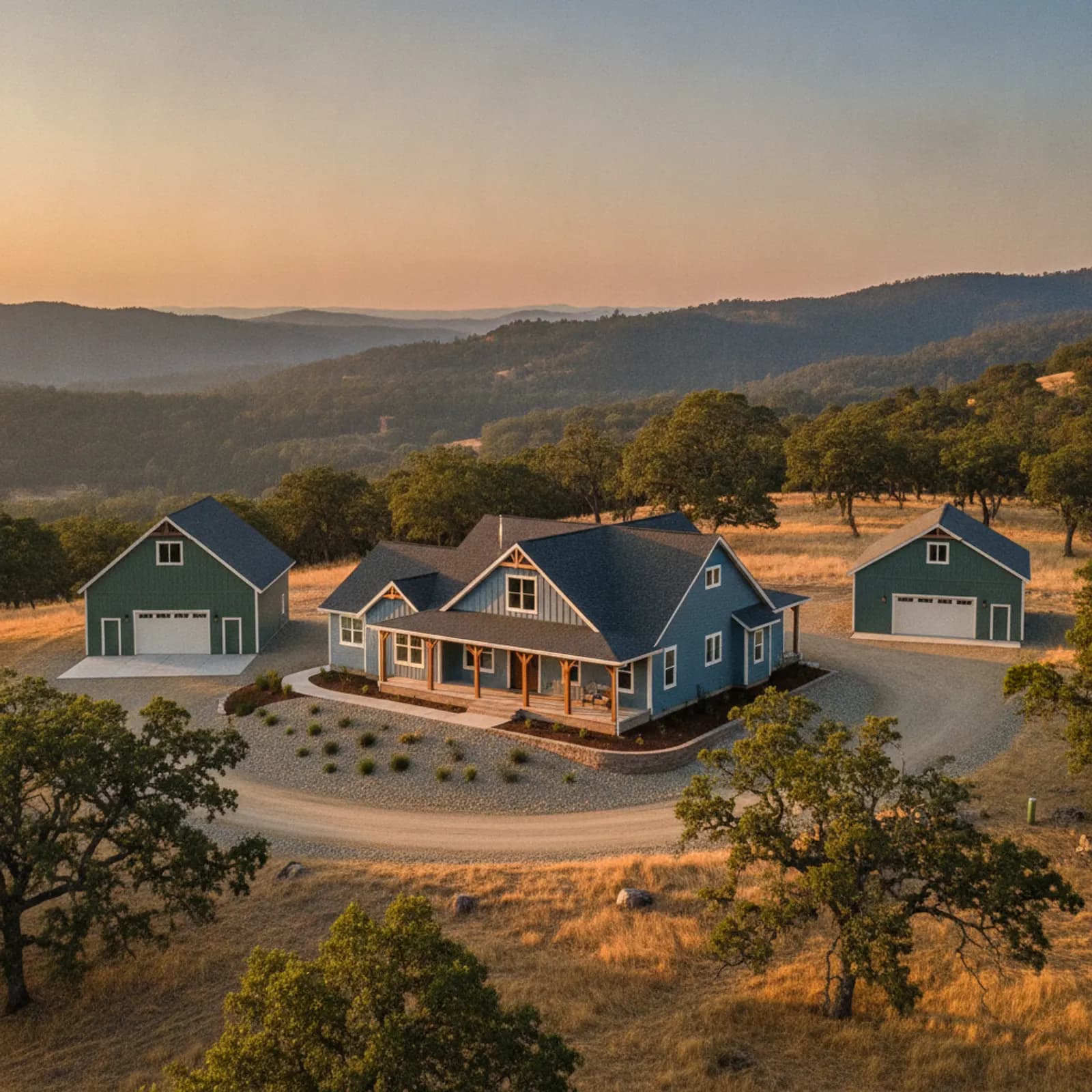
For a Cool property the James Hardie decision is straightforward on the product line and more interesting on allocation, because on an open ranchette parcel the money frequently does more good somewhere other than the house's wall.
We hold no certified or preferred installer status with any manufacturer and will say when a generic board detailed to the same standard is the better use of the budget.
HZ10 is the line, and the sun makes it matter
HZ10 is Hardie's formulation for hot, dry Western conditions with high UV, which describes an unshaded Cool tableland parcel precisely. There is no genuine HZ5 question at this elevation. Where the specification does earn attention is the finish, because on ground with no canopy the UV load is applied to the entire building rather than to two elevations, and a coating that would be adequate on a shaded suburban lot has a considerably harder life here.
Non-combustible, and where it does the most
Fiber cement is non-combustible with a Class A rating as a category, and on a horse-property parcel that applies as usefully to a barn or shelter as to the residence. Where an outbuilding sits upwind and close enough to be an ignition path, cladding it in non-combustible material removes the path — and doing it while a crew is already on the property is materially cheaper than a separate job. On Cool parcels that is often a better use of budget than a premium finish on the house.
ColorPlus across an unshaded building
The factory-finish argument is stronger on an open tableland parcel than almost anywhere, because there is no shaded elevation to slow the ageing. Field-painting an entire ranchette on a short cycle is a real recurring cost, and it scales with the outbuildings too. ColorPlus holds color substantially longer under this load. Field-painted board remains a legitimate lower-upfront choice and we will price it that way — the arithmetic simply favours the factory finish more as exposure and surface area increase.
Method over brand, as always
Fastening, clearances, joint treatment, and flashing govern real-world performance far more than the manufacturer does, and the departures that cause failures get blamed on the product later. On an open windy parcel the specific one worth attention is fastening, because wind load on an exposed building is genuinely higher than on a sheltered one. A warranty on a board does not rescue a carelessly built assembly, which is why the useful questions are about method.
Why this matters in Cool
- Specified for Sierra Foothills conditions
- fiber cement as the recommended system
- Correctly detailed weather-resistive barrier and flashing
- Installed by a crew with 20 years combined experience
Recommended systems for Cool
- fiber cement
- James Hardie
- LP SmartSide
James Hardie Siding for Cool homes
The full james hardie siding approach — materials, weather-resistive detailing, and the manufacturer standards we install to — is covered on the main service page, then specified for Cool's conditions on this one.
Our Cool process
- Step 1
Consultation
We listen to your goals and assess your home on site — exposure, substrate, and architecture.
- Step 2
Design & Proposal
A clear written proposal with the right system specified for your climate and a transparent scope.
- Step 3
Expert Installation
Trained crews install to manufacturer best practices with careful weather-management detailing.
- Step 4
Walkthrough & Support
A final walkthrough, full cleanup, and a clear written record of the scope completed — work we stand behind.
FAQ
James Hardie Siding in Cool — FAQ
Yes, without ambiguity — hot, dry, high-UV Western conditions describe an unshaded tableland parcel precisely. Where the specification earns real attention is the finish, because with no canopy the UV load applies to the whole building rather than to two elevations.
Where it sits upwind and close enough to be an ignition path, yes — and doing it while a crew is already on the property is materially cheaper than a separate job. On Cool parcels that is often a better use of budget than a premium finish on the house.
The case is stronger on open tableland than almost anywhere, because there is no shaded elevation to slow the ageing and the cost scales across outbuildings too. Field-painted board remains legitimate if budget is the constraint — the arithmetic just favours the factory finish more as exposure grows.
Fastening especially, because wind load on an exposed tableland building is genuinely higher than on a sheltered one. Beyond that, clearances, joint treatment, and flashing govern the outcome far more than the brand does.
Keep Exploring
More for Cool homeowners
More in Cool
Other exterior services in Cool
Nearby Service Areas
James Hardie Siding near Cool
Helpful Exterior Guides