
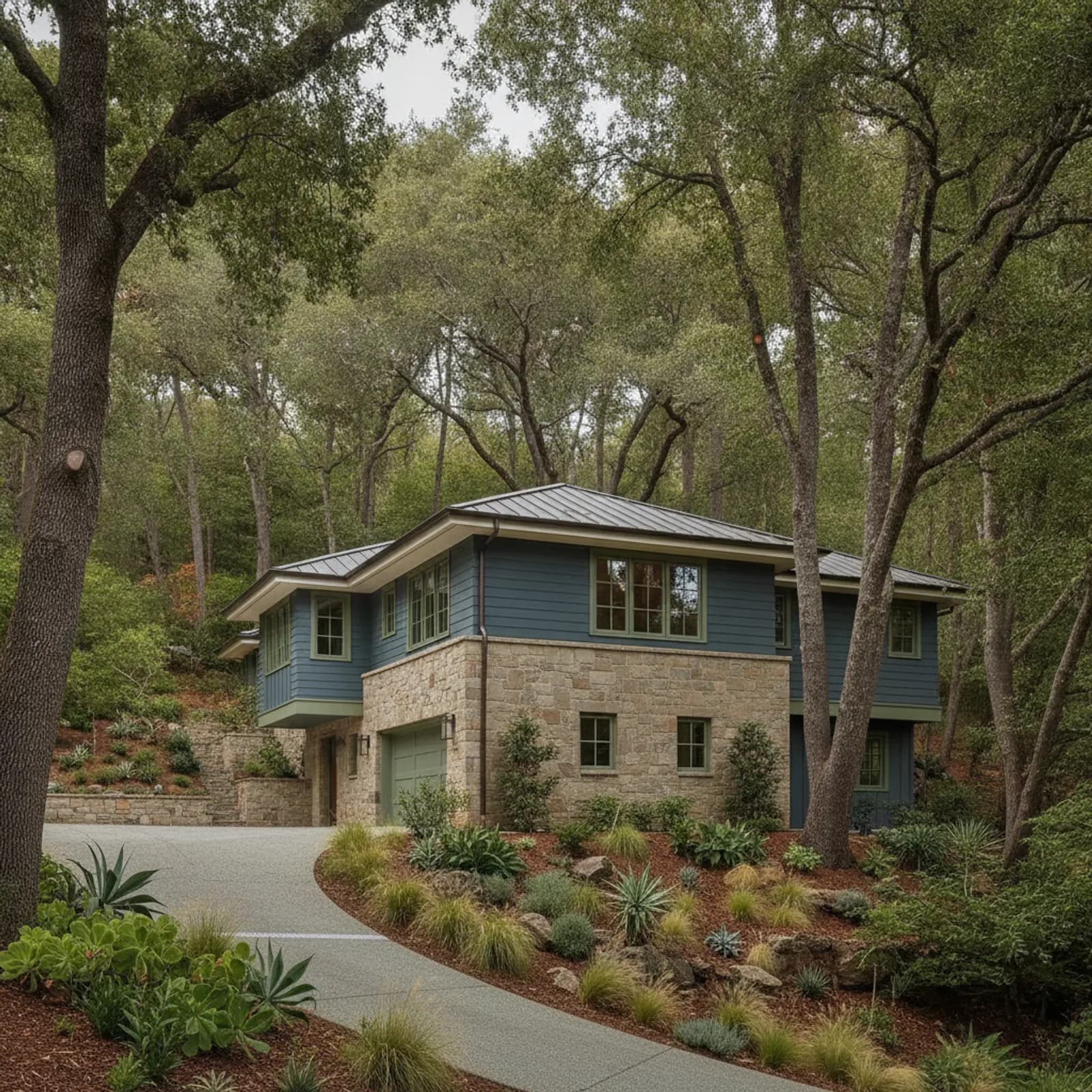
Fire-Resistant Siding in Kentfield
Fire-resistant siding in Kentfield is a measured, parcel-specific service rather than a blanket alarm. Much of Kentfield reads as a sheltered, canopy-covered residential community, and we say that plainly. But the community climbs the lower slopes of Mt. Tamalpais, and the parcels nearer that mountain edge carry genuine moderate wildfire exposure where embers and slope-driven fire behavior are a real consideration. We scope each address for what it actually faces.
An honest read of Kentfield's fire exposure
Kentfield is not a deep-canyon or ridge-top town, and we do not overstate its fire story. The interior streets, tucked under tree canopy on the gentler lower slopes, face a moderate, manageable exposure where non-combustible cladding is more a low-regret durability upgrade than a survival decision. The homes that sit higher and closer to the Mt. Tamalpais open space and wooded fuel are the ones that change the conversation. There the slope can carry fire and wind-driven embers toward the house, and the exterior earns treatment as a defensive system. The distinction matters: scoping a sheltered interior home as if it were on the fire front wastes money, and treating a slope-edge home as if it were safe leaves it under-protected.
Embers and defensible-space basics
Where fire is a real consideration in Kentfield, most home losses in this kind of terrain start with embers, not a wall of flame, so the first moves are unglamorous. We keep the bottom course of cladding clear of grade, bark mulch, and the leaf litter that gathers under the canopy, screen vents to ignition-resistant standards so embers cannot draft into the wall, and flag combustible material stacked against the exterior. Non-combustible fiber-cement or mineral cladding removes the wall itself as fuel. Eaves and soffits, where embers lodge against a slope-facing elevation, get hardened detailing. None of this requires treating Kentfield as a fire-front town — it is the sensible baseline for a home on the mountain's lower edge.
Why the slope damp shapes the fire spec
Fire is only half of what a slope-edge Kentfield wall deals with. The same Mt. Tam-slope fog and canopy shade that keep these assemblies persistently damp also dictate how fire-resistant siding has to be built here, because a non-combustible cladding that traps water against the framing simply trades a fire risk for a rot one. So on these parcels we build the wall as a system: Class A fiber-cement or mineral board paired with a vented rainscreen gap, a taped weather-resistive barrier, and flashing that sheds the standing moisture the tree-shaded north elevations collect. Done right, the same detailing that resists embers also lets the wall dry, so the fire upgrade does not quietly become a moisture failure a few winters on. We size the assembly for both from the start.
The non-combustible value on the interior streets
For the sheltered interior Kentfield homes well back from the mountain edge, fire-resistant cladding is worth framing honestly: the wildfire case is modest, but a non-combustible wall still carries real value. It removes the home from the small but nonzero ember risk that drifts even into canopy neighborhoods on a bad fire day, it pairs naturally with the moisture-drying assembly these damp lots need anyway, and it brings the durability and finish-life advantages of fiber cement over wood. We present it as a low-regret upgrade rather than an urgent one, and we let the homeowner weigh it as a feature of a quality re-side rather than overselling a fire threat the location does not carry.
Why this matters in Kentfield
- Specified for North Bay conditions
- Class A non-combustible fiber cement as the recommended system
- Correctly detailed weather-resistive barrier and flashing
- Installed by a crew with 20 years combined experience
Recommended systems for Kentfield
- Class A non-combustible fiber cement
- James Hardie
- rigorous drainage-plane detailing
- fire-hardened eave and vent detailing
Fire-Resistant Siding for Kentfield homes
The full fire-resistant siding approach — materials, weather-resistive detailing, and the manufacturer standards we install to — is covered on the main service page, then specified for Kentfield's conditions on this one.
Our Kentfield process
- Step 1
Consultation
We listen to your goals and assess your home on site — exposure, substrate, and architecture.
- Step 2
Design & Proposal
A clear written proposal with the right system specified for your climate and a transparent scope.
- Step 3
Expert Installation
Trained crews install to manufacturer best practices with careful weather-management detailing.
- Step 4
Walkthrough & Support
A final walkthrough, full cleanup, and a clear written record of the scope completed — work we stand behind.
FAQ
Fire-Resistant Siding in Kentfield — FAQ
It depends on where you sit. Parcels nearer the Mt. Tamalpais slope and its open and wooded fuel carry genuine moderate exposure and benefit clearly; sheltered interior homes face a modest risk where it's a low-regret upgrade, not a necessity. We assess by address.
No — we say this plainly. It's a canopy-covered community on the gentler lower slopes, with moderate, parcel-specific exposure that rises only on the homes closest to the mountain edge. It is not a deep-canyon or ridge-top fire town.
No — we design both into one assembly: hardened eaves, vents, and ground transitions plus a vented, drying-capable plane for the canopy damp. The same wall handles embers and moisture without compromise.
Closing ember paths — screening vents to ignition-resistant standards, keeping the base of wall clear of mulch and leaf litter, and hardening eaves. Most losses in this terrain start with embers, not a flame front, so those moves matter most.
Keep Exploring
More for Kentfield homeowners
More in Kentfield
Other exterior services in Kentfield
Nearby Service Areas
Fire-Resistant Siding near Kentfield
Helpful Exterior Guides