James Hardie Siding in Pebble Beach
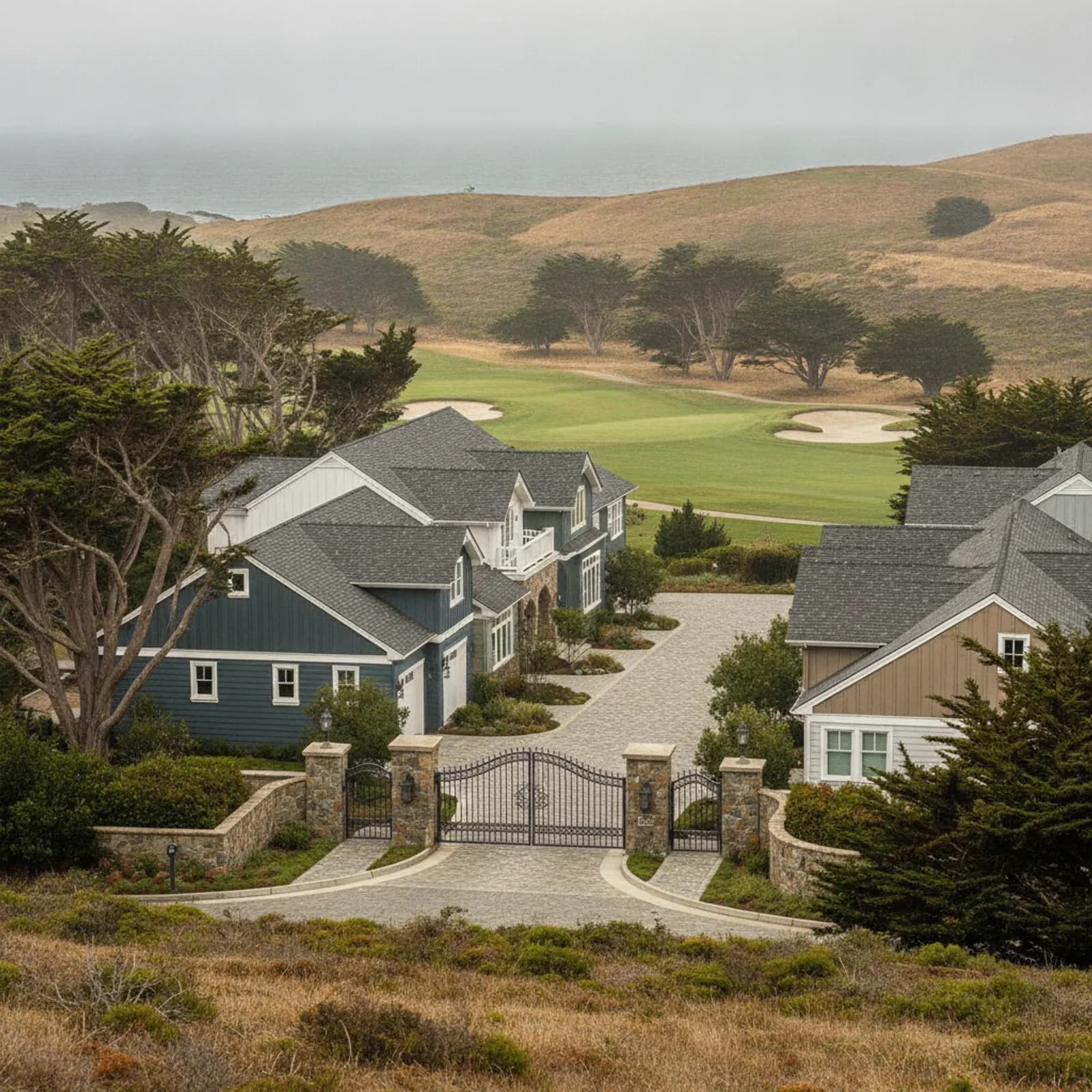
Pebble Beach is gated estate territory in the Del Monte Forest, where large architect-designed homes off 17-Mile Drive take open-Pacific salt and live under a damp Monterey pine canopy. The James Hardie case here is specific: HZ10 boards engineered for coastal-marine climates, ColorPlus factory finish that holds against salt scouring and shade-held moisture, and Hardie profiles selected and detailed to satisfy estate finish and design-review standards rather than a stock builder package.
HZ10 is built for this marine climate
James Hardie's HZ10 product line is formulated specifically for wet, coastal, freeze-tolerant climates, which is exactly what the Del Monte Forest delivers — open-ocean salt plus the chronic canopy damp that keeps forest-facing walls wet. The cement composition is inert to the chloride that corrodes the backs of older painted estate wood, so on these homes the board itself is the easy half. The work is the system around it: HZ10 earns its place because it tolerates the salt-and-shade moisture load this forest setting imposes far better than the cladding it usually replaces.
ColorPlus for salt scour and shade
On exposed Pebble Beach elevations we lean on Hardie's pre-finished ColorPlus surface, baked on in controlled conditions, because it holds up against constant salt scouring and the UV and moisture cycling of a coastal-forest exposure better than a field-applied coat on a damp wall. For an estate home where finish quality is part of the design-review judgment, a consistent factory finish across a large wall matters. We select conservative, forest-appropriate ColorPlus tones — deep greens, warm greys, heritage darks — that sit correctly against the pines and the architecture rather than fighting them.
Hardie profiles to estate and design-review standards
The Hardie profile and exposure on a Pebble Beach home are chosen to match the original architect's intent — wide shingle-style courses on a shingle home, true HardiePanel-and-batten on a board-and-batten elevation, crisp lap reveals where the design calls for them. Because exterior changes on many properties run through the community's design-review expectations, the questions that come up are whether the new exposure widths, corner treatments, and trim returns read as the original from the approach. We plan for that scrutiny: matching reveals so courses line up with window heads and water tables, carrying the home's trim depth across new fascia, and keeping visible changes consistent with the estate's established character.
Detailing Hardie for forest-and-ocean exposure
Hardie's cement shrugs off salt that would chew through the back of old painted redwood, but on a Pebble Beach estate the failure point is never the board — it is the metal and the joints, made worse by canopy damp. We specify corrosion-resistant fasteners and flashing rather than standard galvanized, because rusting heads and bleeding flashing telegraph through a finish coat within a couple of damp winters under this much moisture. Behind the cladding, a properly lapped weather-resistive barrier, generous base clearance, and back-ventilation give the wind-driven and shade-held moisture a path to dry outward instead of soaking the sheathing of a large custom frame. On forest-facing walls that never fully dry, that drying detail is what makes the Hardie install last.
Why this matters in Pebble Beach
- Specified for Monterey Peninsula conditions
- James Hardie as the recommended system
- Correctly detailed weather-resistive barrier and flashing
- Installed by a crew with 20 years combined experience
Recommended systems for Pebble Beach
- James Hardie
- fiber cement
- engineered wood
James Hardie Siding for Pebble Beach homes
The full james hardie siding approach — materials, weather-resistive detailing, and the manufacturer standards we install to — is covered on the main service page, then specified for Pebble Beach's conditions on this one.
Our Pebble Beach process
- Step 1
Consultation
We listen to your goals and assess your home on site — exposure, substrate, and architecture.
- Step 2
Design & Proposal
A clear written proposal with the right system specified for your climate and a transparent scope.
- Step 3
Expert Installation
Trained crews install to manufacturer best practices with careful weather-management detailing.
- Step 4
Walkthrough & Support
A final walkthrough, full cleanup, and a clear written record of the scope completed — work we stand behind.
FAQ
James Hardie Siding in Pebble Beach — FAQ
Yes — HZ10 is engineered for wet coastal climates, which fits the Del Monte Forest's open-ocean salt and canopy-held marine damp. It tolerates the salt-and-shade load far better than the estate wood it usually replaces.
Yes — the baked-on factory finish resists salt scouring and the UV-and-moisture cycling of a coastal-forest exposure better than a field coat on a damp wall, and it gives a large estate elevation a consistent finish for design review.
Yes — with profiles, exposures, and trim depths matched to the architect's original intent and detailed to the community's design-review expectations. That replication is the demanding part of an estate Hardie project.
Conservative, forest-appropriate ColorPlus tones — deep greens, warm greys, heritage darks — chosen to sit correctly against the pines and the estate architecture rather than against an open-coast palette.
Keep Exploring
More for Pebble Beach homeowners
More in Pebble Beach
Other exterior services in Pebble Beach
Nearby Service Areas
James Hardie Siding near Pebble Beach
Back to
Monterey County & Pebble Beach
Helpful Exterior Guides