
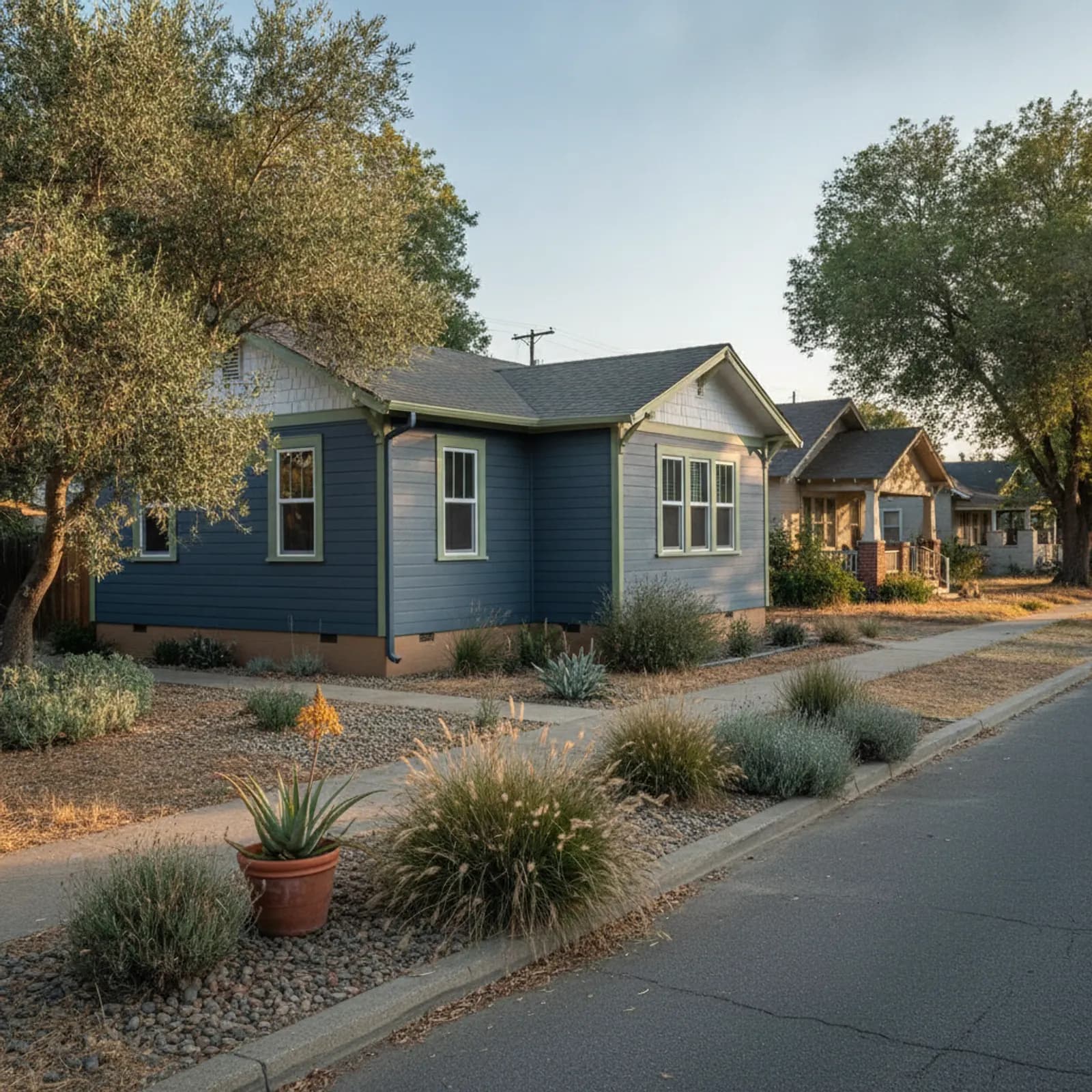
Exterior renovation in Ripon
Ripon is a small, close-knit town near the southern edge of San Joaquin County along Highway 99, set among the almond orchards that define the surrounding ag country and bordering the Stanislaus River toward the Stanislaus County line. Its housing is more modest and rural than the larger cities to the north: older small-town homes and bungalows near downtown, almond-country farmhouses and ranch houses on the surrounding parcels, post-war and mid-century cottages, and a scattering of newer custom and rural-edge homes. Much of that stock wears original or economy cladding that decades of hard valley sun have chalked and cupped on the town's open, low-canopy lots.
Why it matters here specifically
The controlling stressor is heat and UV across a long, bright valley summer — not fire or moisture. The town and its surrounding orchards sit on the open valley floor with little canopy on the newer homes, so original hardboard, T1-11, and economy materials fade, cup, and open at the joints worst on south and west walls. In a small ag town where exterior quality is read closely and homes are held for the long term, a thoughtful re-side is overdue protection against the valley sun and a lasting upgrade on a tight-knit town's streets.
Considering an exterior project in Ripon?
Ripon housing and architecture
Ripon's stock is shaped by its small-town and agricultural roots: older homes and bungalows near the walkable downtown, almond-country farmhouses and ranch houses on the surrounding orchard parcels, post-war and mid-century cottages, and a handful of newer custom and rural-edge homes built as the area has drawn buyers wanting acreage along the Stanislaus River corridor. The farmhouses and older cottages reward simple, honest lap profiles and straightforward trim rather than ornate detailing, and many have ancillary structures worth re-cladding alongside the main house. The newer homes take a clean lap or lap-and-batten re-side well. We design to the home's era and rural character rather than to one template.
Built for Ripon's valley heat
The performance priority across Ripon is heat and UV durability — the long, high-sun valley summer is the single controlling stressor, and the town's flat, open, orchard-country setting means little self-shading on the exposed walls. We specify fiber cement with factory-applied fade-resistant finishes because field-painted and economy products lose color and integrity quickly here. Detailing matters as much as the board: correct gapping and fastening for large daily and seasonal temperature swings, and finish selection tuned to elevation orientation, since south and west walls take the brunt of the afternoon sun. Ripon sits well within the low-fire valley floor and away from flood-plain moisture, so heat is the clear driver and other risks are secondary.
Recommended materials for Ripon
James Hardie fiber cement with a factory finish is the core recommendation for most Ripon homes: non-combustible, dimensionally stable in heat, and far more color-stable than field paint under sustained valley UV on the town's unshaded orchard-country walls. The same product line carries the downtown homes, the farmhouses, and the newer rural-edge homes, keeping the spec consistent across a small, partly rural service area. Simple, durable trim suits the town's straightforward architecture, while factory finishes hold their color through Ripon's long, bright summers. Engineered wood is a reasonable option on the low-fire valley parcels where deep wood character is the goal.
What an exterior project costs in Ripon
Ripon pricing follows the usual drivers: home size and stories, trim and profile complexity, substrate and dry-rot condition once cladding comes off, window integration, and the weather-management scope. The variable specific to Ripon is rural access — farmhouses and ranch houses on orchard parcels can involve longer staging and the option to re-clad outbuildings alongside the main house — and older homes more often reveal substrate surprises at demolition after decades of heat cycling. We provide a written, scoped estimate after an on-site assessment so the number reflects the actual parcel rather than a generic per-foot figure, especially across Ripon's mix of in-town and rural homes.
The downtown and older small-town homes
Ripon's walkable downtown and the older homes and bungalows around it are the core of the town's tight-knit character. These homes reward simple, period-sensitive profiles and durable trim rather than ornamentation, and they are the most likely to hide dry rot or layered original siding behind weathered cladding. We plan for that at demolition rather than discover it mid-project. In a small town where neighbors notice exterior quality, a re-side that respects the original proportions reads as deliberate and protects the streetscape.
Almond-country farmhouses and ranch houses
Beyond the town, Ripon's parcels run to almond orchards, farmhouses, and ranch houses tied to the area's agricultural roots along the Stanislaus River corridor. These properties often have accessory outbuildings worth re-cladding alongside the main house, and rural access can mean longer staging on acreage, which we account for in the on-site walk. The honest, simple lap profiles that suit these homes pair well with the heat-durable fiber cement that the open, unshaded orchard-country walls demand.
Long-hold ownership and resale
Ripon homes tend to be held for the long term in a stable, family-oriented small-town market, which makes durability the central exterior value. A re-side that puts a heat-stable, fade-resistant system on the walls protects the home through many more valley summers than economy cladding would survive, and a well-detailed, character-respecting exterior supports resale standing in a town where buyers value upkeep. We keep records of the materials and assemblies used so those details are available when they matter.
City of Ripon, city utilities, and Ripon Fire
Working exteriors in Ripon coordinates with a few local authorities. Building permits come through the City of Ripon Community Development Department (Ripon is one of San Joaquin County's smaller incorporated cities). Electric and gas are PG&E. Water and wastewater are supplied by the City of Ripon municipal utilities under the South San Joaquin Groundwater Sustainability Agency framework, with surface-water irrigation for many almond parcels running through South San Joaquin Irrigation District (SSJID). Fire response is the Ripon Consolidated Fire District alongside CAL FIRE Tuolumne-Calaveras Unit (TCU) on regional wildland calls into the surrounding orchard corridor.
HZ10 climate on Ripon's almond-country setting
Ripon is in James Hardie's HZ10 climate zone; installing HZ5 is a documented warranty misapplication. On the fire side, essentially all of Ripon sits in Low or unmapped FHSZ territory under California's 2025 LRA Fire Hazard Severity Zone map — this is irrigated Central Valley almond-country ground along the Stanislaus River, and wildland fire is not the local threat. Chapter 7A moved into the standalone WUI Code on January 1, 2026, but does not typically drive Ripon's spec.
Our process in Ripon
- Step 1
Consultation
We listen to your goals and assess your home on site — exposure, substrate, and architecture.
- Step 2
Design & Proposal
A clear written proposal with the right system specified for your climate and a transparent scope.
- Step 3
Expert Installation
Trained crews install to manufacturer best practices with careful weather-management detailing.
- Step 4
Walkthrough & Support
A final walkthrough, full cleanup, and a clear written record of the scope completed — work we stand behind.
Ripon rewards an exterior approach that takes the intense valley sun seriously, from an older downtown bungalow to an almond-country farmhouse along the Stanislaus River. We scope every Ripon project on site and put it in a written, itemized estimate, so the decision rests on substance and lasting durability rather than a headline number.
FAQ
Ripon — Common Questions
Fiber cement with a factory fade-resistant finish. Ripon sits in the intense northern San Joaquin Valley heat belt among open orchard country, and factory-finished fiber cement holds color and integrity far longer than field-painted or economy products on the town's unshaded walls.
Yes — the Ripon downtown and older homes, plus the surrounding almond-country farmhouses and ranch houses along the Stanislaus River corridor. We plan for longer rural access in our staging and can re-clad outbuildings alongside the main house.
Original or economy cladding was never specified for the valley UV load. Chalking, cupping, opening joints, and faded paint on sun-facing elevations is the typical end-of-life pattern across Ripon's open, low-canopy orchard country.
Generally no — Ripon sits on the open valley floor surrounded by almond orchards and farmland, with low wildfire exposure. Non-combustible fiber cement is still a sound, low-regret choice alongside its heat durability.
When feasible, yes — it ensures correct flashing integration, avoids duplicated trim work, and produces a better-looking, better-performing exterior in one project.
South- and west-facing walls take the heaviest afternoon sun and age fastest, especially on Ripon's open, low-canopy lots and orchard-country parcels; we account for orientation when specifying finishes and detailing.
For exterior purposes, yes — Ripon shares the intense northern San Joaquin Valley heat and UV profile, so the same heat-durable specification applies across the town and its surrounding orchard country.
A correctly installed fiber cement system commonly performs 30+ years in Ripon's climate, with factory finishes extending the time before any cosmetic refresh — valuable in a market where homes are held for the long term.
Helpful Exterior Guides