Fire-Resistant Siding in Bonny Doon
This is the primary service in Bonny Doon, and one of the most genuinely urgent in our service area. The ridge above Santa Cruz is severe wildfire terrain — the 2020 CZU Lightning Complex burned straight across it, destroying homes that are still being rebuilt — while the redwood canopy keeps the same walls damp and shaded. Fire-resistant siding here is not an honest-light pivot; it is real WUI-code, ember, and defensible-space work on an exposed mountain shelf.
Severe, recently demonstrated ridge exposure
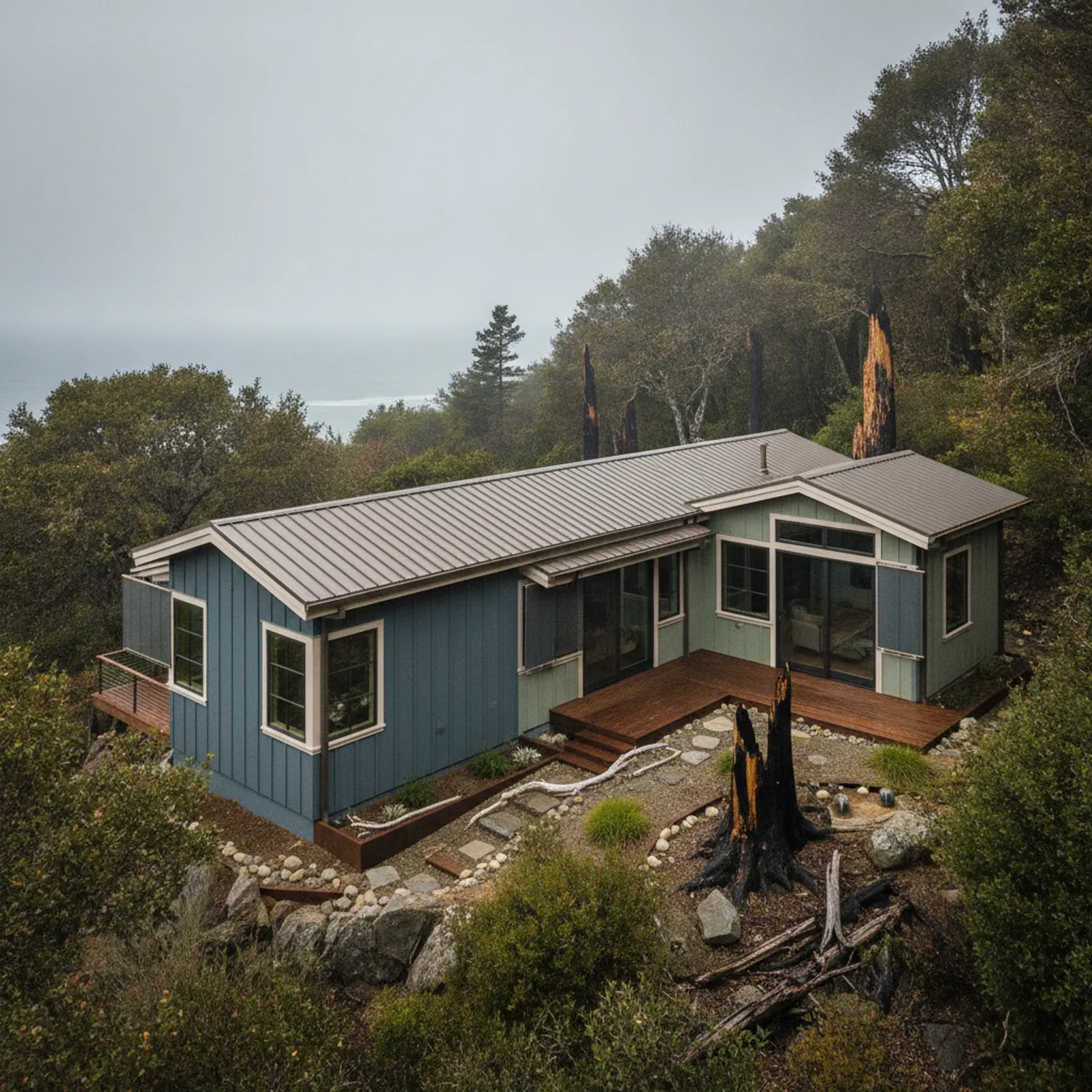
Bonny Doon's forested ridge homes and rural acreage sit in terrain with catastrophic recent loss and constrained, remote access up Empire Grade and Smith Grade. We specify Class A non-combustible cladding and aggressively harden eaves, soffits, vents, decks, and ground transitions as the non-negotiable baseline — because on a wind-exposed ridge the threat is wind-driven embers, and the wall's weakest junction is what fails first.
WUI ember defense from the soffit line down
Bonny Doon's lots are not open grassland; they are forested ridge parcels where wind-driven embers land in needle drift and brush against the foundation and sweep up under eaves. That changes how we detail fire-resistant siding here. The panel is only as good as its weakest junction, so we concentrate on the bottom six inches, the eave returns, and the inside corners where bark litter and duff collect. We carry the non-combustible board down to a clean, gapless ground transition with a noncombustible kickout so a smoldering ember bed at grade cannot find an exposed framing edge. Soffit and frieze details get tight closure, and every vent penetration through the new wall plane gets ember-rated screening, so the siding job does not quietly reopen a path into the wall cavity. On an exposed Bonny Doon ridge the spec that matters is the one that survives an ember storm at the most overlooked seams, not the showpiece field of the wall.
After CZU, the assembly file can shape coverage
Insuring a home on the post-CZU Bonny Doon ridge is among the hardest in the region, and remote ridge access weighs against it — so the assembly documentation isn't a formality, it can influence whether coverage is offered at all. We document the Class A materials and the harden-plus-drying detailing thoroughly, building a record the homeowner can hand a carrier. We're candid that thorough documentation supports the conversation but never guarantees a carrier's decision in severe terrain; insurers set their own criteria.
Hardened board over a wall that still has to dry
The same ridge canopy that drops fire risk into the foundation also keeps Bonny Doon walls in deep, perpetual shade and high humidity, with fog drip from the trees long after the rain stops. A fire-resistant siding project here has to win on two fronts at once, because noncombustible cladding still fails early if the wall stays wet behind it. We pair Class A fiber-cement or mineral board with a rainscreen gap and back-ventilation so the persistent ridge moisture can drain and dry rather than sit against sheathing on the shaded north and canyon-facing elevations. Factory-finished or fully sealed cut edges matter more on this damp ridge than on a dry inland site, since raw board ends wick moisture in this microclimate. We also flash conservatively around the deck ledgers and stair connections common on the sloped, wooded lots up Empire Grade, where the fire-hardened ground transition and the moisture detail land on the exact same joint and both have to hold.
Why this matters in Bonny Doon
- Specified for Santa Cruz Mountains conditions
- Class A non-combustible fiber cement as the recommended system
- Correctly detailed weather-resistive barrier and flashing
- Installed by a crew with 20 years combined experience
Recommended systems for Bonny Doon
- Class A non-combustible fiber cement
- James Hardie
- aggressive fire-hardening detailing
- drainage-plane detailing
Fire-Resistant Siding for Bonny Doon homes
The full fire-resistant siding approach — materials, weather-resistive detailing, and the manufacturer standards we install to — is covered on the main service page, then specified for Bonny Doon's conditions on this one.
Our Bonny Doon process
- Step 1
Consultation
We listen to your goals and assess your home on site — exposure, substrate, and architecture.
- Step 2
Design & Proposal
A clear written proposal with the right system specified for your climate and a transparent scope.
- Step 3
Expert Installation
Trained crews install to manufacturer best practices with careful weather-management detailing.
- Step 4
Walkthrough & Support
A final walkthrough, full cleanup, and a clear written record of the scope completed — work we stand behind.
FAQ
Fire-Resistant Siding in Bonny Doon — FAQ
Severe — the 2020 CZU Lightning Complex burned across this ridge, destroying homes still being rebuilt. Maximally hardened non-combustible exteriors are the baseline, not an optional upgrade.
Among the most acute — exposed, wind-driven ridge terrain with catastrophic recent CZU history. We assess each parcel honestly, but the baseline here is aggressive hardening.
No — on a wind-exposed ridge the eave, soffit, vent, deck, and ground-transition detailing are as critical as the cladding. We treat the exterior as one aggressively hardened assembly.
It can support insurability in this severe, CZU-affected terrain. We document materials and assemblies thoroughly, though insurers set their own criteria and remote access can weigh against coverage.
Only if done without a drying strategy — the central mistake here. We pair the hardened, non-combustible detailing with a rainscreen drying plane so the wall sheds canopy damp instead of sealing it in.
Keep Exploring
More for Bonny Doon homeowners
Nearby Service Areas
Fire-Resistant Siding near Bonny Doon
Back to
Santa Cruz County & Bonny Doon
Helpful Exterior Guides