
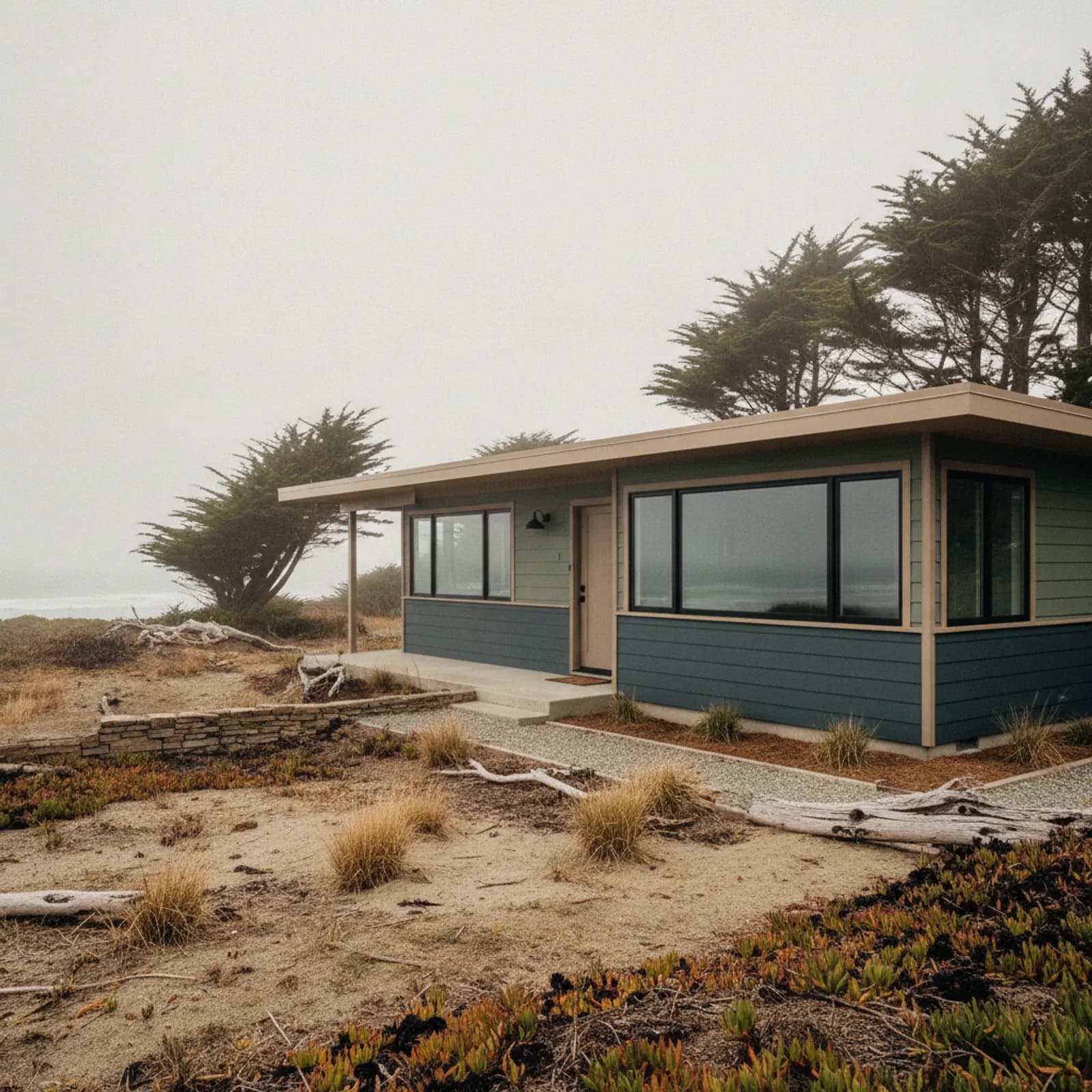
Exterior Contractor in Live Oak
Live Oak is a dense, flat, fully coastal community wedged between Santa Cruz and Capitola, and its exterior priority is singular rather than split: salt air and marine moisture on tight Pleasure Point and Eastside lots. There is no mountain fringe and no fire variable to balance — the whole envelope question is corrosion and drying, on parcels packed close enough that walls, windows, and trim all share the same salt load.
What a Live Oak exterior contractor delivers is whole-envelope integration tuned to that one stressor: corrosion-aware fastening, a rigorous drainage plane, and window-to-wall flashing tied into the assembly as a single system. Trade-by-trade bids on these blocks reliably get the salt-air durability wrong at the interfaces, because each trade closes its own scope and leaves the seams between siding, windows, and WRB for the weather to find.
What an integrated Live Oak exterior includes
On a Pleasure Point cottage or an Eastside bungalow, an integrated scope strips salt-failed cladding, corrects the WRB with rigorous drainage-plane detailing, installs corrosion-aware fasteners in stainless or hot-dipped galvanized, ties window flashing into the new assembly rather than caulking over the old, and re-clads in non-combustible fiber cement with profiles matched to the home's era. On these flat coastal lots every junction is detailed for the same salt-and-moisture exposure, so the wall behaves as one assembly instead of several.
Where the split-trade exterior fails in Live Oak
Live Oak fails fast at the interfaces. A siding crew lands corrosion-prone fasteners; a separate window installer flashes to a different standard; the WRB gets nicked and never corrected. In ordinary salt air those gaps stay quiet for a season, then bleed rust and wick moisture into the cavity at window heads and laps. Because Pleasure Point and Eastside homes sit so close together, shaded damp walls give that moisture nowhere to dry. An integrator owns the whole salt-aware envelope, so no seam is anyone else's problem.
Coordinating siding, windows, trim, and WRB as one system
The value here is sequence and ownership. We pull cladding, inspect and repair the substrate, lay a continuous WRB and drainage plane, set windows into that plane with corrosion-rated flashing, then re-clad and trim over the top — each step staged so the next can integrate into it rather than patch around it. Salt-rated hardware, sealed cut ends, and factory finishes selected for coastal durability run through every trade. That single chain of custody is the difference cheap single-trade bids cannot reproduce on a Live Oak lot.
Dense coastal lots and unincorporated logistics
Live Oak is unincorporated county, so permitting and setbacks follow county rules rather than the Santa Cruz or Capitola city codes on either side, and we confirm what each parcel allows before scoping. The blocks are tight — narrow side yards, shared drives, beach-traffic parking — so material staging, scaffold footprint, and debris haul-off are planned up front and the home is kept weather-tight day to day. Doing siding, windows, and trim under one schedule also means one mobilization on a street that has little room for several.
Why this matters in Live Oak
- Specified for Central Coast conditions
- non-combustible fiber cement as the recommended system
- Correctly detailed weather-resistive barrier and flashing
- Installed by a crew with 20 years combined experience
Recommended systems for Live Oak
- non-combustible fiber cement
- James Hardie
- corrosion-aware fastening
- rigorous drainage-plane detailing
Exterior Contractor for Live Oak homes
The full exterior contractor approach — materials, weather-resistive detailing, and the manufacturer standards we install to — is covered on the main service page, then specified for Live Oak's conditions on this one.
Our Live Oak process
- Step 1
Consultation
We listen to your goals and assess your home on site — exposure, substrate, and architecture.
- Step 2
Design & Proposal
A clear written proposal with the right system specified for your climate and a transparent scope.
- Step 3
Expert Installation
Trained crews install to manufacturer best practices with careful weather-management detailing.
- Step 4
Walkthrough & Support
A final walkthrough, full cleanup, and a clear written record of the scope completed — work we stand behind.
FAQ
Exterior Contractor in Live Oak — FAQ
Because Live Oak's salt air finds the seams between trades. When siding, windows, WRB, and trim are scoped as one salt-aware assembly, the flashing and fastener details at every junction stay consistent, which is exactly where split-trade jobs corrode and leak here.
Pleasure Point and the Eastside sit in near-constant ocean aerosol, so standard galvanized fasteners rust within months. We specify stainless or hot-dipped galvanized across siding, windows, and trim as standard on Live Oak coastal projects.
Usually yes if they are dated — older Pleasure Point and Eastside homes rarely have salt-rated perimeter flashing, and integrating new windows into the drainage plane while the cladding is off is the highest-value coastal detail.
No — Live Oak is flat and fully coastal with no mountain or redwood interface, so there is no fire variable to design around. The entire envelope budget goes into corrosion and moisture control.
Most Live Oak single-family homes run four to seven weeks of active work depending on size, scope, and how much salt-driven substrate repair surfaces once the old cladding is off.
Keep Exploring
More for Live Oak homeowners
Nearby Service Areas
Exterior Contractor near Live Oak
Helpful Exterior Guides