Exterior Contractor in Geyserville
Geyserville is the last real town before the Alexander Valley narrows toward the steam vents of The Geysers, and its homes sort into three worlds: the close-packed buildings along the single-block Geyserville Avenue downtown, the flat ranch houses spread across the valley floor, and the estates that climb the vineyard edges and ridges east of Highway 128. An exterior built for one of those settings is wrong for the other two, which is why a contractor working here starts by reading the address, not the catalog.
Geyserville also carries a fact no other Sonoma town does: the 2019 Kincade Fire began in the hills directly above it. Up here, the outside of a house is not finish work that happens to be flammable — it is the part of the home that either turns embers away or lets them in, and that reframes how the whole exterior gets planned.
Reading the Geyserville address before the work
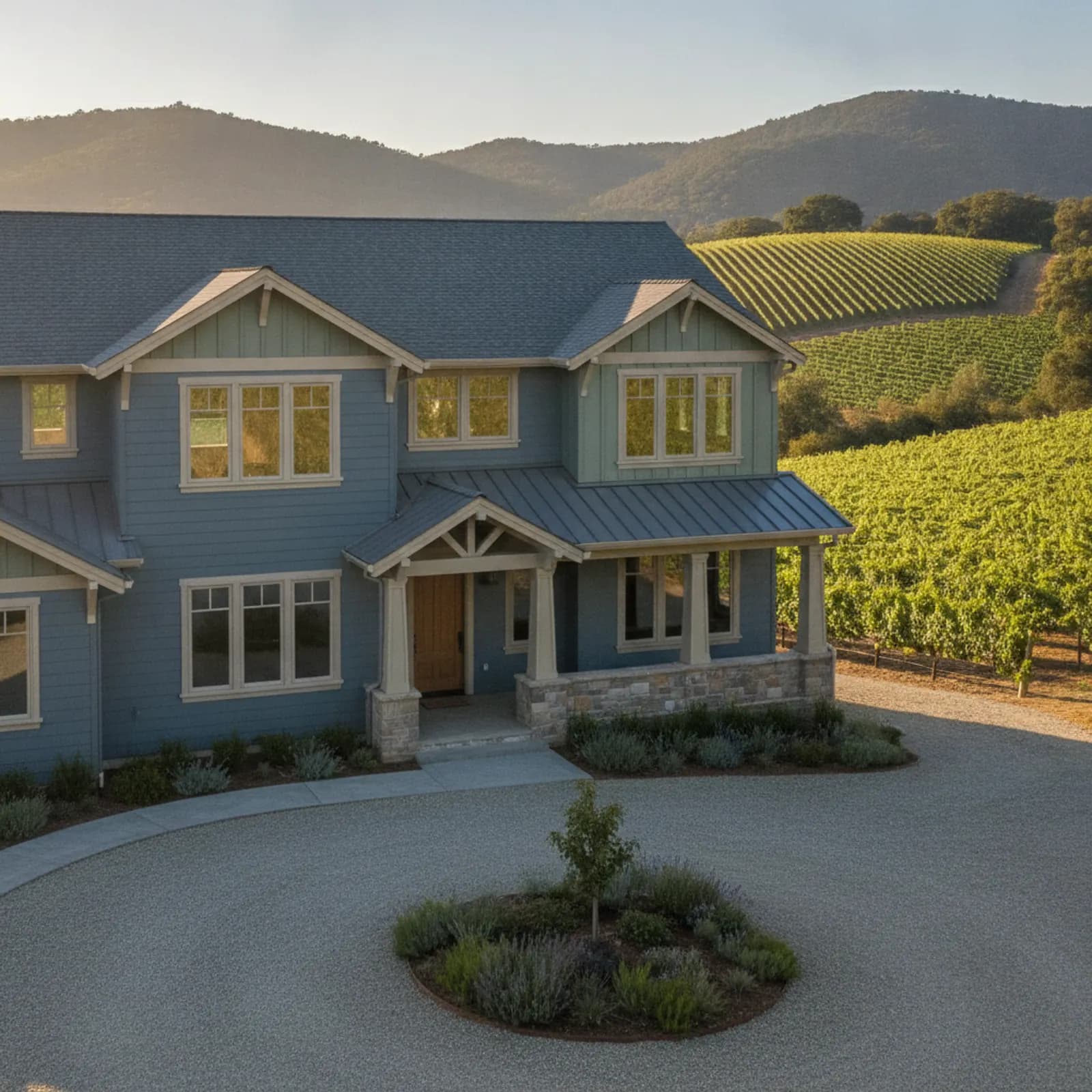
Geyserville Avenue runs barely more than a block, and the houses behind it sit on tight lots where elevations are expected to read period-correct, so siding, trim, and window choices are made with the streetscape in mind. Drop down onto the valley floor and the ranch homes spread out, easy to stage but exposed to long hot afternoons. Climb the vineyard edges toward Geysers Road and everything shifts again: steeper grades, brush right up to the wall, and the heaviest fire rating in town. We decide profile, material, and detailing per setting rather than running one specification across all three, because a Geyserville exterior that ignores where it sits is an exterior that fails where it sits.
Why the parts get planned together here
On a Geyserville ridge home the siding, the windows and their flashing, the weather barrier behind the cladding, the eave and soffit closures, and the foundation vents are not separate jobs — they are five edges of the same problem, which is keeping wind-driven embers off The Geysers ridges from finding a way behind the wall. Plan the cladding without the vents, or set windows into a wall whose barrier was finished by a different hand, and you build the exact small openings a long ember storm hunts for. We sequence those pieces as one continuous skin so nothing is left half-finished between them, and the wall reads as a single hardened surface rather than a patchwork of separate scopes.
Living with the Kincade ignition history
Because Kincade started in the hills above town, exterior work on the ridge and vineyard-edge parcels is driven by where embers will land far more than by how the house looks from the drive. The wall becomes a fire-rated system: non-combustible or ignition-resistant cladding, ember-resistant vents at every eave and crawl opening, fascia and soffit details that give a blowing ember nowhere to catch, and a clean transition wherever wall meets roof edge or an attached deck. Those uphill parcels carry the heavier rating, so a correct job there runs deeper than the same elevation on a sheltered downtown lot. Leave one combustible trim return or skip a single vent retrofit, and a long burn will find it.
Staging a downtown lot versus a ranch at the end of a drive
The logistics flip completely between Geyserville's settings. On Geyserville Avenue the lots are tight and the neighbors close, so scaffold, material laydown, and dumpster placement get mapped before the first board comes off, and we work to keep the period elevation intact. Out past Highway 128 and up Geysers Road the problem inverts: long private gravel drives, grade changes, vineyard irrigation lines, and harvest-season truck traffic decide where lifts and deliveries can even go. Walking the access and the architecture of the specific parcel up front is what keeps a Geyserville project moving on schedule instead of stalling at the gate.
Detailing for the dry up-valley heat
This far up the Alexander Valley the summers run to the hot, dry end of Sonoma's range, and the exterior has to carry that load on top of the fire question. We favor heat-stable fiber cement with UV-cured factory finishes meant for hot-dry sites, leave room for thermal movement in the lap and trim, and run a vented rainscreen so the south and west walls shed heat instead of baking it into the sheathing. Handling that heat detailing in the same pass as the ember hardening is the difference between a Geyserville wall built for one stressor and one built for both.
Why this matters in Geyserville
- Specified for Wine Country / North Bay conditions
- Class A non-combustible fiber cement as the recommended system
- Correctly detailed weather-resistive barrier and flashing
- Installed by a crew with 20 years combined experience
Recommended systems for Geyserville
- Class A non-combustible fiber cement
- fire-hardened eave and vent detailing
- rigorous drainage-plane detailing
- durable factory finishes
Exterior Contractor for Geyserville homes
The full exterior contractor approach — materials, weather-resistive detailing, and the manufacturer standards we install to — is covered on the main service page, then specified for Geyserville's conditions on this one.
Our Geyserville process
- Step 1
Consultation
We listen to your goals and assess your home on site — exposure, substrate, and architecture.
- Step 2
Design & Proposal
A clear written proposal with the right system specified for your climate and a transparent scope.
- Step 3
Expert Installation
Trained crews install to manufacturer best practices with careful weather-management detailing.
- Step 4
Walkthrough & Support
A final walkthrough, full cleanup, and a clear written record of the scope completed — work we stand behind.
FAQ
Exterior Contractor in Geyserville — FAQ
Real and local on the ridge and vineyard-edge parcels — the 2019 Kincade Fire began in the hills near The Geysers above town. The flat downtown grid sits lower but still inside the footprint, so we rate each address on its own setting.
Because on a ridge home the cladding, windows, weather barrier, vents, and eaves all guard the same wall against embers off The Geysers. Planning them together keeps the hardened skin continuous instead of leaving gaps between separately handled pieces.
Yes — Geyserville's hot, dry summers push the cladding toward heat-stable fiber cement with UV-cured finishes, plus expansion room in the detailing and a vented rainscreen so the south and west walls shed heat rather than baking the sheathing.
Yes — we map staging around the gravel approach, the grade, irrigation lines, and harvest-season traffic, sorting material drops and lift access before tear-off starts.
In this Kincade-origin terrain it commonly supports insurability and is increasingly something carriers expect. We document the hardened assembly thoroughly for the carrier file, though each carrier sets its own criteria.
Keep Exploring
More for Geyserville homeowners
Nearby Service Areas
Exterior Contractor near Geyserville
Helpful Exterior Guides