
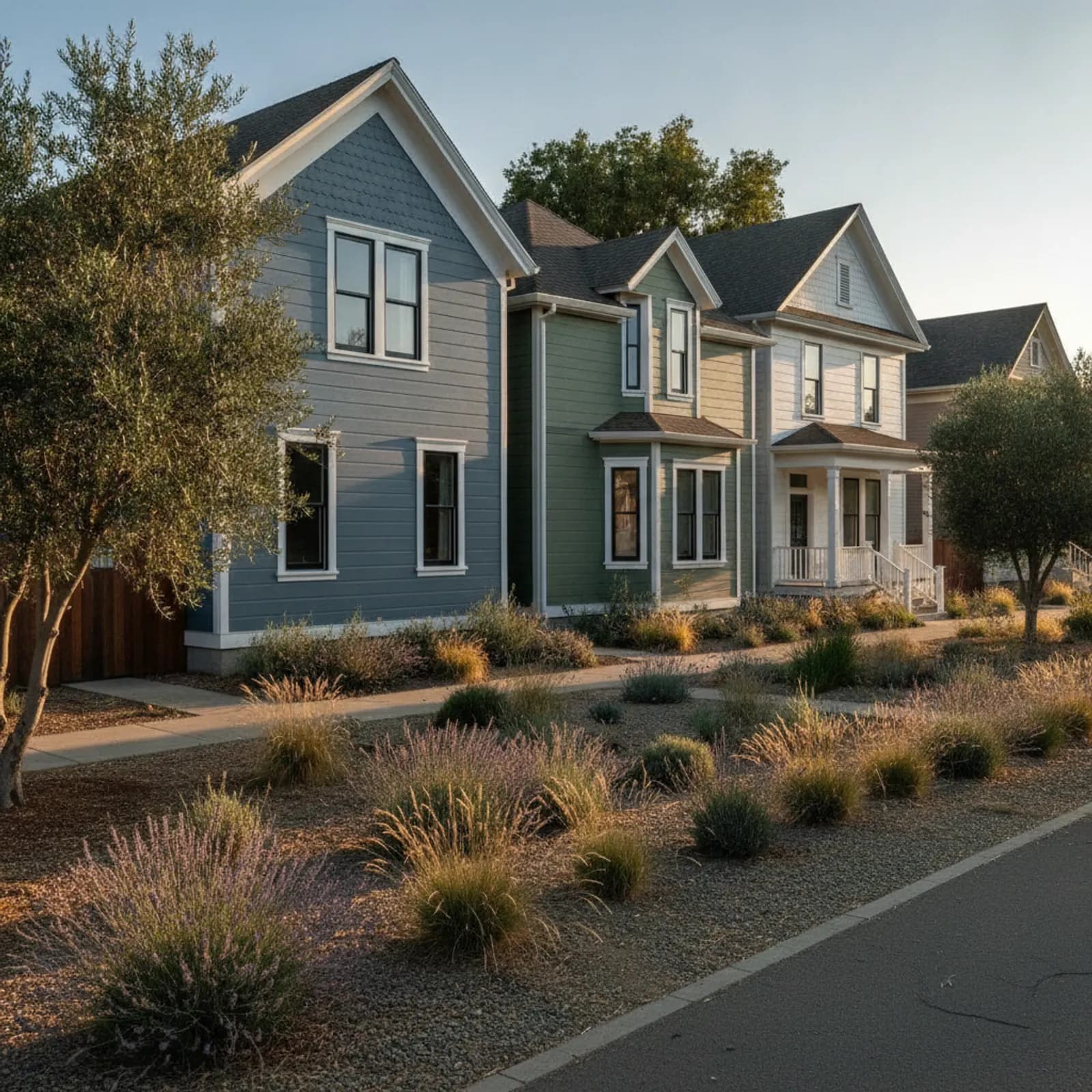
Fiber Cement Siding in Knights Landing
Knights Landing sits on a bend of the Sacramento River north of Woodland, in country that has been shaped by flooding for as long as the town has existed. Hard valley sun governs the day-to-day wear on a wall here, and the river governs everything about how the bottom of it should be built.
That combination is what makes the specification specific to this town rather than generic valley practice.
A town built around water management
Knights Landing exists inside a landscape of levees, drains and the Ridge Cut that carries water east into the Yolo Bypass, and the surrounding land is rice and row crop ground that is deliberately flooded in season. That context does not mean every house is at risk, but it does mean the ground around buildings here is wet more often and for longer than valley averages suggest. For an exterior the consequence is concentrated at the base of the wall, where clearance at grade, the condition of the bottom course and what is stored against the building matter more than they would a few miles inland.
Building with the possibility of water in mind
There is a practical difference between a wall detailed as though water will never reach it and one detailed as though it might. The second uses a non-absorbing material at the lower courses, holds generous clearance above grade, avoids trapping details near the ground, and keeps the drainage path behind the cladding genuinely open so that anything that does get in can leave. Fiber cement suits that approach because it does not decay when it stays damp — but the detailing is what turns the material into an assembly that recovers rather than one that holds water against framing.
Sun is what wears the wall the rest of the time
For most of the year the actual antagonist is the sun. Knights Landing is open country with very little canopy, and the summers deliver the full Sacramento Valley UV load. The visible failure pattern is the standard valley one — chalked and faded finish, boards cupping through daily thermal cycling, butt joints opening, and winter rain finding the gaps that summer created. A factory-applied finish rather than field paint is the correct answer to that, and it is the part of the specification that most owners will notice year to year.
Modest older stock, and being realistic about scope
Much of the housing here is older river-town cottages, farmhouses and post-war homes rather than large custom construction, and the honest conversation about scope reflects that. On a modest house the difference between a good exterior outcome and a poor one is usually in the unglamorous items — clearance at grade, flashing at openings, a sound barrier behind the cladding — rather than in premium profiles or an elaborate trim package. We would rather put a budget into the parts that determine how long it lasts and be plain that the decorative upgrades are optional.
Why this matters in Knights Landing
- Specified for Sacramento Valley conditions
- James Hardie fiber cement as the recommended system
- Correctly detailed weather-resistive barrier and flashing
- Installed by a crew with 20 years combined experience
Recommended systems for Knights Landing
- James Hardie fiber cement
- rigorous weather-management detailing
- factory finishes
- durable trim packages
Fiber Cement Siding for Knights Landing homes
The full fiber cement siding approach — materials, weather-resistive detailing, and the manufacturer standards we install to — is covered on the main service page, then specified for Knights Landing's conditions on this one.
Our Knights Landing process
- Step 1
Consultation
We listen to your goals and assess your home on site — exposure, substrate, and architecture.
- Step 2
Design & Proposal
A clear written proposal with the right system specified for your climate and a transparent scope.
- Step 3
Expert Installation
Trained crews install to manufacturer best practices with careful weather-management detailing.
- Step 4
Walkthrough & Support
A final walkthrough, full cleanup, and a clear written record of the scope completed — work we stand behind.
FAQ
Fiber Cement Siding in Knights Landing — FAQ
It affects the bottom of the wall specifically. This is levee, drain and Ridge Cut country with seasonally flooded rice ground around it, so the ground near buildings is wet more often and for longer than valley averages imply. Clearance at grade, the condition of the bottom course and what is stored against the building matter more here than a few miles inland.
Using a non-absorbing material at the lower courses, holding generous clearance above grade, avoiding details that trap water near the ground, and keeping the drainage path behind the cladding genuinely open so anything that gets in can leave. Fiber cement suits it because damp does not decay it — but the detailing is what makes the assembly recover rather than hold water against framing.
Sun, for most of the year. This is open country with little canopy and a full Sacramento Valley UV load, and the visible failure pattern is the standard one — finish chalking and fading, boards cupping, butt joints opening, winter rain finding the gaps summer created. Moisture shapes how the bottom of the wall is built; sun shapes what you look at every year.
Usually not before the fundamentals. On this housing stock the difference between a good outcome and a poor one is clearance at grade, flashing at openings and a sound barrier behind the cladding, not profile selection. We would rather put the budget where it determines longevity and be plain that the decorative upgrades are genuinely optional.
Keep Exploring
More for Knights Landing homeowners
More in Knights Landing
Other exterior services in Knights Landing
Nearby Service Areas
Fiber Cement Siding near Knights Landing
Back to
Yolo County & Knights Landing
Helpful Exterior Guides