James Hardie Siding in Plumas Lake
For a Plumas Lake house, the James Hardie decision is essentially a choice about which maintenance pattern to sign up for over the next twenty years, because the original builder specification has just shown you what its pattern looks like.
The relevant properties are a substrate that does not swell or delaminate and a finish that holds up without mature shade to protect it.
Changing the cycle rather than repeating it
The straightforward reading of a 2000s production house at its first refresh is that the original specification lasted about twenty years and then needed replacing. Re-cladding in a similar product buys a similar span. Fiber cement is a cement-and-fibre composite rather than a wood-based one, so the swelling, delamination and coating failure that ends those products is not its failure mode, and a factory-applied finish starts the clock in a considerably better place than a field-painted surface does. That is the actual trade being considered: not appearance today, but how many times this project recurs.
HZ10 for a valley subdivision with no canopy
HZ10 is Hardie's line for California's hot, dry interior, engineered around sustained heat, heavy UV and the annual swing into a wet winter. Plumas Lake sits in that zone with essentially no mature shade, so the material is being asked to perform near the top of its intended range. Dimensional stability across the summer-to-winter cycle is what keeps butt joints closed, and on a house whose original cladding has just demonstrated what happens when joints open, that is a concrete rather than abstract benefit.
Color, and how to choose in a subdivision context
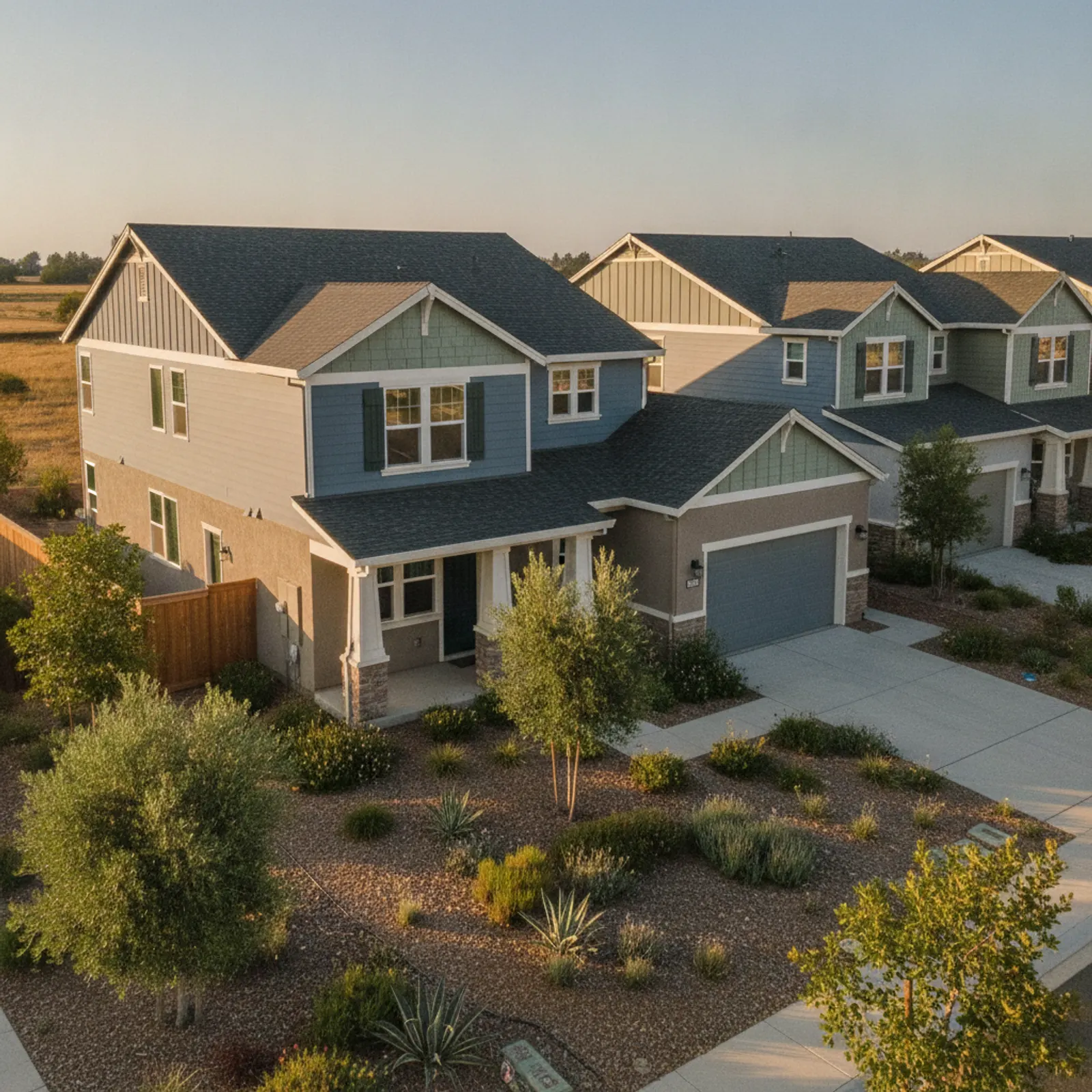
Two things pull against each other here. Deep saturated colors look excellent on contemporary production architecture and are the obvious way to differentiate from the neighbours; they also absorb more heat and show their age soonest on the elevation taking the afternoon sun, of which every house here has one. The workable approach is usually a considered body color with the west wall in mind, and the differentiation carried by trim, a defined accent mass and profile change rather than by pushing the body color as far as it will go.
What the installation has to get right
The manufacturer's published requirements govern both durability and product coverage: clearance at grade, clearance above roofing and hard surfaces, gapping at butt joints, back-priming cut ends and flashing at openings. On 2000s production housing there is a specific thing worth checking during removal, which is how the original weather-resistive barrier was installed and whether it is intact. Builder-era barriers are sometimes fine and sometimes not, and a re-side is the only realistic opportunity to see it and correct it.
Why this matters in Plumas Lake
- Specified for Sacramento Valley conditions
- James Hardie fiber cement as the recommended system
- Correctly detailed weather-resistive barrier and flashing
- Installed by a crew with 20 years combined experience
Recommended systems for Plumas Lake
- James Hardie fiber cement
- factory finishes
- modern lap and board-and-batten profiles
- refined trim and color packages
James Hardie Siding for Plumas Lake homes
The full james hardie siding approach — materials, weather-resistive detailing, and the manufacturer standards we install to — is covered on the main service page, then specified for Plumas Lake's conditions on this one.
Our Plumas Lake process
- Step 1
Consultation
We listen to your goals and assess your home on site — exposure, substrate, and architecture.
- Step 2
Design & Proposal
A clear written proposal with the right system specified for your climate and a transparent scope.
- Step 3
Expert Installation
Trained crews install to manufacturer best practices with careful weather-management detailing.
- Step 4
Walkthrough & Support
A final walkthrough, full cleanup, and a clear written record of the scope completed — work we stand behind.
FAQ
James Hardie Siding in Plumas Lake — FAQ
For this failure pattern, yes. The original specification lasted about twenty years and then needed replacing; re-cladding in something similar buys a similar span. Fiber cement does not swell or delaminate the way wood-based products do, and a factory finish starts in a better place than field paint. The trade is about how often this project recurs, not how it looks today.
HZ10, built for California's hot, dry interior. Plumas Lake is in that zone with essentially no mature shade, so the material works near the top of its intended range. Stability across the summer-to-winter swing is what keeps butt joints closed — a concrete benefit on a house whose original cladding just showed what open joints look like.
Choose the body color with the west wall in mind, and carry the differentiation with trim, a defined accent mass and a profile change rather than by pushing the body color as far as it goes. Deep colors look excellent on this architecture but absorb more heat and age first on the afternoon elevation, which every house here has.
The original weather-resistive barrier, during removal. Builder-era barriers are sometimes perfectly sound and sometimes not, and a re-side is the only realistic opportunity to see it and correct it. Beyond that, the published clearances, joint gapping, back-priming and flashing at openings govern both durability and the product coverage.
Keep Exploring
More for Plumas Lake homeowners
More in Plumas Lake
Other exterior services in Plumas Lake
Nearby Service Areas
James Hardie Siding near Plumas Lake
Helpful Exterior Guides