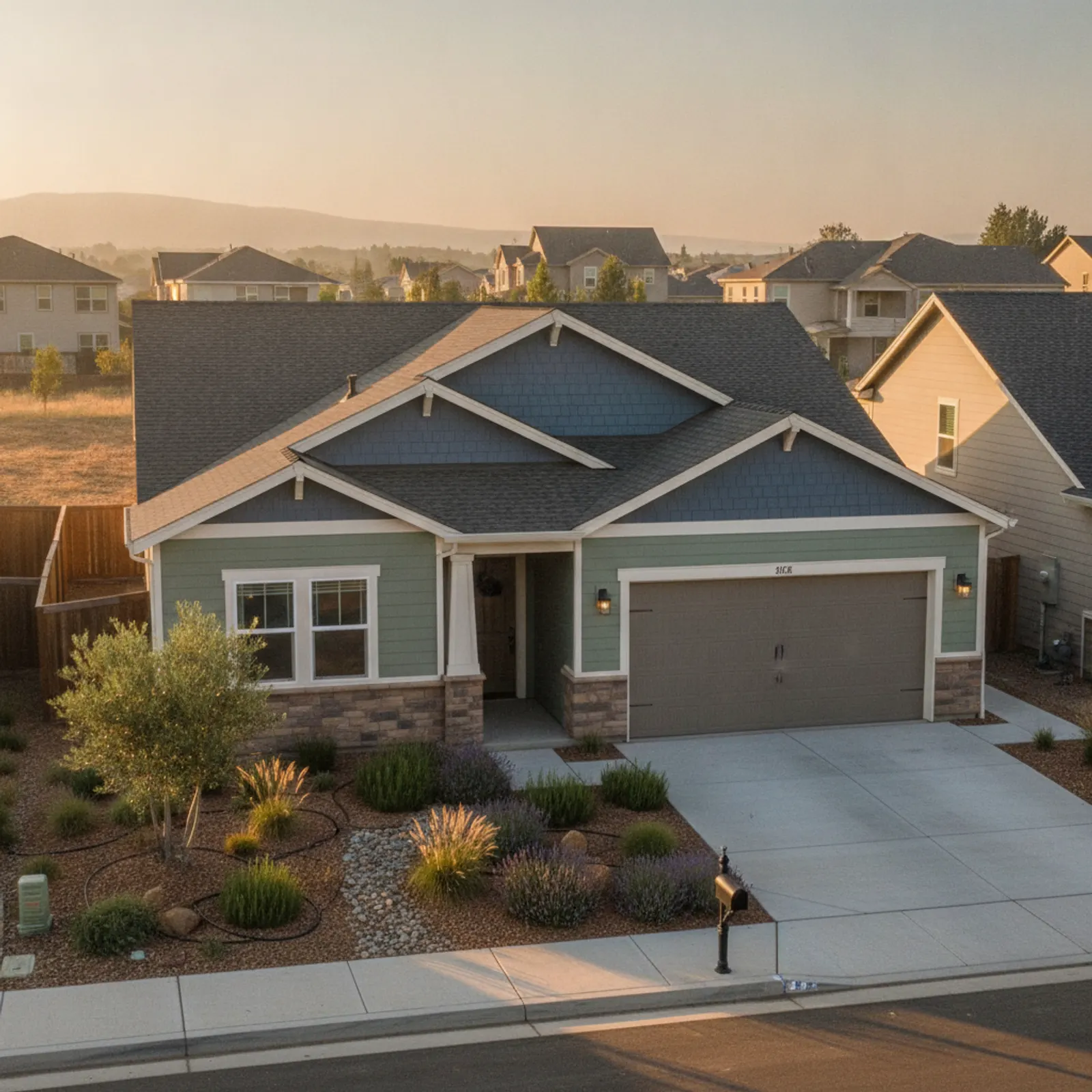
Exterior renovation in Plumas Lake
Plumas Lake is one of Yuba County's newest communities, a master-planned development on the valley floor south of Olivehurst that built out largely in the 2000s and 2010s. Unlike the county's historic and post-war towns, its housing is almost entirely current-generation: two-story production homes, newer single-story tracts, and ongoing infill construction, all on planned streets with managed landscaping. That young, uniform stock is now reaching the age at which its first builder-grade siding and original paint begin to fade and chalk under the valley sun — making Plumas Lake a re-side and exterior-refresh market defined by newer tracts rather than aging original homes.
Why it matters here specifically
Plumas Lake's controlling exterior stressor is heat and UV across the long valley summer, set back from the rivers on the open floor where fire and moisture are minor concerns. Because the community is young and built to a few repeated builder elevations, its exterior story is less about end-of-life failure and more about early fade, builder-grade paint reaching its limit, and a desire to distinguish near-identical homes. A thoughtful re-side or color program here puts a heat-stable, fade-resistant system on walls the sun is already working on and gives a production home real individual character on streets where elevations repeat.
Considering an exterior project in Plumas Lake?
Plumas Lake housing and architecture
Plumas Lake's stock is overwhelmingly 2000s-2010s master-planned production housing: two-story tract homes, newer single-story homes, and current-generation infill on planned streets. These are repeated builder elevations with stucco-and-siding combinations, board accents, and a limited original palette — handsome when new but quick to read as uniform across a street. That makes the community an ideal candidate for a modern lap-and-batten re-side or a refined trim and color refresh that breaks builder uniformity and gives a home individual character. With the framing young and consistent, the scope is usually predictable, and we design to distinguish one repeated elevation from the next rather than imposing one template.
Built for Plumas Lake's valley heat
Heat and UV durability is the priority across Plumas Lake — the long, high-sun valley summer is the controlling stressor, and the community's flat, planned, low-mature-canopy layout intensifies it on exposed two-story walls. We specify fiber cement with factory-applied fade-resistant finishes because builder-grade paint and economy accents lose color quickly on Plumas Lake's young but already sun-exposed elevations. Detailing matters too: correct gapping and fastening for large temperature swings, and finish selection tuned to orientation, since south and west walls fade first. Set on the open floor away from the rivers, the community sees minor moisture exposure and low fire exposure, so heat is the clear and dominant spec driver.
Recommended materials for Plumas Lake
James Hardie fiber cement with a factory finish is the core recommendation for Plumas Lake: non-combustible, dimensionally stable in heat, and far more color-stable than the builder-grade paint and accents the valley sun is already fading. On these two-story production homes a modern lap-and-batten field with a refined trim and color package modernizes the elevation and breaks builder uniformity while putting a heat-stable system on walls that were value-engineered when new. Engineered wood remains a reasonable option on these low-fire valley-floor parcels where deep wood character is the goal, and we'll walk through that trade-off honestly against the longest-lasting heat performance.
What an exterior project costs in Plumas Lake
Plumas Lake pricing turns on home size and stories — many homes here are two-story, which affects staging and access — profile and trim complexity, the existing accent and stucco configuration, window integration, and the weather-management scope. Because the housing is young and uniformly built, substrate and framing are usually predictable, which often makes for a cleaner, more estimable scope than the county's older towns. Two variables are particular here: many homes sit within HOAs whose design review governs exterior color and material, and partial re-side or accent-and-color refreshes are common. We provide a written, scoped estimate after an on-site assessment rather than a generic per-foot figure.
Master-planned tracts and breaking builder uniformity
Plumas Lake's defining feature is that nearly every street is a master-planned tract of repeated builder elevations, handsome when new but quick to blend together over time. That makes it the county's strongest market for a re-side or refresh aimed at individuality: a modern lap-and-batten program, refined trim, and a fresh palette distinguish one home from its near-identical neighbors while upgrading durability. With consistent framing, these are often clean, predictable projects where the visible payoff is immediate on a repeated streetscape.
HOA design review
Many Plumas Lake neighborhoods sit within homeowners associations whose design review governs exterior color and, sometimes, material and profile. We confirm any overlay requirements before scoping so the approved palette and materials are the ones we install, and we can help align a refresh with the community's standards rather than running into them after the work is planned. Getting this right up front keeps the project on schedule and avoids rework.
Early fade and value-driven resale
Because Plumas Lake's homes are young, the exterior conversation is often about getting ahead of early fade and builder-grade paint reaching its limit rather than wholesale failure. Replacing value-engineered accents and tired paint with a heat-stable, fade-resistant, low-maintenance system protects the home from the valley sun and distinguishes it in a market of similar production houses. A refreshed, individual exterior reads strongly at resale on streets where most homes still wear their original builder look.
Yuba County, Olivehurst PUD, and Linda Fire
Working exteriors in Plumas Lake coordinates with a few local authorities. Plumas Lake is unincorporated Yuba County — there is no city government, so building permits come through the Yuba County Community Development and Services Agency rather than a municipal department. Electric and gas are PG&E. Water and wastewater are supplied by the Olivehurst Public Utility District (OPUD), whose service area extends across the Plumas Lake plan area. Fire response is the Linda Fire Protection District (which extends its coverage into Plumas Lake) alongside CAL FIRE Nevada-Yuba-Placer Unit on wildland calls. Because the Plumas Lake plan area lies within the Feather River flood plain, FEMA-designated flood hazard zones govern base-flood-elevation requirements on many parcels — a factor built into the master-planned community's original design and still relevant to any base-of-wall or ground-transition work.
HZ10 and the master-planned FHSZ reality
Plumas Lake is in James Hardie's HZ10 climate zone; installing HZ5 is a documented warranty misapplication. On the fire side, essentially the entire Plumas Lake plan area sits in Low or unmapped FHSZ territory under California's 2025 LRA Fire Hazard Severity Zone map — this is engineered valley-floor ground on the Feather River corridor, and wildland fire is not the local threat. The 1997 New Year's flood at nearby Olivehurst/Linda is the plainest local reminder of what does drive exterior scope here — Plumas Lake's original planning explicitly addressed post-1997 levee and elevation requirements. Chapter 7A moved into the standalone WUI Code on January 1, 2026, but does not typically drive Plumas Lake's spec.
Our process in Plumas Lake
- Step 1
Consultation
We listen to your goals and assess your home on site — exposure, substrate, and architecture.
- Step 2
Design & Proposal
A clear written proposal with the right system specified for your climate and a transparent scope.
- Step 3
Expert Installation
Trained crews install to manufacturer best practices with careful weather-management detailing.
- Step 4
Walkthrough & Support
A final walkthrough, full cleanup, and a clear written record of the scope completed — work we stand behind.
Plumas Lake rewards an exterior approach built around the valley sun and the chance to give a production home real individual character, whether that is a full re-side or a refined accent-and-color refresh. We scope every Plumas Lake project on site, confirm any HOA requirements, and put it all in a written, itemized estimate.
FAQ
Plumas Lake — Common Questions
Fiber cement with a factory fade-resistant finish. Plumas Lake's flat, low-canopy valley setting delivers sustained summer UV, and factory-finished fiber cement holds color far longer than the builder-grade paint and accents on these newer tract homes.
Often it is about getting ahead of early fade and builder-grade paint reaching its limit rather than wholesale failure. A re-side or refined color and accent refresh puts a heat-stable system on walls the sun is already working on and gives a production home individual character.
Yes — that is one of Plumas Lake's strongest opportunities. A modern lap-and-batten program with refined trim and a fresh palette distinguishes a home from its near-identical neighbors while upgrading durability.
Often, yes — many neighborhoods have design review governing exterior color and sometimes material. We confirm any HOA requirements before scoping so the approved palette and materials are the ones we install.
Generally no — Plumas Lake sits on the open valley floor with low wildfire exposure. Non-combustible fiber cement is still a sound, low-regret choice alongside its heat durability.
When feasible, yes — it ensures correct flashing integration, avoids duplicated trim work, and produces a better-looking, better-performing exterior in one project.
South- and west-facing walls take the heaviest afternoon sun and fade first, especially the two-story elevations on the community's open, low-mature-canopy streets; we account for orientation when specifying finishes.
A correctly installed fiber cement system commonly performs 30+ years in Plumas Lake's climate, with factory finishes extending the time before any cosmetic refresh.
Helpful Exterior Guides