8 min read · Hardie
James Hardie and Nichiha are both legitimate fiber-cement brands, but they've built their reputations in different places — and that's the most useful way to compare them. Hardie is the residential market leader in California, organized around climate-engineered lap and panel lines and a factory-baked color finish. Nichiha is best known for architectural wall panels and a distinctive hidden-clip, integrated-rainscreen installation system that's a favorite on modern and commercial-leaning facades. Neither is 'better' in the abstract; they fit different projects. This guide compares them fairly for a California homeowner, with the honest note that we primarily install Hardie for availability and fit, not because Nichiha is a lesser product.
What's the same
Both are fiber cement, so they share the category's fundamentals: a cement-and-cellulose material that resists moisture, rot, and pests, and that is non-combustible — the trait that matters most across California's wildfire-prone regions, where the UC ANR Fire Network lists fiber cement (lap or panel) among compliant noncombustible sidings. Nichiha describes its products as fiber cement with a 'dense fiber cement core'; Hardie publishes that its fiber cement is 'noncombustible and/or has a Class A fire rating when tested in accordance with ASTM E84' (with the fair caveat, in Hardie's own words, that the rating covers the board, not applied paints or coatings). So on the things that protect your home, these are siblings, not rivals.
Where they genuinely differ
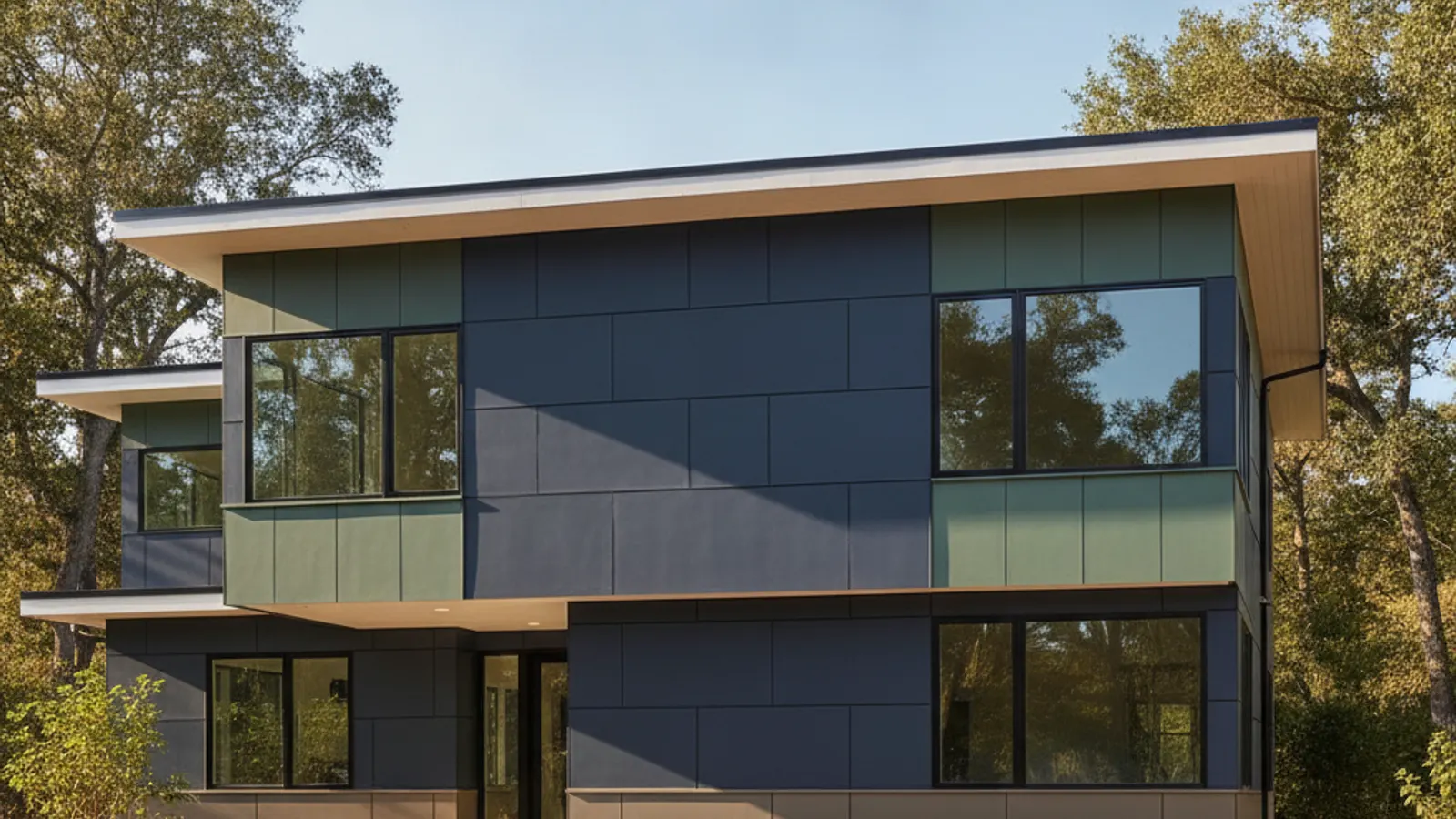
The real distinction is focus. **Nichiha** is known for architectural wall panels positioned for 'commercial, institutional, and residential settings' and contemporary design, and for its install system — a 'hidden fastening system' with a 'built-in Ultimate Clip and track system' and an 'integrated rainscreen system' that manages moisture behind the panel. That clip-and-rainscreen approach is genuinely distinctive and well-suited to modern panelized looks (its wood-look Natura line is an example). **James Hardie** organizes around climate-zoned residential siding — its 'Engineered for Climate' HZ5 and HZ10 product lines — and the ColorPlus factory-applied, baked-on finish built for color retention in high UV. Put simply: Nichiha shines on modern architectural panel facades with a clip system; Hardie shines on climate-matched residential lap and panel with a deep factory-color program.
Availability and fit in California
For a typical Northern California home, availability and contractor familiarity are legitimate, practical factors — and here Hardie has the edge in residential work: broader distribution, more color availability on the shelf, and deep installer and supplier familiarity, which translates to fewer sourcing delays and well-understood detailing. Nichiha's strengths concentrate in architectural-panel and commercial-leaning projects, and its clip system rewards installers experienced with it. None of that makes Nichiha a worse product — if your design calls for a crisp, modern architectural-panel facade with concealed fasteners, Nichiha may be the better fit, and we'll tell you so. For most climate-zoned residential re-sides in our heat-, fog-, and fire-prone areas, Hardie is the practical default.
What actually decides the outcome: the install
Whichever brand you choose, the installation governs the result. The U.S. Department of Energy's building-science guidance and Building Science Corp. both make the same point: a wall stays dry because of a continuous water-resistive barrier, flashing integrated at openings, proper clearances, and correct fastening — not because of the label on the cladding. Nichiha's integrated rainscreen is one engineered approach to that drainage requirement; conventional Hardie lap relies on the installer to build the drainage and flashing details correctly. Both work when detailed right. So weigh brand fit and availability, but put the most weight on hiring an installer who treats the WRB and flashing as the real product — see how we approach fiber cement and the broader brand comparison.
James Hardie vs. Nichiha (qualitative)
| Factor | James Hardie | Nichiha |
|---|---|---|
| Best known for | Climate-zoned residential lap & panel | Architectural wall panels |
| Install system | Conventional fastening (installer builds drainage/flashing) | Hidden-clip + integrated rainscreen |
| Finish | ColorPlus factory baked-on color | Prefinished/architectural programs |
| Material | Fiber cement, noncombustible | Fiber cement, noncombustible-class |
| CA residential availability | Broad; high contractor familiarity | Strong in architectural/commercial work |
Key takeaways
- Both are fiber cement — same core material, both noncombustible-class — so they're siblings on the traits that protect your home.
- Nichiha is known for architectural wall panels and a hidden-clip + integrated-rainscreen system; great for modern facades.
- Hardie is known for climate-zoned residential lines (HZ5/HZ10) and the ColorPlus factory finish.
- For typical NorCal residential re-sides, Hardie wins on availability and contractor familiarity — a fit factor, not a quality verdict.
- Either brand performs when the WRB, flashing, and clearances are detailed correctly — the install decides the outcome.
FAQ
Quick Answers
Both are legitimate, high-quality fiber-cement brands sharing the same core material and non-combustibility, so neither is simply 'better.' They differ in focus: Nichiha excels at architectural wall panels with a hidden-clip, integrated-rainscreen system, while Hardie excels at climate-zoned residential siding with a factory-baked finish. For modern panel facades, Nichiha may fit better; for typical residential re-sides in California, Hardie's availability and familiarity often win.
Mostly availability and familiarity, not a quality gap. In California residential work, James Hardie has broader distribution, more on-the-shelf color availability, and deeper installer and supplier familiarity, which reduces sourcing delays and leans on well-understood detailing. Nichiha's strengths concentrate in architectural-panel and commercial work, where its clip system shines. It's a fit-and-availability decision.
Nichiha's integrated rainscreen is a genuinely engineered approach to the drainage that every wall needs. But conventional Hardie lap, installed over a properly built water-resistive barrier with correct flashing and clearances, achieves the same goal. Building-science authorities are clear the install governs moisture performance, so a well-detailed conventional assembly and a clip-and-rainscreen system can both perform — the installer's care is the deciding factor.
They are different rather than one being simply easier. Nichiha's panel-and-clip systems are engineered around a different installation logic to conventional lap, with its own learning curve and its own advantages once a crew knows it. Hardie's lap products are what the large majority of California siding crews install week in and week out. The practical consequence is not about the products — it is that the pool of crews with genuine repetition on one is much larger than on the other in this market.
This is the underrated question in any brand comparison, and it comes down to distribution. A product carried by every lumberyard in the region is straightforward to match years later; a product with narrower regional distribution may mean a special order, a longer wait, or a discontinued profile. That is not a judgement on quality — it is a practical consideration for a material expected to be on the building for decades.
It offers formats and textures that suit contemporary architecture well, and for a design leaning that way it is a legitimate choice worth considering seriously rather than dismissing. What we would say honestly is that the decision should be made on the design and on the installer's actual experience with the system, not on a general claim that one brand is superior. A well-installed Nichiha wall outperforms a poorly installed Hardie wall every time.
Sources
Authoritative references
- Nichiha — fiber cement products (architectural wall panels & premium plank)
- Nichiha — architectural wall panels (hidden-clip & integrated rainscreen system)
- James Hardie — HardieZone / Engineered for Climate (HZ5 & HZ10)
- UC ANR Fire Network — Siding: fiber cement (lap or panel) qualifies as noncombustible for WUI
External links to government, code, and manufacturer sources. Sierra Siding is not affiliated with these organizations; references are provided for verification.