
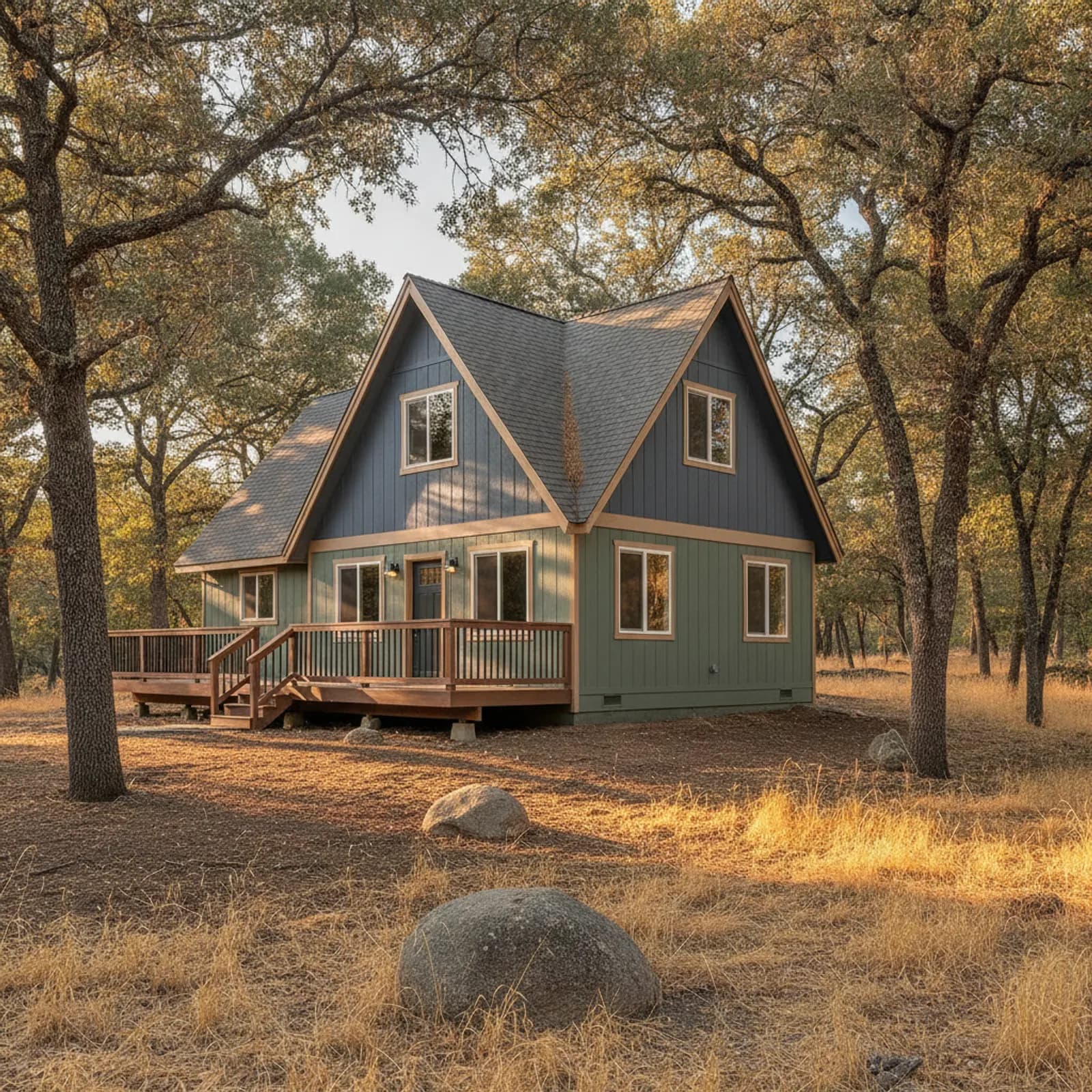
Exterior Contractor in Pine Grove
Pine Grove is a higher-elevation forest community strung along Highway 88 east of Jackson, where the housing runs to A-frame and chalet cabins, board-and-batten mountain homes, and houses on timbered acreage with the pines close to the wall. Most exteriors here have to do two things at once: deliver real ignition resistance for an extreme-fire timber setting and shed light mountain snow and freeze-thaw through the winter.
An integrated Pine Grove exterior is what reconciles those demands. The fire hardening and the snow-and-drainage detailing have to be designed into a coherent cabin envelope, not bolted on by separate trades — and the siding, windows, weather barrier, and trim only perform when one contractor owns the whole assembly from the first walk of the parcel.
What an integrated Pine Grove exterior includes
On a timbered Pine Grove cabin or mountain home, an integrated scope strips combustible cladding, corrects the weather-resistive barrier for elevation moisture, swaps ember-vulnerable vents for ember-resistant equivalents, hardens eave and soffit detailing, integrates window flashing into the non-combustible assembly, and re-clads in Class A fiber cement with a profile chosen to the cabin vernacular. The extreme-fire hardening and the snow-shedding drainage detailing are designed together as one envelope around the home rather than left to separate trades to reconcile at the seams.
Where the split-trade exterior fails up here
Pine Grove's failure mode stacks fire gaps on top of moisture gaps. Separate trades each optimize their own piece — a siding crew picks a profile, a fire-hardening trade picks vents, a window installer flashes to its own standard — and the junction between them is where the siding-to-window-to-trim interfaces both admit embers and trap snowmelt against a mountain wall. The result is a cabin that is either under-hardened beneath an attractive surface or weather-tight but ignition-vulnerable at the transitions. One integrator owns both criteria and the interfaces that single-trade bids on a forest parcel never price.
The interfaces a single-trade bid misses on a forest cabin
The real risk on a Pine Grove exterior lives at the junctions, not in the field of any one trade's work. Where siding meets a window head, where the eave returns to the wall, where a deck or woodpile ties into the cladding, and where the bottom course meets a sloped forest grade that holds snow — those interfaces are simultaneously the ember paths, the meltwater paths, and the freeze-thaw weak points. They are exactly what falls through the cracks when each trade quotes only its own piece. A window installer not hardening the wall, or a siding crew not flashing the openings, leaves both a defensible-space gap and a moisture path on a timbered lot that no single scope owns. We design the window flashing, the WRB laps, the trim terminations, and the vent assemblies as one continuous detail, sequenced so each interface is built once and correctly. On Pine Grove's deep-timber, snow-prone parcels, getting those junctions right is the difference between a hardened, weather-tight envelope and a handsome cabin with hidden gaps.
Trade coordination across timber, slope, and mountain weather
Coordinating the full exterior in Pine Grove is as much a logistics problem as a carpentry one. Homes sit back long forested driveways on grades that drop into the trees, with limited flat ground to stage scaffold, a dumpster, and pallets among standing timber and the defensible-space perimeter, and the work has to be timed against both the summer ember season and the elevation's snow and freeze-thaw window. One contractor sequencing siding, windows, weather barrier, and trim can stage the whole job to the parcel — material drops, tear-off, dry-in, and reclad in one continuous push so no opened wall sits exposed through a mountain rain, a freeze, or an ember day. Split trades arriving on their own schedules cannot, and on Pine Grove's terrain and weather that is exactly where timelines slip and walls sit half-finished in the trees. We walk the approach, the drop zone, the canopy, and the exposure on the site visit so the crew plan, not the square footage, drives a realistic schedule.
Why this matters in Pine Grove
- Specified for Sierra Foothills conditions
- James Hardie fiber cement as the recommended system
- Correctly detailed weather-resistive barrier and flashing
- Installed by a crew with 20 years combined experience
Recommended systems for Pine Grove
- James Hardie fiber cement
- non-combustible fire-hardened detailing
- factory finishes
- snow- and slope-aware bottom-course detailing
Exterior Contractor for Pine Grove homes
The full exterior contractor approach — materials, weather-resistive detailing, and the manufacturer standards we install to — is covered on the main service page, then specified for Pine Grove's conditions on this one.
Our Pine Grove process
- Step 1
Consultation
We listen to your goals and assess your home on site — exposure, substrate, and architecture.
- Step 2
Design & Proposal
A clear written proposal with the right system specified for your climate and a transparent scope.
- Step 3
Expert Installation
Trained crews install to manufacturer best practices with careful weather-management detailing.
- Step 4
Walkthrough & Support
A final walkthrough, full cleanup, and a clear written record of the scope completed — work we stand behind.
FAQ
Exterior Contractor in Pine Grove — FAQ
Extreme — deep-timber, higher-elevation WUI exposure with pine and cedar close to the wall on most parcels. The hardening scope follows a per-parcel read of the real exposure, and on these forest lots that baseline runs high.
Because the ember, rain, and snowmelt risk all live at the siding-to-window-to-trim-to-grade interfaces, which split trades each leave to the other. One integrator owns those junctions, so the envelope is hardened and weather-tight rather than a surface with hidden gaps.
Yes — at Pine Grove's elevation the drainage, back-ventilation, and bottom-course clearance are designed alongside the fire hardening, so the same envelope sheds meltwater and resists embers instead of trading one for the other.
Yes — long forested driveways, sloped wooded lots, standing timber near the structure, and defensible-space perimeters are normal Pine Grove conditions. We plan access, staging, and sequencing around them on the site visit.
Most single-family Pine Grove homes are roughly four to seven weeks of active work depending on size, the extent of fire hardening the timbered parcel warrants, access down a forested driveway, and the weather window at elevation.
Keep Exploring
More for Pine Grove homeowners
More in Pine Grove
Other exterior services in Pine Grove
Nearby Service Areas
Exterior Contractor near Pine Grove
Helpful Exterior Guides