
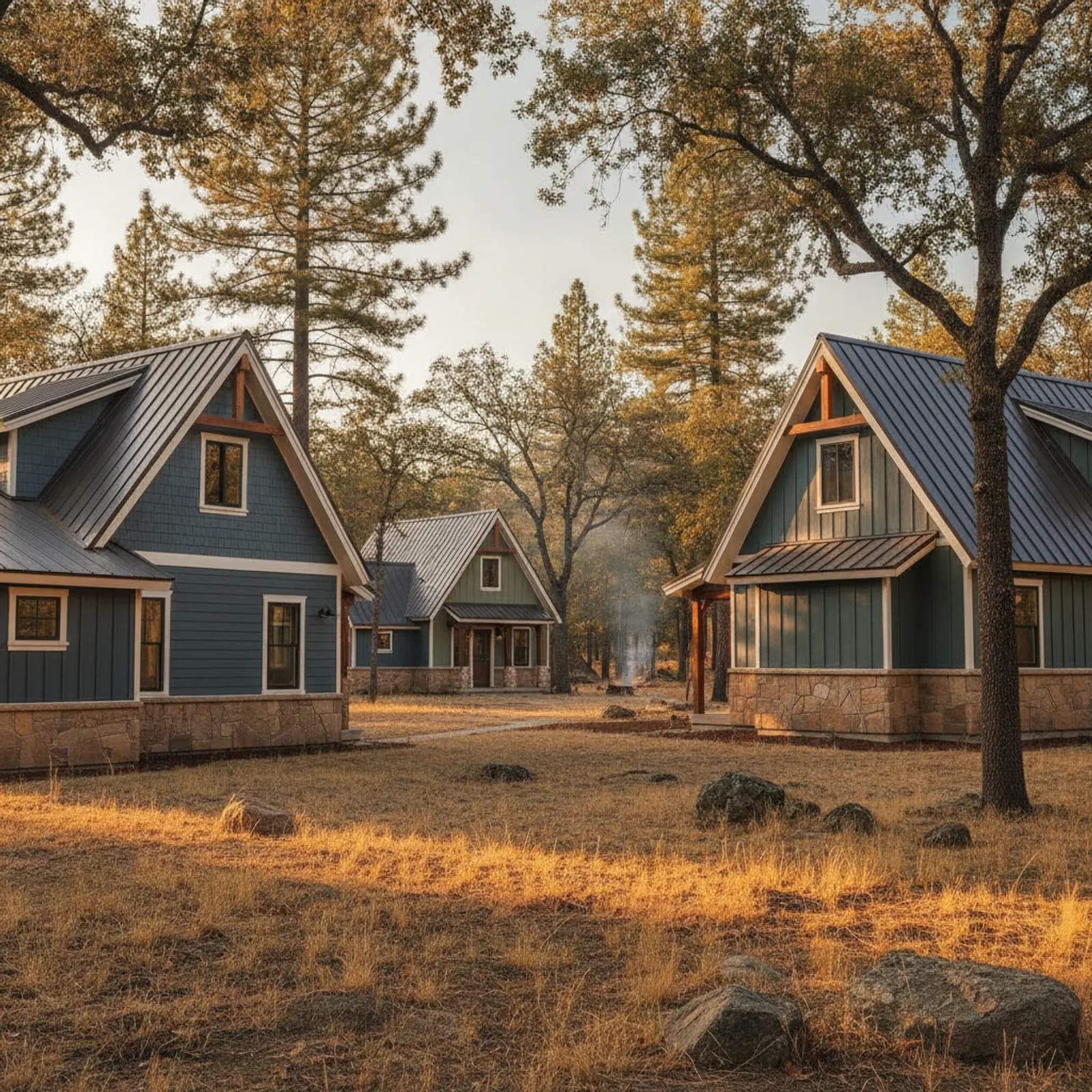
Fire-Resistant Siding in Pine Grove
Fire-resistant siding is the headline service in Pine Grove. This is deep-timber, higher-elevation country east of Jackson where ponderosa and cedar stand right up against the building line, the canopy lays down a continuous needle-and-bark fuel bed, and the wildfire exposure is genuinely extreme rather than a precaution. A re-side here is first a home-hardening decision.
Wind-driven embers riding ahead of a timber fire are the realistic threat on most of these forest parcels, and that drives the whole spec: non-combustible Class A cladding detailed together with ember-resistant vents, hardened eaves and soffits, and a clean ground-to-wall transition, built as one continuous defensible envelope around the mountain home.
Extreme WUI exposure in deep Amador timber
Pine Grove sits squarely in mapped wildland-urban-interface terrain, but the exposure runs hotter than the foothill towns below it. The standing ponderosa and cedar, the heavy ground litter, and the slope-and-canopy continuity mean a fire here moves with crown and ember energy a grass-and-oak foothill setting does not produce. We read each parcel honestly — a home with timber cleared back sits differently than one with the forest pressing against three walls — but across most of Pine Grove the realistic baseline is heavy ember loading and direct radiant exposure, and the hardening scope follows that real, elevated risk.
The WUI code in a mountain-forest setting
Because Pine Grove falls inside high-hazard wildland terrain, a fire-resistant re-side is governed by WUI-code provisions, which reach far past the wall covering. The cladding moves to non-combustible or ignition-resistant material, and the same standard drives ember-resistant vents, hardened eaves and soffits, fire-rated trim, and tight detailing wherever the wall meets a deck, a woodpile, a fence, or the forest grade. On a Pine Grove cabin the eaves, vents, and the open gap behind old wood trim are exactly the assemblies a crown-fire ember storm exploits, so we treat the tear-off as the moment to bring the whole exterior up to the WUI standard, not to re-clad one vulnerability with another.
Class A cladding and the Zone 0 ember trap under the canopy
On a timbered Pine Grove lot the threat is rarely a tidy wall of flame; it is a wind-driven ember wash landing against the base of the house, often well ahead of any visible front and lasting long after. That reality dictates what goes on the wall and where the detailing concentrates. We use non-combustible Class A cladding — fiber cement or mineral-based panels — because charred wood becomes its own fuel against a forest structure. The first several inches above grade and every deck-to-wall junction get particular attention, since dry needles, bark, and cones pile against mountain homes all season and embers lodge precisely there. We hold cladding off the splash and ignition zone, detail non-combustible base trim, and close the seams where a spark would wedge behind a board. Where a homeowner wants to keep the cabin character, a fire-rated board-and-batten or shingle profile keeps the mountain look while the assembly — cladding, hardened soffit, and trim together — reads as one fire system rather than a handsome surface over an ember gap.
Honest defensible-space and documentation in the trees
Fire-resistant siding is one layer, and in deep timber we are blunt that it works alongside the defensible space the homeowner controls — the cleared, ember-resistant Zone 0 within five feet of the wall does as much as any board on a Pine Grove parcel. We point out where firewood stacked against the cabin, a wood deck or fence tying into the cladding, propane near the wall, or needle-packed corners undercut an otherwise hardened exterior, because a Class A wall over an open ember trap still feeds fire upward. We document the Class A materials and the hardened detailing we install so the record is available when a homeowner, buyer, or insurer asks what is on the walls — a real concern in a high-hazard mountain setting where carriers have grown selective. We provide the evidence and the hardened assembly; insurers and assessors set their own criteria, and we are honest about that line.
Why this matters in Pine Grove
- Specified for Sierra Foothills conditions
- James Hardie fiber cement as the recommended system
- Correctly detailed weather-resistive barrier and flashing
- Installed by a crew with 20 years combined experience
Recommended systems for Pine Grove
- James Hardie fiber cement
- non-combustible fire-hardened detailing
- factory finishes
- snow- and slope-aware bottom-course detailing
Fire-Resistant Siding for Pine Grove homes
The full fire-resistant siding approach — materials, weather-resistive detailing, and the manufacturer standards we install to — is covered on the main service page, then specified for Pine Grove's conditions on this one.
Our Pine Grove process
- Step 1
Consultation
We listen to your goals and assess your home on site — exposure, substrate, and architecture.
- Step 2
Design & Proposal
A clear written proposal with the right system specified for your climate and a transparent scope.
- Step 3
Expert Installation
Trained crews install to manufacturer best practices with careful weather-management detailing.
- Step 4
Walkthrough & Support
A final walkthrough, full cleanup, and a clear written record of the scope completed — work we stand behind.
FAQ
Fire-Resistant Siding in Pine Grove — FAQ
Extreme — Pine Grove is deep-timber, higher-elevation WUI country where standing pine and cedar and heavy ground litter create crown-and-ember fire energy well beyond the foothill towns below. Non-combustible cladding and full ember-resistant detailing are a serious, low-regret baseline here.
Inside high-hazard WUI terrain, the standard drives non-combustible or ignition-resistant cladding plus ember-resistant vents, hardened eaves and soffits, fire-rated trim, and tight detailing where the wall meets decks, woodpiles, fences, and grade — not just the wall covering.
No — eaves, soffits, vents, the ground-to-wall transition, and the defensible-space Zone 0 within five feet of the cabin complete the protection. In deep timber we treat the cladding and those details as one fire assembly and are candid about the part homeowners control.
Both matter at this exposure, but wind-driven embers landing against the base of the house, often ahead of any front, are the most common ignition path. Hardening the first few inches above grade and the deck-to-wall junctions is where the detailing concentrates.
It can support a high-hazard mountain home's insurability, and we document the Class A materials and hardened assemblies so the record is available to a homeowner, buyer, or insurer — though carriers in this terrain set their own, often strict, criteria.
Keep Exploring
More for Pine Grove homeowners
More in Pine Grove
Other exterior services in Pine Grove
Nearby Service Areas
Fire-Resistant Siding near Pine Grove
Helpful Exterior Guides