
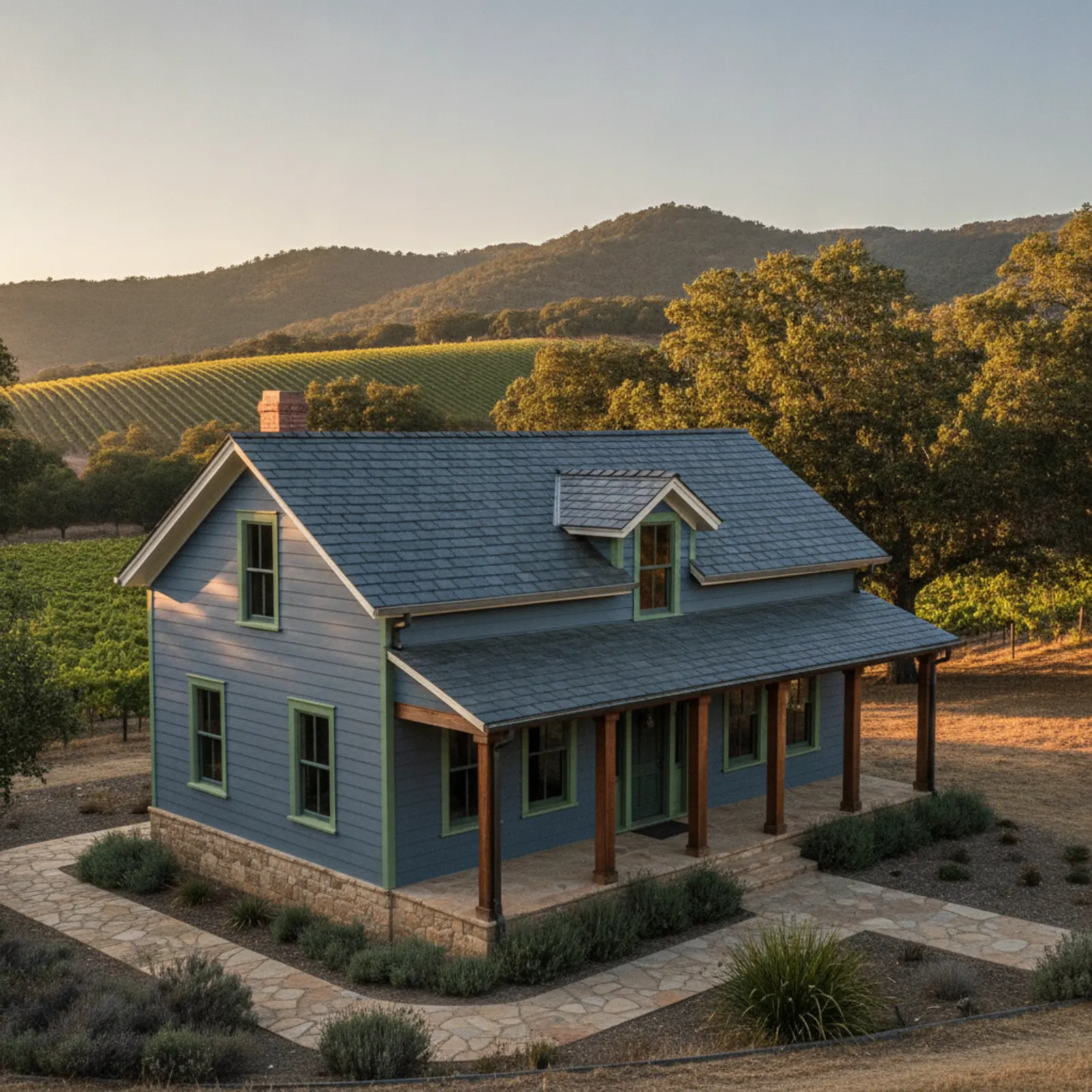
Fire-Resistant Siding in Plymouth
Fire-resistant siding is a primary service in Plymouth. This is not a valley-floor town — Plymouth sits in genuine Amador foothill wildfire country at the gateway to the Shenandoah Valley, where hot, tinder-dry summers cure the surrounding oak-grassland, brush, and vineyard margins into ready fuel. For the rural estates and ranches on the wine-country edge, ember and radiant exposure during the long fire season is the controlling exterior reality, not a remote possibility.
Real wildfire exposure at the Shenandoah gateway
Plymouth's location is the defining fact for its exteriors. The town opens onto the Shenandoah Valley wine region, and many of its homes sit on rural parcels where brush, dry grass, and oak woodland run right up to the building line. Through the long rainless summer that vegetation cures to flashy fuel, and wind-driven embers can travel well ahead of a fire front. We specify Class A non-combustible cladding as the baseline and harden the eaves, soffits, vents, and ground transitions, treating each home as a structure in genuine wildland-urban interface rather than a low-risk town lot.
Zone 0 and the first five feet around the structure
Fire-resistant siding only does its job in Plymouth when the non-combustible cladding meets a clean ground transition. On rural estates and older town lots we routinely find wood skirting, bark mulch, lattice, and plantings crowding the base of the wall, which can turn even a Class A panel into a wick. California's hardening guidance pushes toward an ember-resistant Zone 0 in the first five feet around the structure, and that is where we focus the base detailing. We carry the non-combustible material down to a defined break above grade, swap combustible vent screening for finer ember-rated mesh, and detail the wall-to-deck and wall-to-porch junctions so a ground fire cannot climb behind the cladding.
Hardening exposed walls on vineyard-edge estates
The wine-country estates and ranches are the most exposed homes in the Plymouth area — long elevations on open parcels with little buffer from the surrounding vegetation. On these we focus on the details that matter most under sustained ember attack: gap-free joints across the extended runs, hardened eave and soffit returns where embers collect, and metal-flashed transitions at decks, breezeways, and outbuilding connections. We also read how each parcel sits relative to the brush and vineyard margin and to the prevailing fire-season wind, so the hardening effort concentrates on the elevations actually facing the threat rather than being spread evenly across a wall.
An honest read of each Plymouth parcel
Fire exposure is not uniform across Plymouth, and we assess it honestly rather than applying one label to every address. A cottage tucked into the small town core with paved streets and neighboring structures faces a different risk profile than a ranch home backing onto open grassland east of town. We won't overstate the threat on a sheltered in-town lot, and we won't understate it on a vineyard-edge estate surrounded by fuel. The non-combustible cladding recommendation generally holds across both, but the depth of the hardening detail and the priority elevations get matched to where the building actually sits.
Why this matters in Plymouth
- Specified for Sierra Foothills conditions
- James Hardie fiber cement as the recommended system
- Correctly detailed weather-resistive barrier and flashing
- Installed by a crew with 20 years combined experience
Recommended systems for Plymouth
- James Hardie fiber cement
- non-combustible fire-hardened detailing
- factory finishes
- durable trim packages
Fire-Resistant Siding for Plymouth homes
The full fire-resistant siding approach — materials, weather-resistive detailing, and the manufacturer standards we install to — is covered on the main service page, then specified for Plymouth's conditions on this one.
Our Plymouth process
- Step 1
Consultation
We listen to your goals and assess your home on site — exposure, substrate, and architecture.
- Step 2
Design & Proposal
A clear written proposal with the right system specified for your climate and a transparent scope.
- Step 3
Expert Installation
Trained crews install to manufacturer best practices with careful weather-management detailing.
- Step 4
Walkthrough & Support
A final walkthrough, full cleanup, and a clear written record of the scope completed — work we stand behind.
FAQ
Fire-Resistant Siding in Plymouth — FAQ
Genuine and primary. Plymouth sits in real Amador foothill fire country at the Shenandoah Valley gateway, with hot, tinder-dry summers curing the surrounding brush, grassland, and vineyard margins into fuel. Non-combustible, hardened exteriors are the sound baseline here.
Often, yes. Rural estates and ranches on the wine-country edge sit on open parcels with vegetation right at the building line, so ember and radiant exposure is higher there than for a cottage in the sheltered town core. We assess each address individually.
Zone 0 is the first five feet around the structure, where California guidance pushes for an ember-resistant design. We carry non-combustible cladding to a defined ground break, use ember-rated vent mesh, and detail deck and porch junctions so a ground fire cannot climb behind the wall.
In this foothill fire terrain it can support insurability. We document the materials and assemblies used for that conversation, though insurers set their own criteria.
Keep Exploring
More for Plymouth homeowners
More in Plymouth
Other exterior services in Plymouth
Nearby Service Areas
Fire-Resistant Siding near Plymouth
Helpful Exterior Guides