
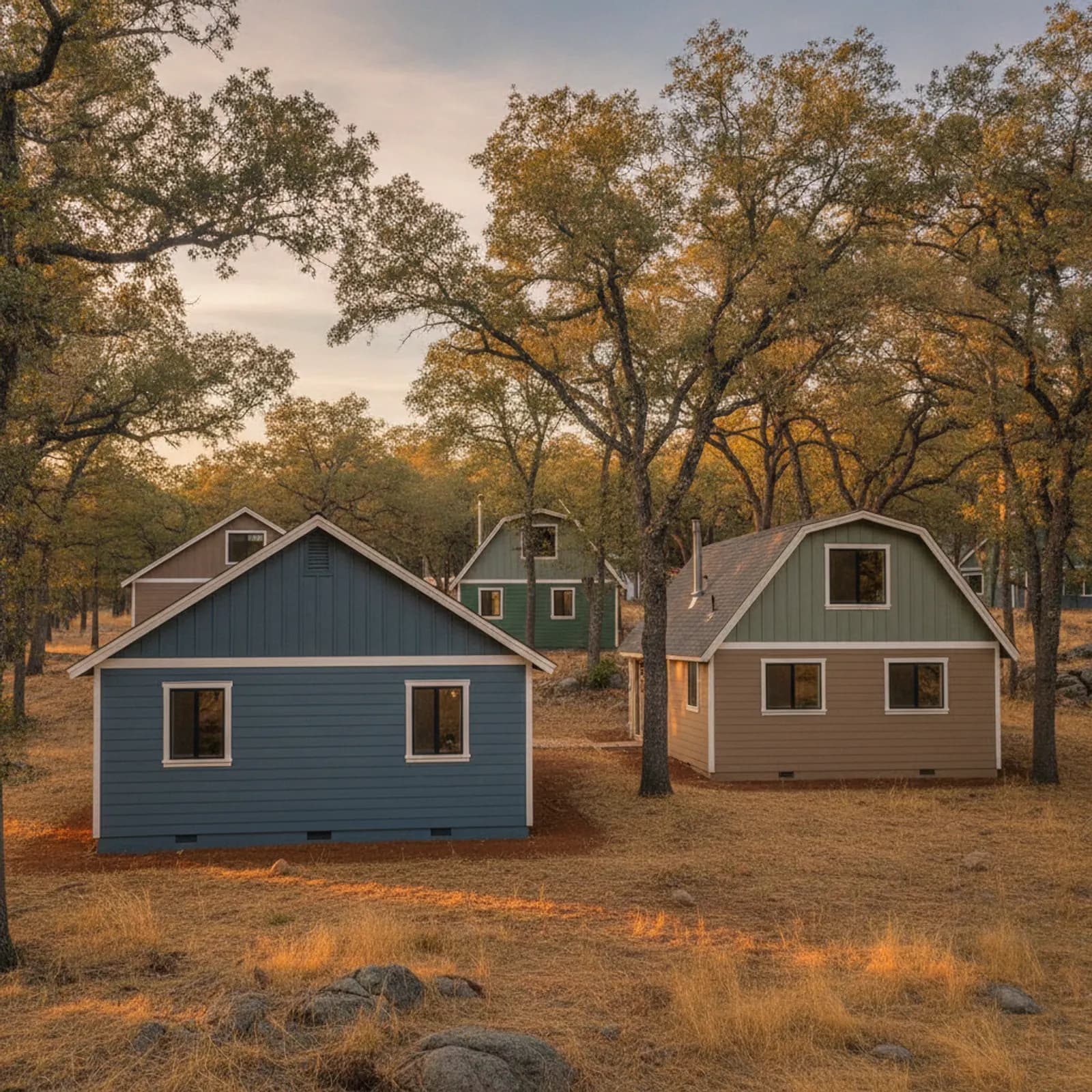
Fiber Cement Siding in Pine Grove
Pine Grove sits deep in the timber along Highway 88, and its wildfire exposure is rated extreme — the defining exterior reality here, not one factor among several.
A wall in this community is a defensive element before it is a finish, and the specification should be built in that order.
Extreme means continuous timber, and that changes the exposure
The distinction between this and the grass-exposure markets lower down the county is not one of degree. Continuous conifer and mixed timber produces sustained radiant heat and a prolonged ember load rather than a fast pass, and it can carry crown fire that grassland cannot. The 2015 Butte Fire, which burned roughly seventy thousand acres across Amador and Calaveras counties and destroyed hundreds of structures, is the local demonstration of what this terrain supports. Non-combustible cladding is a baseline in that context rather than an upgrade, because a wall that ignites during a prolonged exposure becomes part of the fire.
Fire detailing and snow detailing pull against each other
Pine Grove carries moderate snow alongside its extreme fire rating, and the two want different things from a wall. Fire hardening wants a tight envelope with every opening protected and no gaps for embers. Snow detailing wants generous clearance at grade so drifted snow does not sit against the lower courses, and it wants joints and flashings that tolerate freeze-thaw movement. Those are reconcilable but not automatically — the resolution is generally to hold the snow clearance and manage the ember risk at that transition through material choice and keeping the zone clear, rather than closing the gap. A specification that ignores one of the two will fail on the other.
Meltwater is the moisture mechanism that matters
At this elevation the moisture problem is not rain so much as snow sitting against a wall and meltwater travelling behind cladding from the roof. Snow drifted against the lower courses keeps them wet at temperatures where nothing dries, and freeze-thaw levers open any joint that admits water, fractionally wider each cycle, until it becomes a genuine entry point. Kickout flashings at every roof-to-wall junction, properly gapped butt joints and fasteners rated for high cycle counts are what address that, and they are frequently missing on houses detailed by someone working to lower-elevation practice.
Cabins, A-frames and the stock this community is built from
Much of Pine Grove is forested cabins, A-frames, mid-century mountain homes and newer custom houses on wooded acreage, and that stock has characteristic vulnerabilities: deep overhangs and open eaves that collect embers, wood decking attached directly to the building, and long unbroken elevations where thermal and moisture movement accumulate. A re-side is the practical moment to address the eaves and to assess the deck honestly, because both are frequently more consequential to the building's survival than the cladding being replaced.
Why this matters in Pine Grove
- Specified for Sierra Foothills conditions
- James Hardie fiber cement as the recommended system
- Correctly detailed weather-resistive barrier and flashing
- Installed by a crew with 20 years combined experience
Recommended systems for Pine Grove
- James Hardie fiber cement
- non-combustible fire-hardened detailing
- factory finishes
- snow- and slope-aware bottom-course detailing
Fiber Cement Siding for Pine Grove homes
The full fiber cement siding approach — materials, weather-resistive detailing, and the manufacturer standards we install to — is covered on the main service page, then specified for Pine Grove's conditions on this one.
Our Pine Grove process
- Step 1
Consultation
We listen to your goals and assess your home on site — exposure, substrate, and architecture.
- Step 2
Design & Proposal
A clear written proposal with the right system specified for your climate and a transparent scope.
- Step 3
Expert Installation
Trained crews install to manufacturer best practices with careful weather-management detailing.
- Step 4
Walkthrough & Support
A final walkthrough, full cleanup, and a clear written record of the scope completed — work we stand behind.
FAQ
Fiber Cement Siding in Pine Grove — FAQ
Different in kind, not degree. Continuous conifer and mixed timber produces sustained radiant heat and a prolonged ember load rather than a fast pass, and can carry crown fire that grassland cannot. The 2015 Butte Fire — roughly seventy thousand acres across Amador and Calaveras, hundreds of structures lost — is the local demonstration.
They genuinely pull against each other. Fire hardening wants a tight envelope with no gaps for embers; snow detailing wants generous clearance at grade so drifted snow does not sit against the lower courses. The usual resolution is to hold the snow clearance and manage ember risk at that transition through material choice and keeping the zone clear — a specification ignoring either will fail on the other.
Meltwater and drifted snow rather than rain. Snow against the lower courses keeps them wet at temperatures where nothing dries, and freeze-thaw levers open any joint admitting water, a fraction wider each cycle. Kickout flashings at every roof-to-wall junction, properly gapped joints and fasteners rated for high cycle counts are what address it.
The eaves and the deck, and often before the walls. Deep overhangs and open eaves collect embers, and wood decking attached directly to the building is frequently the single largest vulnerability on this stock. Both are commonly more consequential to whether the building survives than the cladding being replaced.
Keep Exploring
More for Pine Grove homeowners
More in Pine Grove
Other exterior services in Pine Grove
Nearby Service Areas
Fiber Cement Siding near Pine Grove
Helpful Exterior Guides