
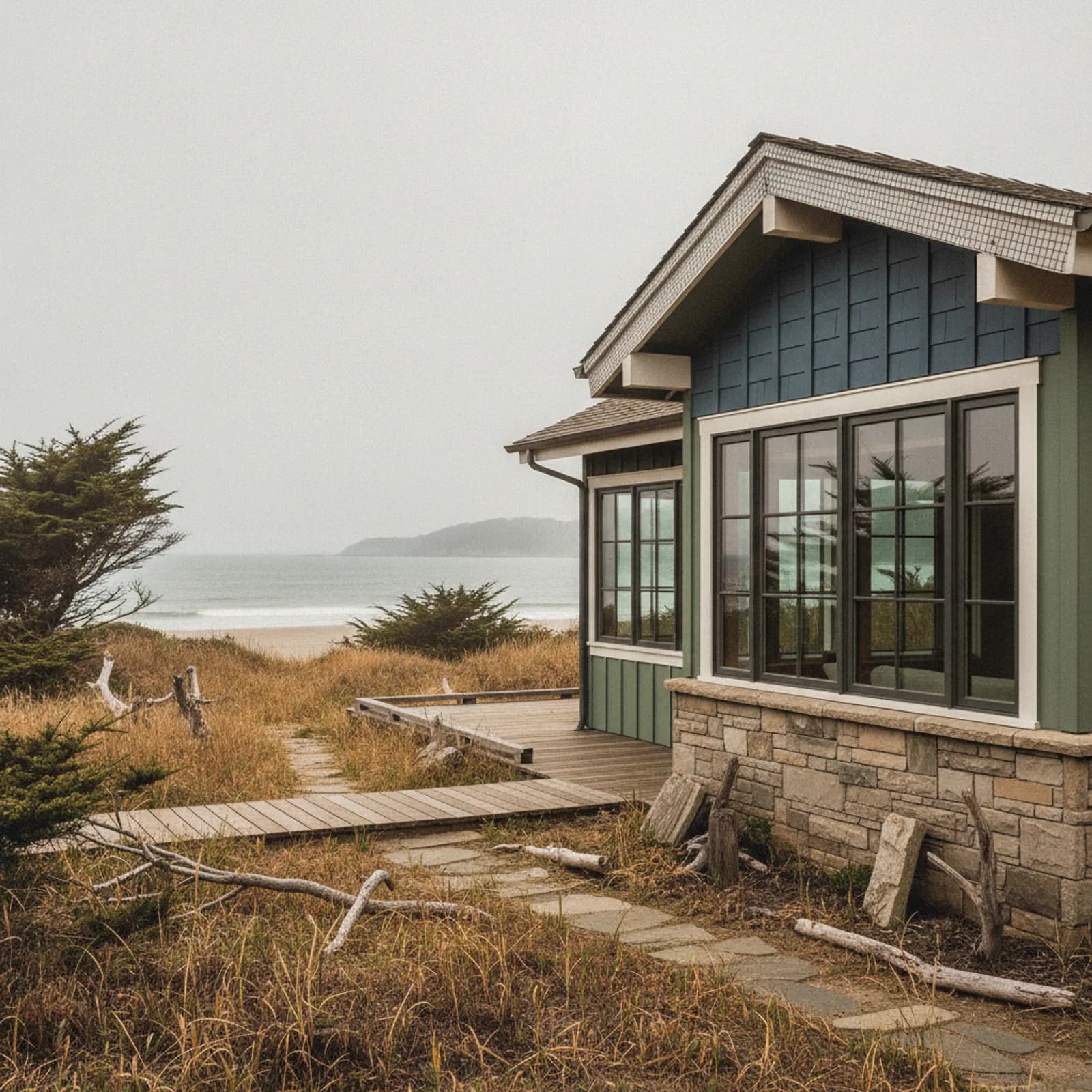
Fire-Resistant Siding in Stinson Beach
Fire-resistant siding in Stinson Beach has to be honest about geography, because the town has two very different fire pictures within walking distance of each other. The flat sandspit and the Seadrift lots out on the lagoon face little direct wildland threat — open beach and water surround them. But the homes climbing the steep flank of Mount Tamalpais sit against brush and forest, in a moderate wildfire-exposure setting where the wildland edge is genuinely close.
So we scope fire-resistant cladding here lot by lot: measured, real hardening on the hillside elevations that face Mt. Tam, ember-and-defensible-space basics for the beach-flat homes, and — on every Stinson project — corrosion-resistant detailing, because the same non-combustible board still has to survive open-Pacific salt air.
Two fire realities in one small town
Most cities we serve have a single fire profile; Stinson has two. Out on the sandspit and at Seadrift, surrounded by sand, surf, and the lagoon, the direct wildland fire threat is low — there is simply little vegetation upwind to carry a fire to the wall. We say that plainly rather than overselling a fire upgrade those homes do not need. The hillside homes are the opposite: the steep, vegetated Mt. Tam slope rises right behind them, and a wind-driven ember run off that wildland edge is a credible event. For those lots, non-combustible Class A cladding and a hardened envelope are a sound, measured response. Matching the fire spec to the actual lot is the whole discipline here.
On the Mt. Tam slope, the wall is a system not a face
For the hillside houses, choosing a Class A cladding is only the start, because embers do not respect the wall plane. Non-combustible board paired with open eaves, unscreened vents, or a wood-to-grade transition leaves the obvious gaps that ember intrusion exploits. So on a slope lot near the wildland edge we treat eaves, soffit and foundation vents, and the ground-contact zone as part of the same scope — closing the underside of eaves, fitting ember-resistant venting, and detailing the spots where siding meets soffit, deck ledger, and foundation as ignition points rather than trim. On the older cottages climbing the hill those transitions were often left vented or loosely flashed, so a re-side is the moment to correct them and make the finished exterior read as one continuous defensive layer.
Defensible space and ember basics for the beach flats
For the sandspit and Seadrift homes where direct wildland threat is low, the honest advice is not a heavy fire-rated re-side but the inexpensive basics that matter even in lower-exposure settings. Embers travel, and a non-combustible cladding still adds value as a wall that will not contribute fuel if a neighboring structure ignites in a dense beach-cottage cluster. We focus those projects on the cheap, high-value moves: keeping combustible debris off decks and out of the zone right against the wall, screening vents, and choosing a Class A board so the house is not the weak link in a tightly packed row. That is a measured, proportionate position — we do not dress up a flat beach lot as if it sat in the canyons of Mill Valley.
Fire-rated and salt-proof have to be the same wall
What makes Stinson different from a dry inland fire town is that the fire-resistant assembly still has to survive extreme oceanfront salt and marine damp. A Class A non-combustible surface resists fire, but it is not the corrosion-control or moisture-control layer, and a fire upgrade that ignores the salt simply trades a wildfire risk for a rust-and-rot one. So even the hardened hillside walls get marine-grade fasteners, corrosion-rated flashing, and a drained, back-ventilated rainscreen so the assembly can dry between fog cycles. The goal on a Stinson home is a single wall that does both jobs at once — sheds embers on the outside and manages open-Pacific salt moisture behind it — rather than a fire spec that quietly corrodes its way to a short life on the coast.
Why this matters in Stinson Beach
- Specified for North Bay conditions
- James Hardie as the recommended system
- Correctly detailed weather-resistive barrier and flashing
- Installed by a crew with 20 years combined experience
Recommended systems for Stinson Beach
- James Hardie
- fiber cement
Fire-Resistant Siding for Stinson Beach homes
The full fire-resistant siding approach — materials, weather-resistive detailing, and the manufacturer standards we install to — is covered on the main service page, then specified for Stinson Beach's conditions on this one.
Our Stinson Beach process
- Step 1
Consultation
We listen to your goals and assess your home on site — exposure, substrate, and architecture.
- Step 2
Design & Proposal
A clear written proposal with the right system specified for your climate and a transparent scope.
- Step 3
Expert Installation
Trained crews install to manufacturer best practices with careful weather-management detailing.
- Step 4
Walkthrough & Support
A final walkthrough, full cleanup, and a clear written record of the scope completed — work we stand behind.
FAQ
Fire-Resistant Siding in Stinson Beach — FAQ
It depends on the lot. Flat sandspit and Seadrift homes face low direct wildland threat, so we recommend ember and defensible-space basics. Hillside homes against the Mt. Tam slope carry moderate exposure where Class A cladding makes real sense.
Moderate, and concentrated on the steep, vegetated Mount Tamalpais flank above town. We characterize each lot honestly rather than applying a blanket high-risk label across the whole community.
Only if it is detailed for the coast. We pair Class A board with marine-grade fasteners, corrosion-rated flashing, and a drying rainscreen so the fire upgrade does not rust or rot in the open-Pacific exposure.
No. Embers find eaves, vents, and the wall-to-ground transition. On slope lots we harden those alongside the cladding so the whole envelope reads as one defensive layer.
Keep Exploring
More for Stinson Beach homeowners
Nearby Service Areas
Fire-Resistant Siding near Stinson Beach
Helpful Exterior Guides