
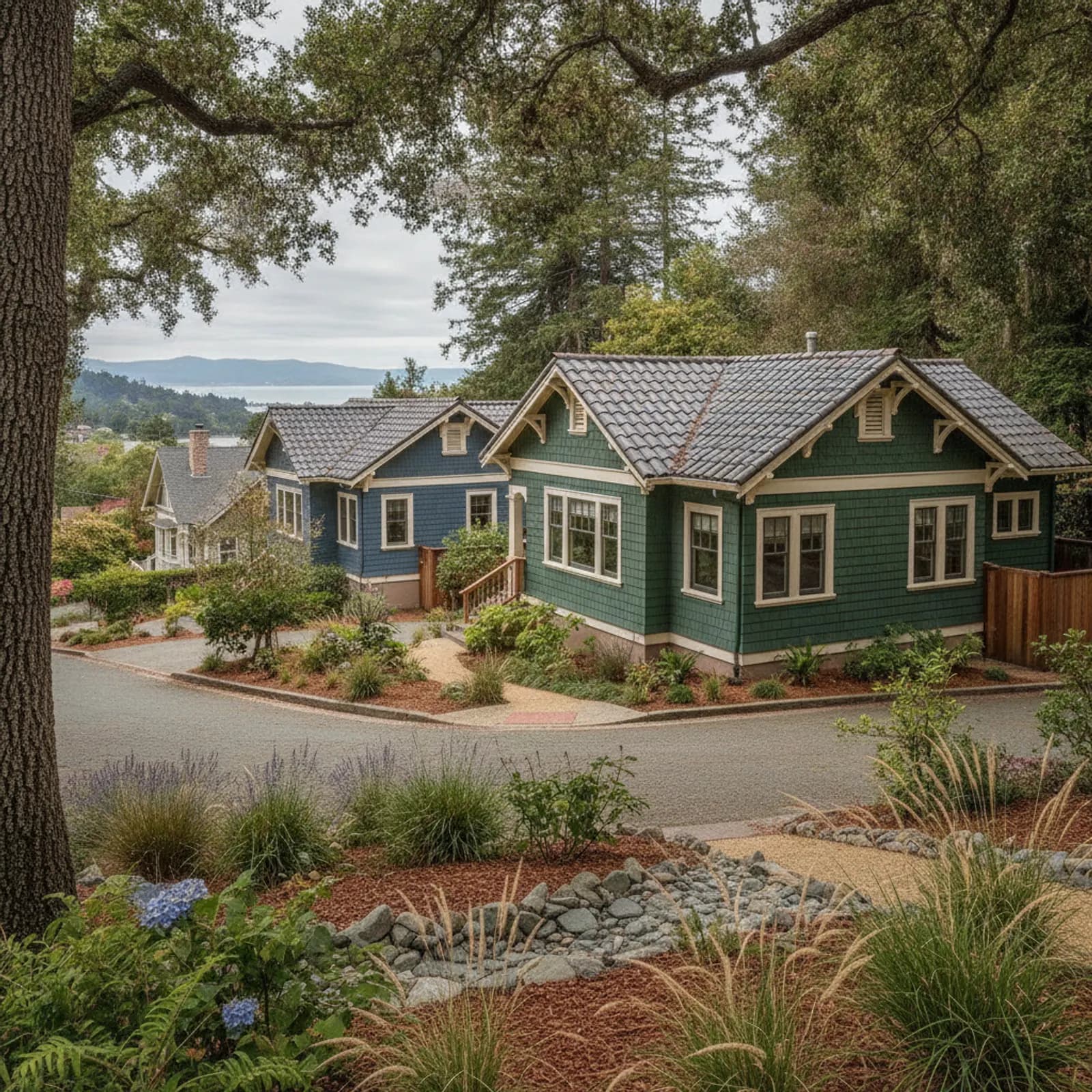
Fire-Resistant Siding in Fairfax
Fairfax is one of the Marin towns where fire-resistant siding is not a precaution but a genuine response to real exposure. Much of the town climbs into steep, brush-and-forest slopes with continuous fuel and narrow, constrained evacuation routes — true wildland-urban-interface terrain. Many parcels fall in mapped fire-hazard zones where California's WUI building standard, the WUI code, governs exterior materials.
On these wooded canyon lots, hardening the exterior is about defending the most likely ignition path — wind-driven embers — not just meeting a code line, and the same details that resist fire also help the cladding survive the canyon's damp.
Genuine WUI exposure, stated plainly
We will not soft-pedal this: the slopes around Fairfax carry real wildfire risk. Forested, brushy hillsides feed fast-moving fire, the canyon's narrow roads complicate evacuation, and homes on the upper streets and ridge edges face direct ember and radiant exposure. That is a different reality than a flat valley-floor town, and it changes the baseline. On these parcels a non-combustible, WUI-code-conscious exterior is the responsible starting point, not an upsell.
Embers are the real threat
Most homes lost in wildfires ignite from wind-blown embers landing on or against the building, often well ahead of any flame front — and in Fairfax those embers ride the canyon and ridge winds straight into town. So hardening is about denying embers a foothold. We specify Class A non-combustible cladding and close the gaps embers exploit: ember-resistant vents, boxed and protected eaves and soffits, the deck-to-wall junction, and the ground-to-siding base where embers pile against the wall. A house with hardened field cladding but an open attic vent or a combustible fence running right up to the wall still has an ember door open, so we look at the whole path embers take, not just the obvious siding face.
The WUI code and the whole assembly
Where a Fairfax parcel sits in a designated fire-hazard zone, the WUI code sets requirements for exterior walls, eaves, vents, and adjacent decks — and siding alone does not satisfy it. We treat the exterior as a system so the cladding, trim, soffits, vents, and transitions all meet the standard together. A single hardened weak point — an unprotected vent or a combustible deck ledger against the wall — undoes an otherwise compliant wall, which is why we scope the full envelope, not just the field of siding.
Defensible space at the wall
Hardened siding works alongside the zero-to-five-foot defensible-space zone right at the foundation, and in damp Fairfax that zone does double duty. Keeping combustible mulch, woodpiles, and dense planting off the wall base both starves embers and stops moisture from wicking into the cladding — so the fire detail and the canyon's rot detail reinforce each other. We coordinate the base clearance and noncombustible ground transition so the same five feet protects the home from ember and from damp at once.
Why this matters in Fairfax
- Specified for North Bay conditions
- Class A non-combustible fiber cement as the recommended system
- Correctly detailed weather-resistive barrier and flashing
- Installed by a crew with 20 years combined experience
Recommended systems for Fairfax
- Class A non-combustible fiber cement
- James Hardie
- rigorous drainage-plane detailing
- fire-hardened eave and vent detailing
Fire-Resistant Siding for Fairfax homes
The full fire-resistant siding approach — materials, weather-resistive detailing, and the manufacturer standards we install to — is covered on the main service page, then specified for Fairfax's conditions on this one.
Our Fairfax process
- Step 1
Consultation
We listen to your goals and assess your home on site — exposure, substrate, and architecture.
- Step 2
Design & Proposal
A clear written proposal with the right system specified for your climate and a transparent scope.
- Step 3
Expert Installation
Trained crews install to manufacturer best practices with careful weather-management detailing.
- Step 4
Walkthrough & Support
A final walkthrough, full cleanup, and a clear written record of the scope completed — work we stand behind.
FAQ
Fire-Resistant Siding in Fairfax — FAQ
Yes — much of it backs onto steep forested and brushy slopes with continuous fuel and constrained evacuation, genuine WUI terrain, and many parcels fall in mapped fire-hazard zones where the WUI code applies.
Wind-driven embers riding canyon and ridge winds, which ignite homes at vents, eaves, deck junctions, and the wall base far more often than a direct flame front does.
No — the WUI code covers walls, eaves, vents, and adjacent decks together, so a single unprotected vent or combustible deck-to-wall junction can undo a compliant wall. We harden the whole exterior assembly.
They reinforce each other — keeping the zero-to-five-foot base clear of fuel and using a non-combustible ground transition both denies embers a foothold and stops damp from wicking into the cladding.
Keep Exploring
More for Fairfax homeowners
More in Fairfax
Other exterior services in Fairfax
Nearby Service Areas
Fire-Resistant Siding near Fairfax
Helpful Exterior Guides