
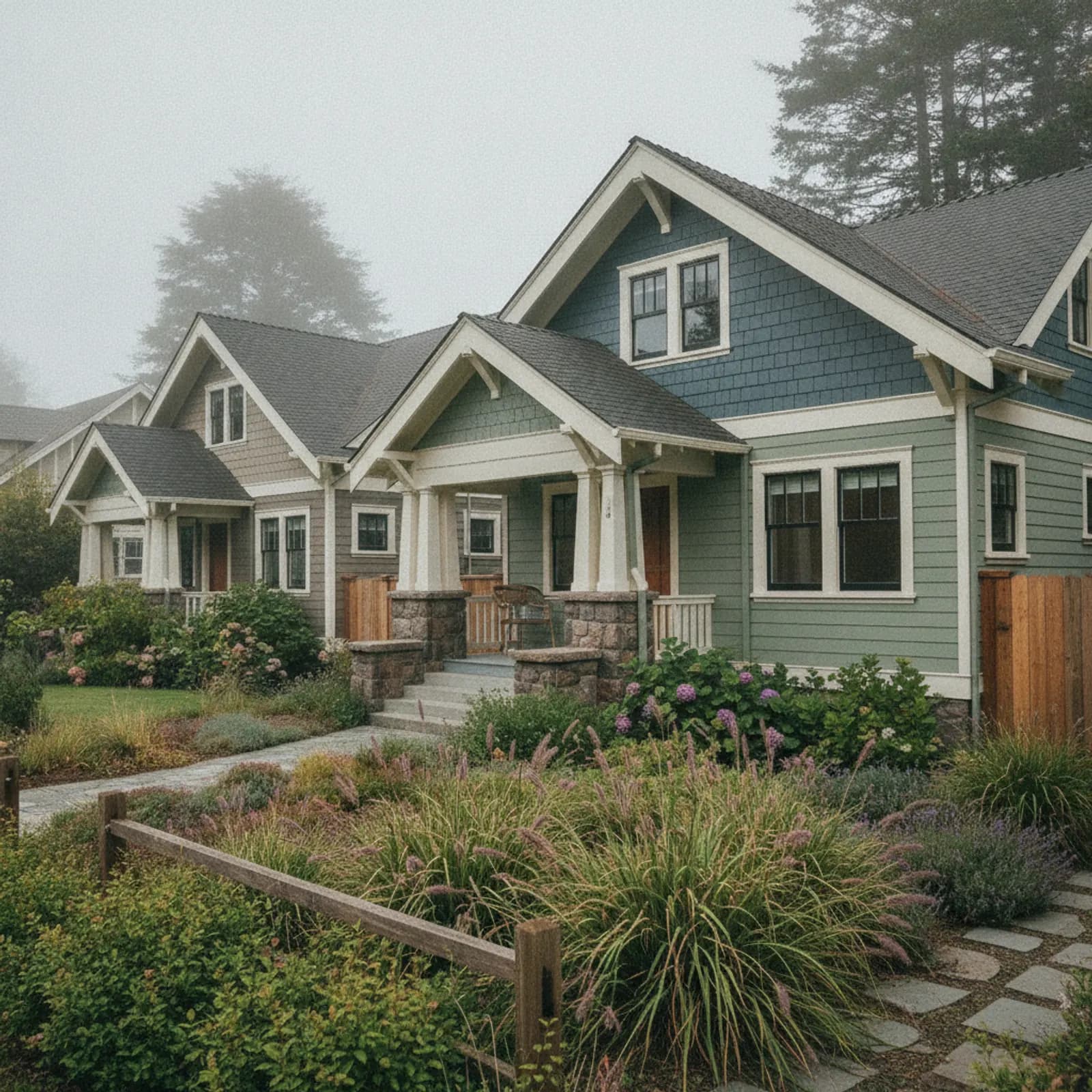
Fiber Cement Siding in Fairfax
Fiber cement is the material that answers Fairfax's two competing problems in one product. The canyon's trapped fog and creekside damp demand cladding that tolerates long wet spells without rotting or swelling, and the wooded ridges above town demand something that will not feed an ember-driven fire. Wood and most engineered-wood products struggle on one front or the other; a properly detailed fiber-cement assembly handles both.
On a Fairfax home the board is only half the answer — the drainage detailing behind it is what makes fiber cement actually outlast the canyon's moisture, and the right installation is what lets one material defend against both the wet and the fire that define this town.
Why the material fits the canyon
Fiber cement does not rot, will not become termite or carpenter-ant food, and stays dimensionally stable through the soak-and-dry cycling that defines a shaded Fairfax canyon wall. Old wood cladding here cups and splits as it absorbs fog and creekside damp, opening joints that let water sit against the sheathing. A cement-composite board rides those swings without moving, so the flashing and sealant lines you install stay where you put them — which is exactly what a wall that stays wet half the year needs.
The rainscreen makes it work here
Fiber cement is only as good as the gap behind it in a town this damp. We install it over a continuous water-resistive barrier with a vented rainscreen cavity so air moves behind the board and the back face can dry between fog cycles. Without that gap, even non-rotting cladding traps moisture against the sheathing on Fairfax's slow-drying north and downhill walls. The cavity also breaks capillary contact, so wind-driven canyon rain that gets past the face has a drained path out rather than a pool to sit in.
Non-combustible value above the canyon floor
On Fairfax's fire-exposed slopes the material choice is not only about moisture. Fiber cement is non-combustible and carries a Class A rating as installed, so it does not ignite from radiant heat or contribute fuel when embers land against the wall — the dominant ignition path in the wooded terrain around town. That lets a single material satisfy both the canyon's wet-rot problem and the ridge's wildfire problem, instead of compromising one to fix the other. For a home that backs onto brush or sits on the upper canyon streets, that dual duty is the practical reason fiber cement wins out over wood and engineered-wood lookalikes that may shrug off damp but still add fuel to a wall under ember attack.
Detailing for wet shade
The failures we replace in Fairfax are almost never the board itself — they are the transitions. Kickout flashing where a roofline dumps onto a wall, shingle-lapped flashing at window heads and penetrations, and generous base clearance off damp soil, leaf litter, and planting beds all matter more in a shaded canyon than they would on a sunny flat lot that dries quickly. We sequence those details so water is shed by laps, not held by caulk, because in this climate any caulk-dependent joint eventually loses and the moisture finds the sheathing.
Why this matters in Fairfax
- Specified for North Bay conditions
- Class A non-combustible fiber cement as the recommended system
- Correctly detailed weather-resistive barrier and flashing
- Installed by a crew with 20 years combined experience
Recommended systems for Fairfax
- Class A non-combustible fiber cement
- James Hardie
- rigorous drainage-plane detailing
- fire-hardened eave and vent detailing
Fiber Cement Siding for Fairfax homes
The full fiber cement siding approach — materials, weather-resistive detailing, and the manufacturer standards we install to — is covered on the main service page, then specified for Fairfax's conditions on this one.
Our Fairfax process
- Step 1
Consultation
We listen to your goals and assess your home on site — exposure, substrate, and architecture.
- Step 2
Design & Proposal
A clear written proposal with the right system specified for your climate and a transparent scope.
- Step 3
Expert Installation
Trained crews install to manufacturer best practices with careful weather-management detailing.
- Step 4
Walkthrough & Support
A final walkthrough, full cleanup, and a clear written record of the scope completed — work we stand behind.
FAQ
Fiber Cement Siding in Fairfax — FAQ
It tolerates the canyon's long wet-and-dry cycling without rotting or moving, and it is non-combustible for the wooded fire slopes above town — answering both of Fairfax's controlling stressors in one product.
Not if it is installed over a vented rainscreen and continuous WRB. The board itself does not rot, and the air gap lets the back face dry between fog cycles, which is essential on Fairfax's slow-drying elevations.
Yes — it is non-combustible and achieves a Class A rating as installed, so it resists radiant heat and ember contact, the main ignition paths in the brushy terrain around Fairfax.
Considerably — wood cups, splits, and rots in the canopy-shaded damp, while cement composite stays stable so flashing and joints keep doing their job through the wet season.
Keep Exploring
More for Fairfax homeowners
More in Fairfax
Other exterior services in Fairfax
Nearby Service Areas
Fiber Cement Siding near Fairfax
Helpful Exterior Guides