
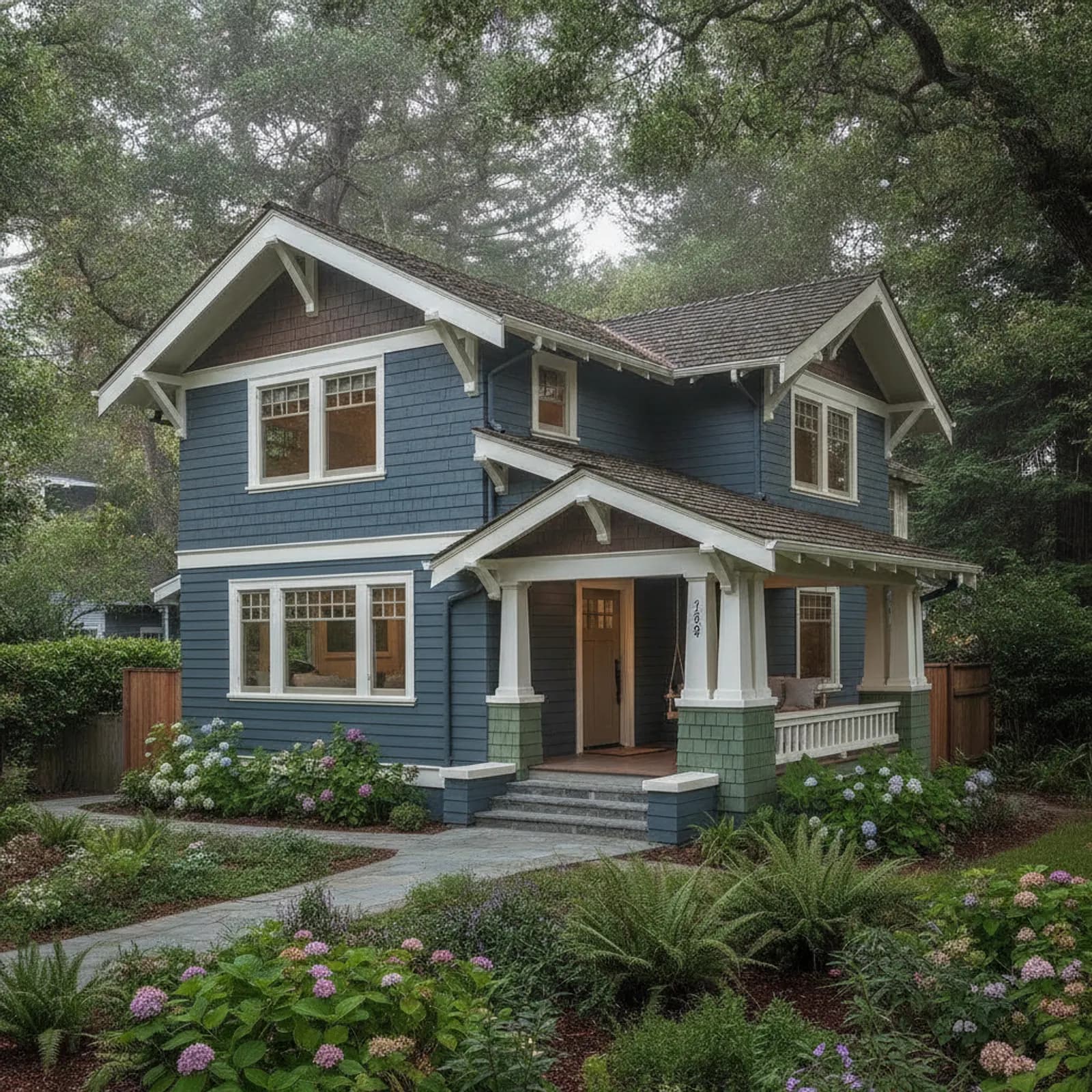
Exterior renovation in Fairfax
Fairfax is the last town before the open ridgelines and forest of upper Ross Valley, and that setting defines almost every exterior decision here. Homes nestle into densely wooded canyons and steep hillsides where tree canopy crowds right up to the walls, and where Fairfax Creek and its tributaries keep the lower neighborhoods shaded and slow to dry. For a homeowner replacing aging cladding, the conversation in Fairfax is rarely about looks alone — it is about a wall that has to resist ignition from the surrounding woodland while still shedding the moisture that the canyon traps against it.
Two stressors, one assembly
What makes Fairfax distinct from the flatter, drier towns down-valley is that fire exposure and moisture exposure are both elevated, and they pull the spec in different directions unless they are engineered together. The wooded-interface parcels demand a non-combustible, hardened wall; the same canyon canopy that raises the fire fuel load also keeps north faces and creekside walls damp for months. A correct Fairfax exterior is therefore both fire-aware and rigorously drained, planned as one system from the substrate out rather than treated as two competing afterthoughts.
Considering an exterior project in Fairfax?
Fairfax housing and architecture
Fairfax's housing stock is among the most eclectic in Marin: early-1900s summer cottages and bungalows that grew into year-round homes, creekside cabins along the lower flats, and a sprawl of custom, owner-built, and mid-century houses climbing the canyon walls toward Cascade, Deer Park, and the open-space boundary. Much of it still wears original wood lap, board-and-batten, shingle, or T1-11 that was never specified for both a woodland fire interface and a damp canyon. Re-cladding these homes is where the biggest gain lives — a chance to harden the wall and stop the moisture cycle while keeping the relaxed, woodsy character that defines the town.
Fairfax's canyon-and-fog climate
Fairfax sits at the inland edge of the bay's marine reach, so it runs cooler and damper than its tucked-away valley position suggests. Bay fog and the canyon's own shade keep shaded walls, creekside elevations, and north faces wet long into the day, while the warm, dry late-summer and fall windows dry the surrounding hills into prime fire fuel. The wet season makes a continuous, drying-capable drainage plane a genuine performance factor on the lower creekside homes, and the dry-season fire windows make non-combustible detailing the controlling concern on the wooded hillsides. The same wall has to carry both.
Hardening a Fairfax home
For Fairfax's wooded-canyon and open-space-adjacent parcels we specify Class A non-combustible fiber cement and harden the ignition-prone points — eaves, vents, and the ground-to-wall transition where leaf litter and embers collect against the foundation. Because tree canopy crowds so many Fairfax walls, ember intrusion and radiant exposure are the realistic threats, so we coordinate cladding with soffit, fascia, and vent detailing to behave as one hardened assembly. We won't overstate the risk on the few flatter creekside lots, but on the canyon walls toward the open space it is real, and combustible cladding is the wrong choice there regardless of aesthetic preference.
Recommended materials for Fairfax
Non-combustible fiber cement, including James Hardie systems, over a rigorously detailed drainage plane is the core recommendation for Fairfax, because it resolves the woodland fire exposure and the canyon moisture together with no durability trade-off. Fiber cement shrugs off the damp that rots the original wood on so many older Fairfax homes, and it holds a factory finish through the long shaded wet season. Shingle and board-and-batten profiles are available in fiber cement, so the town's woodsy character survives the upgrade. On interface parcels we align eave and vent materials to the wall's fire class so the system is hardened end to end.
What an exterior project costs in Fairfax
Fairfax pricing follows the usual drivers — overall size and stories, trim and profile complexity, substrate condition and any hidden dry rot, window integration, and the weather-management scope — plus fire-hardening scope on the wooded parcels. The town's steep canyon lots, narrow dead-end streets, and tight setbacks routinely add access, scaffolding, and material-staging cost beyond what a flat down-valley lot would carry. Older creekside cabins frequently reveal moisture-damaged substrate once the old cladding comes off. We provide a written, scoped estimate after an on-site assessment; in Fairfax the hardening and drainage line items are not where we recommend economizing.
The wooded hillsides toward the open space
The canyon walls climbing toward Cascade, Deer Park, and the surrounding open-space lands are where Fairfax's wildfire conversation is sharpest. Many of these are custom or owner-built homes on steep, view-oriented lots with forest canopy pressing in on every side, and the fuel load around them is genuine. For these parcels re-cladding is an opportunity to bring an older wood wall up to a hardened, non-combustible standard. The grades and the narrow, winding streets shape how we stage material and scaffold, which we walk and plan during the on-site scope rather than assuming.
The creekside flats and downtown cottages
Down on the lower flats along Fairfax Creek and around the small downtown, the housing shifts toward older cottages, bungalows, and converted cabins on more accessible but heavily shaded lots. Fire exposure eases here while moisture exposure rises — these are the homes where slow-drying north walls and trapped water do the most damage. The emphasis shifts toward drainage detailing, substrate repair, and profiles that respect the town's vintage streetscape, and we tailor the spec block by block rather than treating the whole town as one fire problem.
Character, market, and an honest scope
Fairfax homeowners tend to value the town's unpolished, woodsy character, and a re-side here has to upgrade performance without sterilizing that look. We document the materials and assemblies we install so owners have a clear record, which matters in a hardening-and-insurance climate, and we scope each project to the specific parcel — canyon wall or creekside flat, original cottage or later custom. In an affluent but design-conscious Marin market, a hardened, moisture-durable exterior in the right profile protects both the home and its resale appeal.
Town of Fairfax, MMWD, and Ross Valley Fire (JPA)
Working exteriors in Fairfax coordinates with a few local authorities. Fairfax is legally a Town rather than a City — the Town of Fairfax is the correct name for the local government. Electric and gas are PG&E, and Fairfax is in high-PSPS territory because the wooded canyons and adjacent open space raise the shut-off threshold. Water is supplied by the Marin Municipal Water District (MMWD), a customer-owned public agency. Fire response is the Ross Valley Fire Department — a JPA serving Fairfax alongside San Anselmo, Ross, and Sleepy Hollow — alongside Marin County Fire and CAL FIRE on wildland calls into the surrounding open space. On the permit side, the Town of Fairfax Planning and Building Department handles building permits, and the small historic downtown blocks along Broadway and Bolinas Road carry design-review expectations on visible exterior work.
HZ10 and the open-space FHSZ reality
Fairfax is in James Hardie's HZ10 climate zone despite the fog and canyon shade; installing HZ5 is a documented warranty misapplication. On the fire side, the flat downtown-adjacent blocks sit in Low FHSZ territory under California's 2025 LRA Fire Hazard Severity Zone map, while the wooded canyon and hillside neighborhoods climbing toward Cascade, Deer Park, and the surrounding Marin County Open Space District carry Moderate to Very High designations. On designated hillside parcels the 2025 California Wildland-Urban Interface Code governs the exterior wall. Chapter 7A moved into the standalone WUI Code on January 1, 2026.
Our process in Fairfax
- Step 1
Consultation
We listen to your goals and assess your home on site — exposure, substrate, and architecture.
- Step 2
Design & Proposal
A clear written proposal with the right system specified for your climate and a transparent scope.
- Step 3
Expert Installation
Trained crews install to manufacturer best practices with careful weather-management detailing.
- Step 4
Walkthrough & Support
A final walkthrough, full cleanup, and a clear written record of the scope completed — work we stand behind.
In Fairfax, a re-side done right reduces ignition risk on the wooded parcels and ends the moisture cycle on the shaded creekside homes at the same time. We design for both, and we scope every Fairfax project on site so the spec fits the actual canyon lot. Your written estimate governs the work.
FAQ
Fairfax — Common Questions
Most Fairfax homes back up to wooded canyons or open space, so wildfire exposure is real. For those parcels non-combustible cladding with hardened eave and vent detailing is strongly advised.
Yes — the canyon shade and bay fog keep creekside and north-facing walls damp for months, so we design the drainage plane and flashing rigorously alongside the fire strategy.
Class A non-combustible fiber cement, including James Hardie, over a detailed drainage plane, with fire-hardened eaves and vents for the wooded interface.
Yes. Fiber cement comes in shingle and board-and-batten profiles, so we can preserve the town's relaxed character while upgrading the material and fire performance underneath.
Canyon shade and slow-drying north walls trap moisture behind cladding that can't dry out. We lead with the drainage plane and flashing so the next exterior lasts.
They add access and staging considerations, not obstacles. We walk the steep lots and tight streets during the on-site scope and plan scaffolding and material delivery accordingly.
Home hardening can support insurability in this market. We document the materials and assemblies used, though insurers set their own criteria.
A correctly installed fiber cement system commonly performs 30+ years here while reducing ignition risk and ending the moisture cycle that fails wood walls.
Explore
Exterior Services
Helpful Exterior Guides