
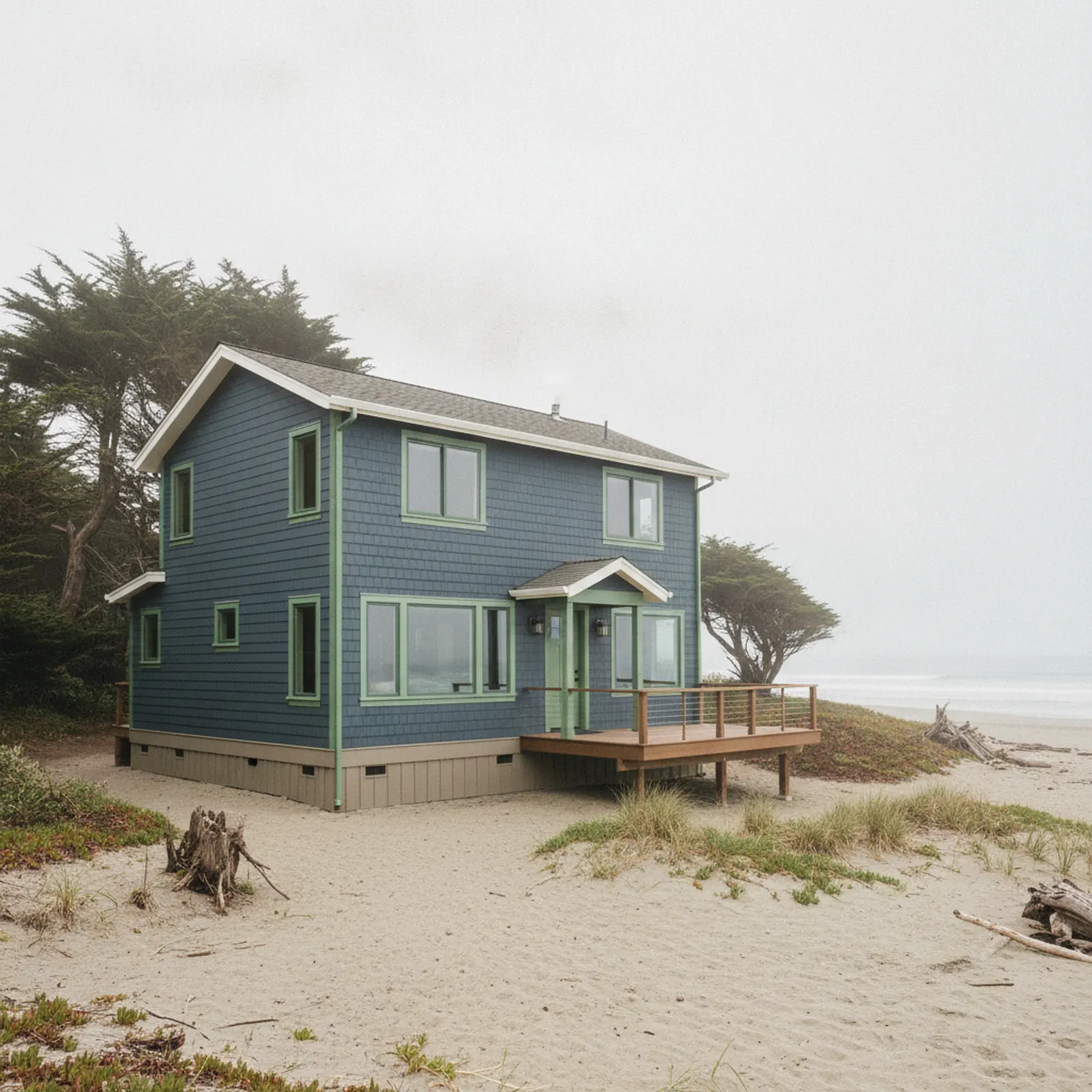
Exterior renovation in Stinson Beach
Stinson Beach is an oceanfront village strung along a sandbar and dune at the foot of Mount Tamalpais, where the Pacific meets the western base of the mountain. Its homes are beach houses in the truest sense — weathered shingle cottages near the public beach, the gated contemporary homes of the Seadrift sandspit, elevated dune-front houses, and a band of homes climbing the steep Bolinas-Stinson slope behind town. Sitting directly in the path of ocean salt spray and prevailing onshore wind, Stinson Beach subjects exteriors to as harsh a coastal environment as exists in Marin, and re-siding here is an exercise in serious salt and moisture engineering.
Why Stinson Beach siding wears the way it does
Nothing matters more in Stinson Beach than salt. With open ocean and no sheltering bay in front of it, the village takes direct salt spray, blowing sand, and persistent onshore wind that drive salt aerosol into every joint, fastener, and finish — at the oceanfront and on the Seadrift sandspit this is about as severe a residential exposure as exists in Northern California. Ordinary fasteners corrode fast, drying is slow under marine fog, and weathered cladding routinely hides dry rot and rusted hardware. Sierra Siding's response is total: James Hardie fiber cement with a factory finish, corrosion-resistant fasteners and coastal-grade flashings throughout, and a relentless drainage plane built for continuous salt loading. We generally steer away from engineered wood at the oceanfront because the loading is too aggressive, and on the Bolinas-Stinson slope behind town, where Mt Tam's brush cures to fuel, the system is non-combustible and fire-aware as well.
Considering an exterior project in Stinson Beach?
Stinson Beach housing and architecture
The village's architecture runs from informal, well-weathered shingle and board beach cottages to the crisp modern homes of Seadrift, with elevated dune houses and hillside homes filling out the range. The casual beach-cottage stock rewards simple lap or shingle-look profiles and a relaxed, salt-faded palette that fits the laid-back coastal setting, while the Seadrift contemporaries want clean lines and flush detailing that hold their modern geometry. Across all of it the priority is cladding that wears gracefully in salt and sun-bleached light rather than ornament. A formal, fussy trim package would feel out of place on this beach; honesty and durability are the design language here.
Built for Stinson Beach's extreme salt-air exposure
Nothing matters more in Stinson Beach than salt. The village sits on open ocean with no sheltering bay between it and the Pacific, so direct salt spray, blowing sand, and persistent onshore wind drive salt aerosol into every joint, fastener, and finish on the building. Coastal exposure here is extreme — at the oceanfront and on Seadrift it is about as severe as a residential setting gets in Northern California. Drying is slow under marine fog, and ordinary fasteners corrode quickly. The spec response is total: corrosion-resistant fasteners and flashings throughout, a relentless drainage plane, and finishes chosen specifically to survive continuous salt loading.
Wildfire exposure in Stinson Beach
Stinson Beach's oceanfront homes may be soaked in salt, but the village climbs into the steep, brush-and-grass-covered slopes of Mount Tamalpais behind it, and that puts wildfire on the table. Those Mt Tam slopes cure to heavy fuel in dry, offshore-wind conditions, and the single coastal access roads make this a serious-consequence WUI setting for the hillside and back-of-town homes. Exposure sits in the moderate range overall — low at the sand, more pointed on the slope — which argues for non-combustible cladding and hardened eave, vent, and ground detailing as a prudent measure, particularly for homes against the mountain.
Recommended materials for Stinson Beach
James Hardie fiber cement with a factory finish, installed with corrosion-resistant fasteners and coastal-grade flashings, is the clear recommendation for Stinson Beach. It is non-combustible for the Mt Tam slope exposure and stands up to relentless salt and damp where wood and field paint fail fast, while its profiles suit both the casual beach cottages and the Seadrift moderns. We generally steer away from engineered wood at the oceanfront here because the salt and moisture loading is simply too aggressive; the right system in Stinson Beach is a fully non-combustible, salt-hardened fiber cement assembly detailed for continuous marine attack.
What an exterior project costs in Stinson Beach
Stinson Beach pricing reflects its severe environment and difficult access. Salt and damp routinely leave dry rot and corroded fasteners hidden behind weathered cladding, so substrate surprises at demolition are common and the contingency stays visible. Coastal-grade flashings and fasteners cost more than standard hardware, and the depth of salt and moisture detailing is greater than anywhere inland. Logistics matter too — the village is reached only over the winding coast highway, and tight beach and Seadrift lots complicate staging. Elevated dune homes and hillside grades add their own access challenges. We provide a written, scoped estimate after an on-site assessment.
Seadrift and the oceanfront
The Seadrift sandspit and the homes directly on the beach take the most punishing exposure in town — full ocean spray, blowing sand, and wind with nothing in front of them. These are the projects where coastal detailing is non-negotiable: every fastener, flashing, and joint has to be specified for salt service, and finishes have to be chosen to survive continuous wetting and salt loading. The gated, lower-density Seadrift setting and tight oceanfront lots also shape staging and material handling. This is the heart of why Stinson Beach is a specialized re-side market.
The Mt Tam hillside and back of town
Homes climbing the Bolinas-Stinson slope behind the village live a split reality: still salt-exposed, but also pressed against the brush and grass of Mount Tamalpais. They drain and dry somewhat better than the sand-level houses, yet carry the area's real fire consideration along with steep-access challenges for staging and equipment. Tree and brush cover shades elevations unevenly, so we read each hillside home's actual exposure on site and combine coastal detailing with non-combustible, fire-aware cladding choices appropriate to the slope.
Access, weather windows, and resale
Stinson Beach is reached only over winding coastal roads, and marine fog limits good finishing days, so scheduling has to respect both logistics and weather windows. On value, oceanfront and Seadrift homes are among the most coveted and scarce real estate in Marin, and buyers here are acutely aware of how brutal the salt environment is on anything not built for it. A genuinely coastal-hardened, fire-aware exterior is a meaningful selling point precisely because so much beach housing is fighting a losing battle with the elements.
Stinson Beach is unincorporated: county permits, Stinson Beach Water, and Coastal Commission
Stinson Beach is not a city. It is an unincorporated community — a Census-Designated Place — governed by Marin County rather than a municipal government of its own. Building permits go through the Marin County Community Development Agency in San Rafael, and coastal parcels additionally fall under California Coastal Commission oversight for scope that alters the building envelope or triggers a coastal-development permit — a real consideration on any substantive re-side within the coastal zone. Electric and gas are PG&E, and Stinson Beach is squarely in high-PSPS territory, where PG&E's Public Safety Power Shutoffs during dry offshore-wind events can affect scheduling. Water is supplied by the Stinson Beach County Water District, an independent customer-owned district serving the village. Fire response is the Stinson Beach Fire Protection District, and Marin County Fire Department along with CAL FIRE cover the Mt Tam slopes above town — all three agencies run defensible-space inspection homeowners on the hillside back of town should treat as routine. We flag county, coastal, utility, and fire-district items at the estimate stage rather than at the wall.
HZ10 and Stinson Beach's Mt Tam FHSZ reality
Stinson Beach is in James Hardie's HZ10 climate zone; installing HZ5 is a documented warranty misapplication. On the fire side, the sandbar and beachfront blocks sit in Low FHSZ territory or unmapped under California's 2025 LRA Fire Hazard Severity Zone map — the salt-and-moisture spec is the entire game there. The Bolinas-Stinson slope climbing behind the village toward Mount Tamalpais, and much of the surrounding SRA territory, carry Very High designations where the brush cures to fuel in offshore-wind events. On those slope parcels the 2025 California Wildland-Urban Interface Code governs the exterior wall. The code frame itself changed on January 1, 2026, when Chapter 7A was deleted from the Building Code and moved into the standalone WUI Code. We check the parcel against the current designation at scoping and match the assembly to the parcel — sand-level home, dune house, or Mt Tam slope.
Our process in Stinson Beach
- Step 1
Consultation
We listen to your goals and assess your home on site — exposure, substrate, and architecture.
- Step 2
Design & Proposal
A clear written proposal with the right system specified for your climate and a transparent scope.
- Step 3
Expert Installation
Trained crews install to manufacturer best practices with careful weather-management detailing.
- Step 4
Walkthrough & Support
A final walkthrough, full cleanup, and a clear written record of the scope completed — work we stand behind.
Stinson Beach asks for the most coastal-hardened exteriors in Marin — corrosion-resistant, salt-detailed fiber cement at the oceanfront, with non-combustible, fire-aware cladding for the Mt Tam slopes behind town. We scope every Stinson Beach project on site so the system matches the severity of the setting, and your written estimate governs the work.
FAQ
Stinson Beach — Common Questions
Non-combustible factory-finished fiber cement installed with corrosion-resistant fasteners and coastal-grade flashings. It withstands the extreme salt and moisture loading at the oceanfront while addressing the Mt Tam slope fire exposure.
The village sits on open ocean with direct salt spray, blowing sand, and constant onshore wind. Salt aerosol drives into every joint and corrodes ordinary fasteners, while fog slows drying — conditions among the harshest in Marin.
We generally advise against it at the oceanfront. The salt and moisture attack is too aggressive; a fully non-combustible, salt-hardened fiber cement assembly is the durable choice in Stinson Beach.
Yes, in the moderate range. The village climbs into the brush-and-grass slopes of Mount Tamalpais, which cure to fuel in dry offshore-wind periods, so non-combustible cladding and hardened detailing matter for hillside and back-of-town homes.
Absolutely. With nothing between them and the Pacific, these homes require salt-service fasteners and flashings throughout, a relentless drainage plane, and finishes selected to survive continuous salt and wetting.
Often, because of coastal-grade materials, the dry rot and corrosion commonly hidden behind weathered cladding, and the access and logistics of a village reached only over winding coast roads. We keep the contingency visible in a written estimate.
When feasible, yes. Integrated coastal flashing at every opening is critical in this wind-and-salt-driven environment, and doing both at once yields a far tighter, more durable exterior.
We plan around marine fog and damp, which limit good finishing days, and around the logistics of reaching Stinson Beach over the coast highway, so the work is staged for the realities of the site.
Explore
Exterior Services
Helpful Exterior Guides