
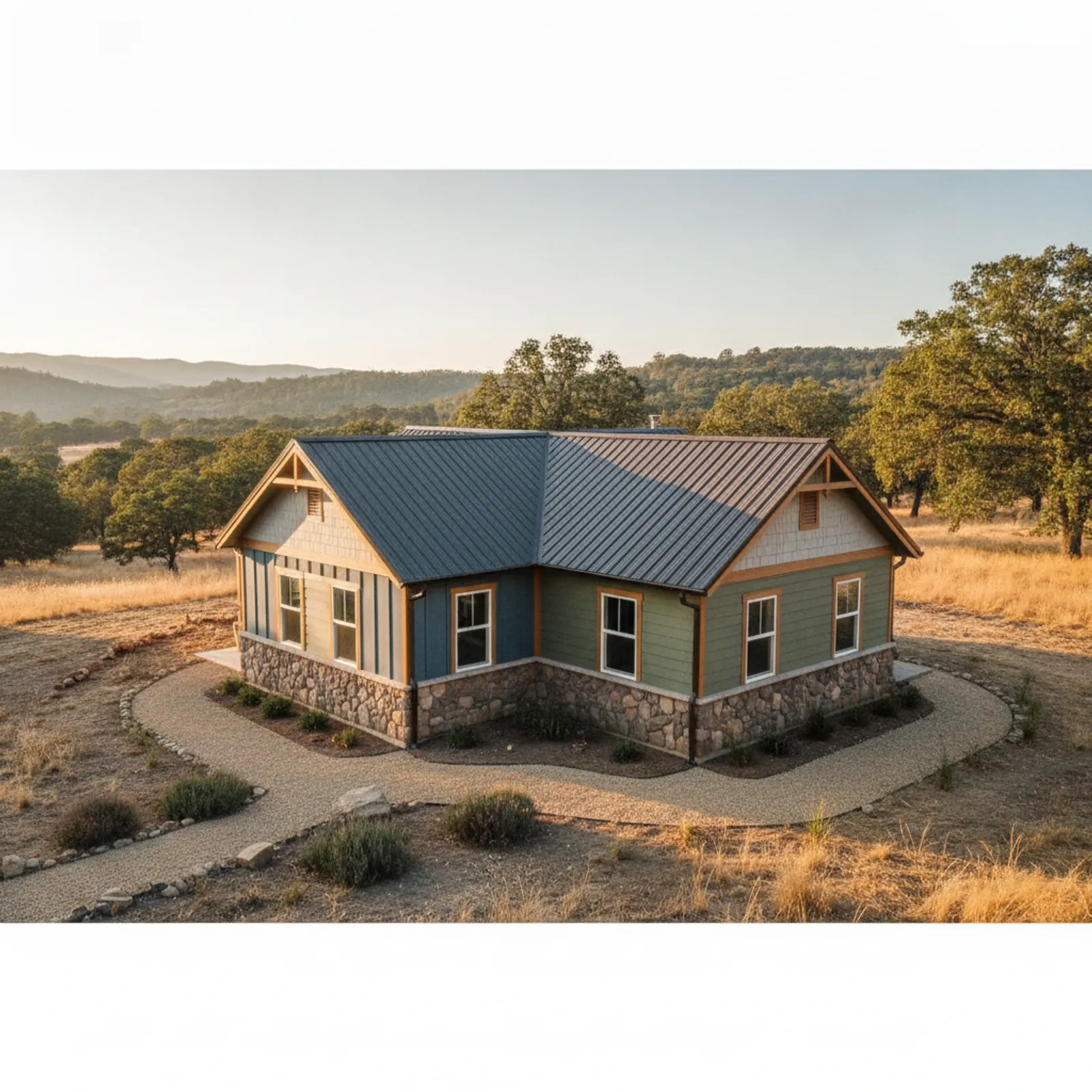
Fire-Resistant Siding in Rough and Ready
Rough and Ready sits in high-wildfire oak-woodland foothills, so fire-resistant siding here is the baseline, not an upsell. The town's historic cottages and rural-acreage homes are largely combustible wood, and on lots surrounded by oak and cured summer grass that wall face is a genuine ignition vulnerability. Replacing it with non-combustible fiber cement is a core part of hardening a home in this setting.
We are straight about the limits: non-combustible cladding takes the wall out of the fuel equation, but a hardened Rough and Ready home — often a rural property with outbuildings and a real defensible-space edge — is a whole-property project, and we scope it that way.
The wall face on a rural oak-woodland lot
Rough and Ready homes sit among oak and grass that cures dry through a long foothill summer, and a combustible wood wall in that setting is a ready ignition surface for radiant heat and lodging embers. Non-combustible fiber cement (Class A per ASTM E84) removes the wall face as fuel, which on the town's historic and rural wood-clad homes is the most impactful cladding change available. It doesn't make the home fireproof — nothing does — but it takes a major, addressable vulnerability off the table.
Rural properties: house, outbuildings, and the edge
A Rough and Ready hardening project is often a rural-property project, not just a house project. Outbuildings close to the home, wood fences and decks tying into walls, stored firewood, and the vegetation edge around the structures all matter — sometimes more than the last few feet of cladding. On acreage, defensible space and the ignition-zone around each structure are central, and we help a homeowner see the property as a system: harden the house's wall face, yes, but also address the connections and the immediate surroundings that actually carry fire to it.
Current WUI rules for a specific parcel
Where a Rough and Ready parcel is in a mapped fire severity zone, exterior requirements come from the current California WUI provisions in Title 24 Part 7 (which replaced the old Chapter 7A), and what applies depends on the jurisdiction and whether the work is new or a repair. Nevada County and the local fire authority are the authorities for a given address, and on some projects a design professional confirms it. We build the exterior side to current fire-resistant standards and document the work so the record exists for the property file.
Honest about outcomes and insurance
Hardening a Rough and Ready home is worthwhile, and we won't oversell it. We can't promise an insurance outcome — carriers set their own criteria and weigh the whole parcel and its surroundings, which on rural acreage is a lot of ground — and we won't claim a hardened wall guarantees survival, because none does. What we do is use documented fire-performance materials, harden the real weak points across the property, and give a clear record of the work. In an area under genuine insurance pressure, that honest documentation serves an owner better than a promise we can't keep.
Why this matters in Rough and Ready
- Specified for Sierra Foothills conditions
- Class A non-combustible fiber cement as the recommended system
- Correctly detailed weather-resistive barrier and flashing
- Installed by a crew with 20 years combined experience
Recommended systems for Rough and Ready
- Class A non-combustible fiber cement
- fire-aware detailing
- period-sensitive profiles
Fire-Resistant Siding for Rough and Ready homes
The full fire-resistant siding approach — materials, weather-resistive detailing, and the manufacturer standards we install to — is covered on the main service page, then specified for Rough and Ready's conditions on this one.
Our Rough and Ready process
- Step 1
Consultation
We listen to your goals and assess your home on site — exposure, substrate, and architecture.
- Step 2
Design & Proposal
A clear written proposal with the right system specified for your climate and a transparent scope.
- Step 3
Expert Installation
Trained crews install to manufacturer best practices with careful weather-management detailing.
- Step 4
Walkthrough & Support
A final walkthrough, full cleanup, and a clear written record of the scope completed — work we stand behind.
FAQ
Fire-Resistant Siding in Rough and Ready — FAQ
Effectively yes — it's high-wildfire oak-woodland foothills and the town's cottages and rural homes are largely combustible wood. Non-combustible cladding is the baseline here, a core part of hardening a home in this setting.
Often not. Outbuildings near the home, wood fences and decks into walls, stored firewood, and the vegetation edge all matter — sometimes more than the last feet of cladding. We help you see the property as a system and address what actually carries fire to the house.
We can't promise it — carriers set their own criteria and weigh the whole parcel, which on acreage is a lot of ground. We use documented fire-performance materials and give you a clear record for your file, but the premium or insurability decision is the carrier's.
It varies by property, but often the connections and immediate surroundings — ember-resistant vents, deck and fence-to-wall details, clearing firewood and vegetation from the first few feet — before or alongside cladding. We give the honest order of operations for your specific lot.
Keep Exploring
More for Rough and Ready homeowners
More in Rough and Ready
Other exterior services in Rough and Ready
Nearby Service Areas
Fire-Resistant Siding near Rough and Ready
Back to
Nevada County & Rough and Ready
Helpful Exterior Guides