Exterior renovation in Kings Beach
Kings Beach is a North Shore lake community on the California side of Lake Tahoe, just west of the Nevada state line on Highway 28, and its exteriors face a demanding combination almost no valley town shares: extreme winter snow load alongside high wildfire and ember exposure. The town's housing leans heavily toward older lakeshore cabins, 1960s and 1970s vacation A-frames and chalets, and a steady stream of mountain-modern remodels and short-term rentals. Many of those structures still wear original wood, board-and-batten, or T1-11 siding that was never specified to manage both the snow and the fire pressures the North Shore now puts on a home. A re-side here is rarely cosmetic alone; it is the chance to resolve two serious performance problems in one project.
Two controlling stressors, one assembly
What makes Kings Beach genuinely different from the foothill and valley parts of Placer County is that neither fire nor snow can be treated as the secondary concern. The home has to shed deep winter snow and survive months of freeze-thaw at lake elevation, and it has to resist wind-driven embers through a long, dry late-summer fire season. We approach a Kings Beach exterior as a single assembly that answers both: non-combustible cladding detailed for ember resistance, set on mountain-grade flashing with the clearances and wall-base details that heavy snow demands.
Considering an exterior project in Kings Beach?
Kings Beach housing and architecture
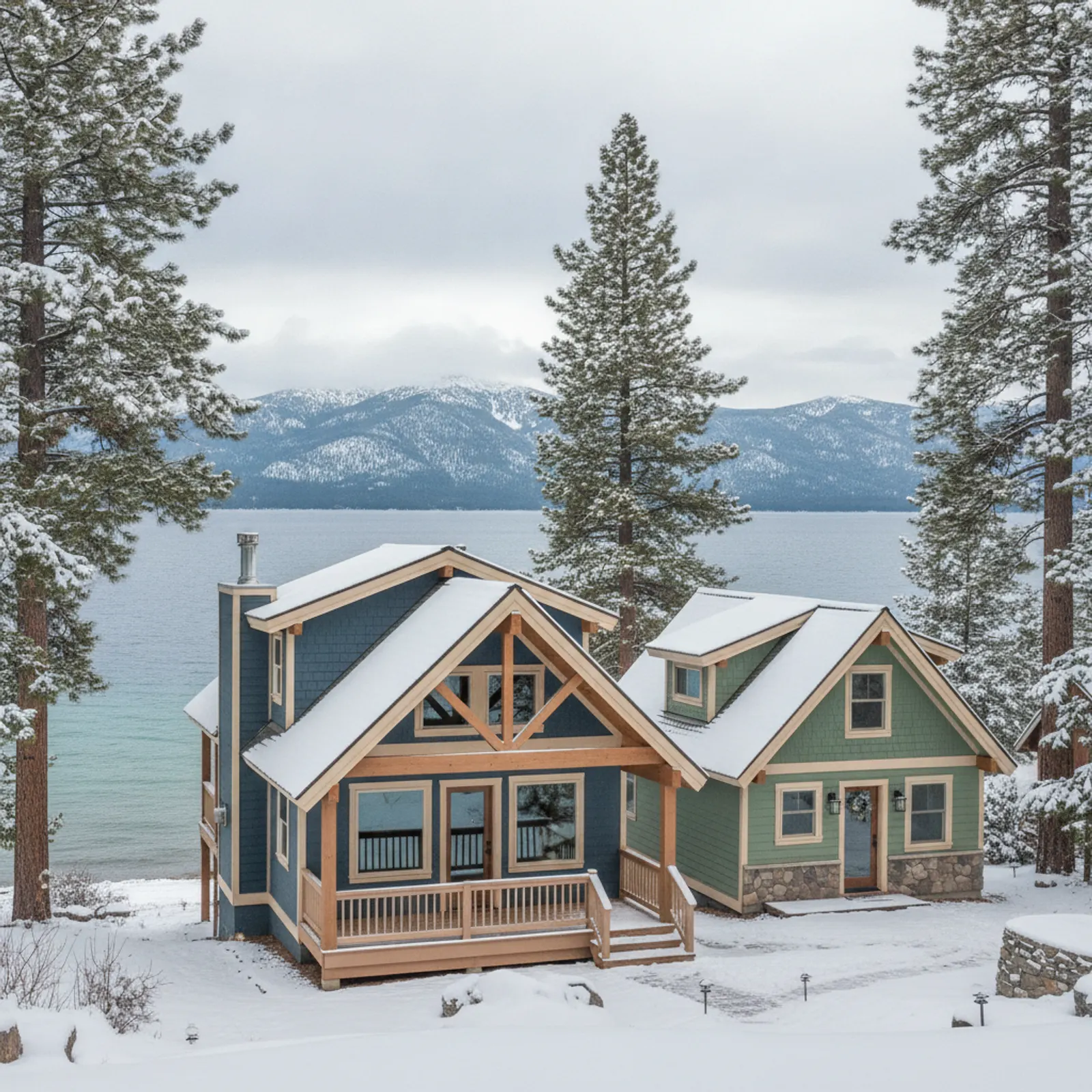
Kings Beach's stock is dominated by compact older lake cabins and 1960s-70s vacation homes — A-frames, chalets, and simple gabled cabins — many on small, tightly spaced lots a short walk from the shore, plus a growing layer of mountain-modern remodels and multi-unit short-term-rental conversions. These structures frequently carry steep roofs, deep eaves, and wood detailing chosen for mountain character rather than for today's fire and snow standards. A re-side here means respecting that cabin-and-chalet vocabulary — vertical board-and-batten, substantial trim, warm finishes — while quietly replacing the combustible, snow-worn materials behind it with a non-combustible system. The look stays mountain; the performance moves decades forward.
Kings Beach's alpine climate
At roughly lake level on the North Shore, Kings Beach takes heavy, sustained Sierra snowfall, long stretches of freeze-thaw cycling, and high-altitude UV, with cool summers that keep ambient heat a minor factor. Snow piling against walls, sliding off steep roofs, and re-freezing at the base of cladding is a relentless stressor on poorly detailed exteriors, driving water intrusion, rot, and finish failure. The spec this forces is specific: generous ground-to-wall and snow-shedding clearances, mountain-grade flashing at every penetration and transition, and a cladding material that does not swell, rot, or split through repeated freeze-thaw. Moisture management is not an afterthought at this elevation; it is half the job.
Fire-hardening a Kings Beach home
The North Shore's wildfire exposure is real and high — the Tahoe Basin's dense conifer forest comes right up to the edge of Kings Beach neighborhoods, and the town's tightly spaced older cabins mean fire can move structure-to-structure as well as from the surrounding fuel. For Kings Beach homes we specify Class A non-combustible fiber cement and harden the points embers exploit: eaves and deep mountain overhangs, vents, deck-to-wall junctions, and the ground transition where needle litter and embers collect under snow-melt edges. Re-cladding the combustible wood and T1-11 common on older cabins is among the highest-value hardening steps a North Shore owner can take, and we coordinate it with soffit, fascia, and deck detailing so the whole exterior reads as one defended assembly.
Recommended materials for Kings Beach
Class A non-combustible fiber cement — James Hardie or an equivalent board — is the clear recommendation for Kings Beach, because it answers both controlling stressors at once: it will not burn, and it does not rot, swell, or split through the lake's relentless freeze-thaw the way wood-based cladding does. We deliberately steer away from combustible engineered wood here regardless of its other merits, since the basin's fire exposure dominates. Paired with mountain-grade flashing, snow-aware clearances, and durable factory finishes, fiber cement gives a Kings Beach cabin the chalet character owners want without the seasonal failure pattern of the materials it replaces.
What drives a re-side's cost in Kings Beach
Kings Beach pricing is shaped by mountain realities more than by square footage alone. Snow-season scheduling compresses the practical build window, tightly spaced lakeshore lots constrain staging and scaffolding, and steep cabin roofs and deep eaves add labor and safety scope. Freeze-thaw and snow contact mean older cabins frequently reveal rot and water damage once cladding is stripped, expanding the substrate scope. The fire-detailing work at eaves, vents, and deck transitions, plus mountain-grade flashing throughout, are core to the assembly here, not extras. We assess all of this on site and provide a written, itemized estimate rather than a per-foot number that would ignore the conditions that actually drive a North Shore project.
Short-term rentals and the off-season window
A large share of Kings Beach homes are vacation properties and short-term rentals, which changes how a project is planned as much as how it is built. Owners want minimal disruption to peak summer and winter booking seasons, so we schedule re-sides around the shoulder windows when conditions and occupancy allow, and we sequence work to keep a property weather-tight throughout. For absentee owners we document the assembly and materials clearly, so a homeowner managing the property remotely knows exactly what was installed and why.
Lakeshore lots and tight access
Many Kings Beach cabins sit on small, closely spaced lots within a short walk of the shore, which makes staging, lift placement, and material handling a genuine planning problem rather than a formality. We walk the actual lot before committing to an approach, because the difference between a constrained near-shore parcel and an open hillside lot above town shows up directly in the schedule, the scaffolding plan, and how the project affects neighbors. Respecting that density is part of doing the job properly here.
Snow contact and the wall base
On the North Shore the most punished part of a wall is its lowest few feet, where snow piles, melts, and re-freezes against the cladding for months. We pay particular attention to the ground-to-wall transition and snow-shedding clearances in Kings Beach, because that detail is where wood-based siding rots first and where embers and melt-water both concentrate. Getting the wall base right is, more than any single material choice, what separates a North Shore re-side that lasts from one that fails at the bottom course within a few seasons.
Kings Beach is unincorporated: county permits, NTPUD, TRPA jurisdiction
Kings Beach is not a city. It is an unincorporated community — a Census-Designated Place — in Placer County, with the county's Tahoe office located here handling North Shore permit processing. Electric is Liberty Utilities (Liberty Energy), not PG&E. Natural gas is Southwest Gas. Water and sewer are supplied by the North Tahoe Public Utility District (NTPUD), a customer-owned public agency serving Kings Beach and adjacent North Shore communities. Fire response is North Tahoe Fire Protection District alongside CAL FIRE's Nevada-Yuba-Placer Unit. Kings Beach falls under Tahoe Regional Planning Agency (TRPA) jurisdiction, which governs any scope that alters the building envelope, floor area, or land coverage in the basin. We flag utility, permit, NTPUD, and TRPA items at the estimate stage.
HZ10 vs HZ5 at 6,240 feet — the Tahoe Basin material conversation
Our HZ10 vs HZ5 reference puts it plainly: HZ10 is the correct spec for essentially all of California, with the Tahoe Basin and high-Sierra elevations being the one nuanced exception. Kings Beach sits at roughly 6,240 feet with sustained freeze-thaw cycling and heavy snow load, and it is one of the few California addresses where the HZ10-vs-HZ5 question is a real conversation rather than a rubber stamp. We look at the parcel's elevation, aspect, and exposure alongside Hardie's climate-zone map and match the line and the install manual to it. On the fire side, essentially all of the basin sits in Very High FHSZ or State Responsibility Area, so the 2025 California Wildland-Urban Interface Code governs the exterior wall on nearly every re-side. The code frame changed on January 1, 2026, when Chapter 7A moved into the standalone WUI Code.
Our process in Kings Beach
- Step 1
Consultation
We listen to your goals and assess your home on site — exposure, substrate, and architecture.
- Step 2
Design & Proposal
A clear written proposal with the right system specified for your climate and a transparent scope.
- Step 3
Expert Installation
Trained crews install to manufacturer best practices with careful weather-management detailing.
- Step 4
Walkthrough & Support
A final walkthrough, full cleanup, and a clear written record of the scope completed — work we stand behind.
In Kings Beach, a re-side done right is a single answer to two hard problems — wildfire and alpine snow — and that is exactly how we design it. We scope every North Shore project on site, around the season and the lot, so the assembly fits the way Kings Beach actually weathers. When you are ready to harden and modernize your North Shore home, we are glad to walk it with you.
FAQ
Kings Beach — Common Questions
Class A non-combustible fiber cement. On the North Shore it answers both controlling stressors at once — high wildfire exposure and extreme snow with freeze-thaw — without the rot and swelling that affect wood-based cladding at lake elevation.
Yes. The Tahoe Basin's dense conifer forest comes right up to Kings Beach neighborhoods, and the town's tightly spaced cabins also allow structure-to-structure spread, so ember and fire exposure is high even near the shore.
The cladding itself does not carry snow load, but it must survive snow piling against walls, sliding off roofs, and months of freeze-thaw. We use non-combustible fiber cement with mountain-grade flashing and snow-shedding clearances built for exactly that.
In this environment, combustible wood or T1-11 is both a fire liability and prone to rot from snow contact and freeze-thaw. Re-cladding in non-combustible fiber cement is one of the most effective upgrades a North Shore owner can make.
Yes. We reproduce the chalet-and-cabin look — vertical board-and-batten, substantial trim, warm finishes — in non-combustible material, so the home keeps its North Shore character while the performance moves forward decades.
The snow season compresses the practical build window, so we typically schedule around the shoulder months when conditions allow, and we sequence work to keep the home weather-tight throughout. We plan timing around both weather and, for rentals, booking seasons.
Yes — a large share of Kings Beach homes are rentals and second homes. We schedule around peak seasons where possible and document the assembly clearly for owners managing the property remotely.
The lowest few feet of wall take the worst of snow piling, melt, and re-freeze for months. We give the ground-to-wall transition and snow clearances particular attention, since that detail is where wood siding rots and where melt-water and embers concentrate.
Explore
Exterior Services
Helpful Exterior Guides