Exterior renovation in Meadow Vista
Meadow Vista is a foothill residential community north of Auburn, set among pine and oak on the slopes above the valley at a higher elevation than the I-80 towns below it. Unlike the pure acreage hamlets nearby, Meadow Vista has a real residential core of foothill subdivisions and wooded custom-home lots, which gives it a denser, more neighborhood feel while keeping it firmly within fire country. For most Meadow Vista homeowners an exterior renovation is a wildfire-hardening project first and a curb-appeal project second, because the wooded setting that defines the community also carries high ember exposure. We scope each home on site and build the exterior to its real foothill conditions.
The exterior as a defense system
Most homes lost in California wildfires are ignited by wind-driven embers landing on or against the structure, not by a wall of flame, and Meadow Vista's pine-and-oak setting is exactly the kind of place where that matters. That reframes a re-side here entirely. Cladding choice, eave and soffit detail, vent strategy, and the ground-to-wall transition are all parts of one assembly whose job is to deny embers a place to take hold. In Meadow Vista we treat fire performance as the design premise, not an upsell, and design the appearance around it.
Considering an exterior project in Meadow Vista?
Meadow Vista housing and architecture
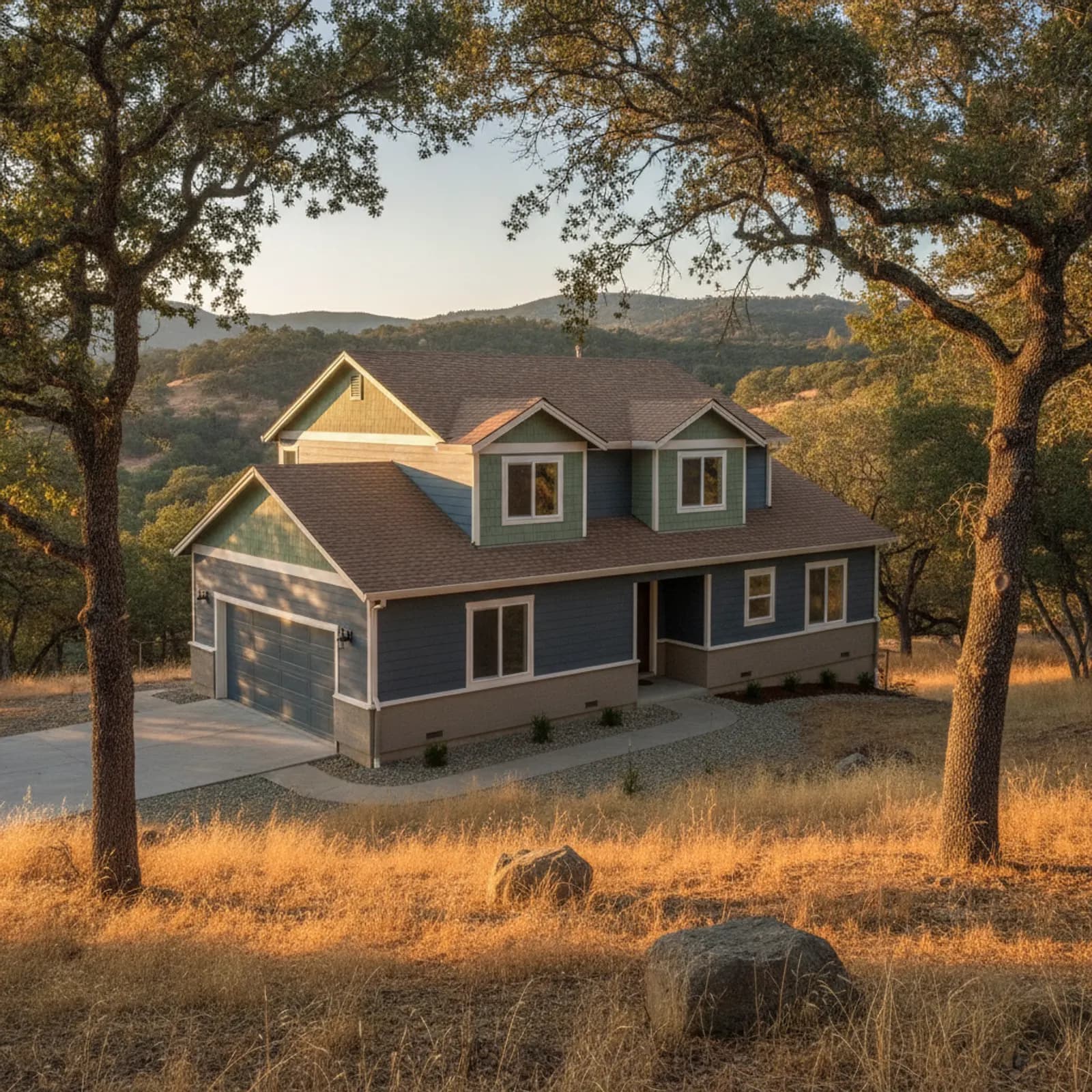
Meadow Vista's stock is a mix of 1970s-through-1990s foothill subdivision homes on wooded lots, custom homes tucked among the pines, and rural-residential acreage parcels on the community's edges, with a layer of newer foothill-residential builds added over time. Many of the older homes still wear original wood, cedar, or T1-11 cladding selected to blend with the trees — combustible materials that are precisely what we want to replace in this environment. Fiber cement reproduces the woodsy, natural profiles that suit a forested community while removing the fire liability the original siding designed into these homes.
Meadow Vista's foothill climate
Meadow Vista's controlling stressor is wildfire, intensified by its higher foothill elevation, pine-and-oak canopy, and sloped terrain. Summers are hot and very dry with elevated UV, and the forest setting cures into heavy seasonal fuel right around the homes. Winters are cooler than the valley with occasional light snow at this elevation, so we account for modest seasonal swings and clearances, though snow load is not a primary driver. The dryness, the dense canopy, and the slope — which can accelerate fire spread uphill toward homes — are what make wildfire the dominant exterior concern here.
Fire-hardening a Meadow Vista home
For Meadow Vista homes we specify Class A non-combustible fiber cement and then address the points that actually decide ignition: closed or carefully detailed eaves, ember-resistant venting, and a non-combustible zone at the base of walls where embers and surface fire collect on sloped, canopied lots. We coordinate cladding with soffit and fascia work so the whole exterior behaves as one hardened system rather than a non-combustible wall undermined by a vulnerable eave. Where homeowners are pursuing broader home-hardening or defensible-space programs, we document the materials and assemblies used so the work supports insurability conversations, though insurers set their own criteria.
Recommended materials for Meadow Vista
Non-combustible fiber cement — James Hardie or equivalent Class A board — is the clear recommendation for Meadow Vista. We deliberately steer away from combustible cedar, engineered wood, and any wood-based cladding here regardless of how naturally it would blend with the pines, because the high fire exposure dominates the decision. Fiber cement also delivers the heat and UV durability the dry foothill summers demand and handles the modest seasonal swings of this elevation, so the safer material carries no real performance penalty. Durable factory finishes and robust flashing complete a spec built for a forested, sloped community.
What drives a re-side's cost in Meadow Vista
Meadow Vista projects carry the standard cost drivers — size, stories, trim complexity, substrate condition, and window integration — plus the fire-hardening scope at eaves, vents, and ground transitions, and frequently more challenging access on sloped, wooded, and rural lots. Demolition and dry-rot discovery on older subdivision and custom homes can expand scope once cladding comes off. We assess all of this qualitatively on site and provide a written, itemized estimate; in a high-exposure community like Meadow Vista, the fire-detailing line items are emphatically not where we recommend economizing.
Sloped, wooded lots and uphill fire spread
Much of Meadow Vista sits on sloped terrain among pine and oak, and slope matters in a fire because flames and embers move uphill faster and concentrate against homes set above a drainage or canyon. We pay particular attention to the downslope-facing walls, eaves, and ground transitions on these lots, since that is where exposure is highest. The forested setting that makes Meadow Vista desirable is also the fuel, so the goal is hardening the home to coexist with the trees rather than stripping the character that draws people here.
Foothill subdivisions versus acreage edges
Meadow Vista's denser subdivision core and its rural acreage edges call for somewhat different detailing even though the underlying non-combustible material answer is consistent. Subdivision homes on tighter lots benefit from attention to home-to-home proximity and shared-fuel realities, while edge-of-community acreage homes face open wildland and outbuilding fuel. We read which context a home sits in and detail accordingly, rather than applying one generic foothill spec across very different parcels.
Meadow Vista is unincorporated: Placer County permits, PCWA, PSPS
Meadow Vista is not a city. It is an unincorporated community — a Census-Designated Place — in Placer County. Building permits, planning review, and code enforcement all run through Placer County's Community Development Resource Agency in Auburn. Electric and gas are PG&E, and Meadow Vista is squarely in high-PSPS territory. Water is supplied by the Placer County Water Agency (PCWA), a customer-owned public agency. Fire response is Placer Hills Fire Protection District alongside CAL FIRE's Nevada-Yuba-Placer Unit. We flag county, utility, and fire-district items at the estimate stage.
HZ10 and Very-High FHSZ across Meadow Vista
Meadow Vista is in James Hardie's HZ10 climate zone; installing HZ5 is a documented warranty misapplication. On the fire side, essentially all of Meadow Vista sits in the pine-and-oak foothills at roughly 1,600 feet with Moderate to Very High FHSZ under California's 2025 LRA Fire Hazard Severity Zone map, with much of the surrounding territory in State Responsibility Area. Because Meadow Vista is unincorporated, the county map governs directly. The 2025 California Wildland-Urban Interface Code governs the exterior wall on essentially every re-side. The code frame changed on January 1, 2026, when Chapter 7A moved into the standalone WUI Code.
Our process in Meadow Vista
- Step 1
Consultation
We listen to your goals and assess your home on site — exposure, substrate, and architecture.
- Step 2
Design & Proposal
A clear written proposal with the right system specified for your climate and a transparent scope.
- Step 3
Expert Installation
Trained crews install to manufacturer best practices with careful weather-management detailing.
- Step 4
Walkthrough & Support
A final walkthrough, full cleanup, and a clear written record of the scope completed — work we stand behind.
In Meadow Vista, a re-side done right is also a meaningful reduction in your home's ignition risk in a genuinely high-exposure setting. We scope every project on site, design the exterior as a hardened, weather-managed defense system, and document the work with a written, itemized estimate — protecting the home without sacrificing the forested character that makes the community what it is.
FAQ
Meadow Vista — Common Questions
High. Meadow Vista's pine-and-oak canopy, higher foothill elevation, and sloped terrain combine to create genuine wildfire exposure, which is why we treat fire performance as the design premise of a re-side here.
Class A non-combustible fiber cement, installed with fire-aware detailing at eaves, vents, and the ground-to-wall transition. Cladding alone is not enough on sloped, wooded lots; the detailing completes the protection.
In Meadow Vista's high-exposure environment, combustible cedar, wood, or T1-11 cladding is a meaningful liability. Re-cladding in non-combustible fiber cement is one of the most effective hardening steps available.
Home hardening can support insurability and resilience in this WUI community. We document the materials and assemblies used so the work can support those conversations, though insurers set their own criteria.
Yes. Fire and embers move uphill faster and concentrate against homes set above a drainage or canyon, so we pay particular attention to downslope-facing walls, eaves, and ground transitions on sloped Meadow Vista lots.
Occasional light snow at this elevation, cooler than the valley but not a primary driver. We account for modest seasonal swings and clearances while keeping wildfire as the dominant exterior concern.
We advise against combustible cladding in Meadow Vista given the high fire exposure. Fiber cement carries no real durability penalty here, so the safer material is also the sound one.
A correctly installed fiber cement system commonly performs 30 or more years in Meadow Vista's foothill climate, with factory finishes extending the time before any cosmetic refresh is needed.
Explore
Exterior Services
Helpful Exterior Guides