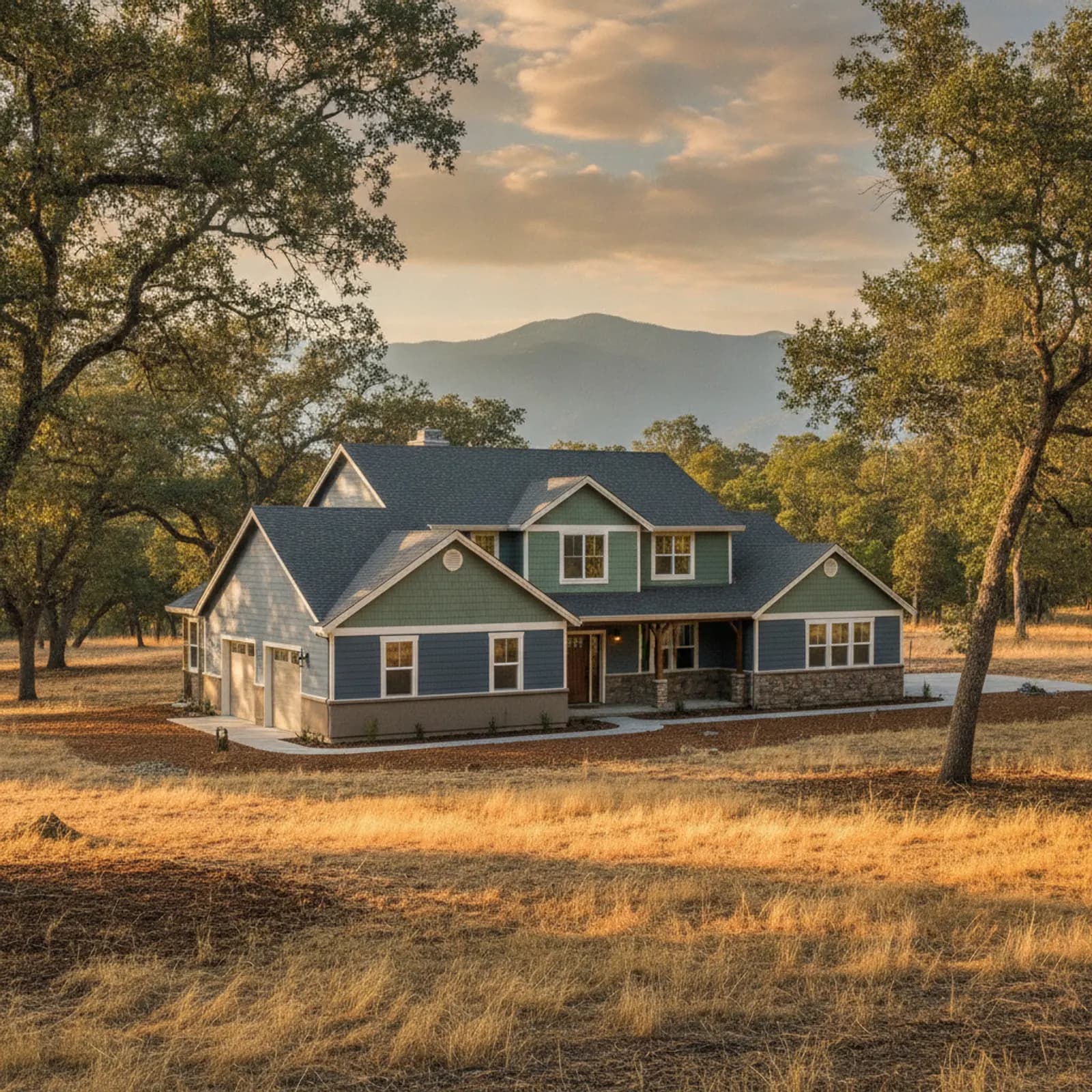
Exterior renovation in Penryn
Penryn is a tiny unincorporated community just east of Loomis along the I-80 corridor, known historically for its granite quarries and today for its low-density rural-residential character — small ranches, hobby farms, and custom homes spread across oak-shaded acreage. There is no dense subdivision pattern here; the appeal is space, trees, and a working-rural feel. That same character is what makes wildfire-aware exterior design the central concern for most Penryn homeowners, because the oaks and dry grass that define the parcels are also the fuel. We scope each Penryn property individually and build the exterior to match its genuine foothill exposure rather than a generic suburban spec.
Hobby farms make it a whole-site question
What sets Penryn apart from a simple acreage lot is how much is built on it. Barns, shops, and animal structures cluster near many homes, and in an ember event the whole site behaves as one fuel landscape rather than a house standing alone. That reframes the spec: Class A non-combustible cladding on the home is the baseline, but we also read how nearby outbuildings and canopy load embers toward the main walls. Retiring the combustible wood or T1-11 common on these country homes is one of the highest-value steps available, and we point out the whole-site realities so the hardening isn't undone by a wood barn a short distance away.
Considering an exterior project in Penryn?
Penryn housing and architecture
Penryn's housing is almost entirely rural-residential: custom and semi-custom homes on acreage, small ranches and hobby farms with barns and outbuildings, and a scattering of older homes near the historic townsite and the granite-quarry area. Lots are large and wooded, structures are spread out, and many homes still carry original wood or T1-11 cladding chosen for a country aesthetic. The substantial, traditional profiles owners favor here are reproduced well in fiber cement, which lets us keep the rural look while removing the fire liability the original combustible siding builds into the home.
Penryn's foothill climate
Penryn's controlling stressor is foothill wildfire driven by its own dry oak-woodland and grassland. Summers are hot and very dry with elevated UV from the foothill elevation, and winters are mild with only occasional light frost, so snow and freeze are not factors here. Through the long dry season the grass cures and oak litter accumulates across these acreage lots, putting seasonal fuel close to the homes and their outbuildings. That heat-plus-fuel combination, not heat by itself, is what dictates the exterior strategy for a Penryn re-side and pushes fire performance to the front of the spec.
Hardening a Penryn property
For Penryn homes we specify Class A non-combustible fiber cement and harden the ignition-prone points: eaves, soffits, vents, and the ground-to-wall transition where embers collect against acreage homes. Re-cladding combustible wood or T1-11 in non-combustible material is one of the highest-value hardening steps available to a rural Penryn property, and we coordinate it with fascia and vent detailing so the assembly performs as a whole. Because Penryn parcels so often include barns, shops, and hobby-farm structures near the house, we read the whole site as one fuel landscape and flag how nearby outbuildings load embers toward the home, not just the main walls.
Recommended materials for Penryn
Non-combustible fiber cement is the clear recommendation for Penryn given its elevated fire exposure. We generally advise against combustible engineered wood and any wood-based cladding here regardless of its country appeal, since fiber cement also delivers the heat and UV durability the dry foothill summers require and therefore involves no real performance trade-off. Durable factory finishes and robust flashing round out a spec built for the rural-residential setting, where the traditional appearance owners want and the protection the oak woodland demands sit comfortably together in one material.
What drives a re-side's cost in Penryn
Cost in Penryn is shaped by the standard drivers — size, stories, trim, substrate condition, and window integration — plus fire-detailing scope and the practicalities of rural acreage work: long or gated driveways, sloped sites, and staging around mature oaks and farm structures. Older custom and ranch homes frequently reveal dry rot behind aging wood siding once it is removed. We assess these qualitatively on site and provide a written, itemized estimate; as throughout the foothill belt, the fire-detailing scope in Penryn is not where we suggest economizing, because it is doing the most important work.
Hobby farms and the whole-site picture
Many Penryn properties are working hobby farms or small ranches with barns, shops, and animal structures clustered near the home. In an ember event the whole site behaves as one fuel landscape, so we consider how those outbuildings and the surrounding canopy load embers toward the house rather than looking only at the main walls. Hardening the home while ignoring a wood barn a short distance away leaves an obvious gap, and we point out those whole-site realities when we scope a Penryn project.
Granite heritage and acreage access
Penryn's history as a granite-quarrying town is still visible in the older townsite, and the surrounding parcels are large, wooded, and often well off the road. That setting changes how a re-side runs: narrow or gated approaches, grading, and mature oaks all shape lift placement, scaffolding, and material staging. We walk the actual lot before committing to an approach, because the staging plan on a Penryn acreage parcel is nothing like one on a suburban lot, and that difference shows up in both safety and schedule.
Penryn is unincorporated: Placer County permits, PCWA, South Placer Fire
Penryn is not a city. It is an unincorporated community — a Census-Designated Place — in Placer County, so building permits, planning review, and code enforcement all run through Placer County's Community Development Resource Agency in Auburn. Electric and gas are PG&E, and Penryn is in high-PSPS territory. Water is supplied by the Placer County Water Agency (PCWA), a customer-owned public agency. Fire response is South Placer Fire District alongside CAL FIRE for surrounding SRA. Our /dry-rot-repair service page names Penryn in its Placer foothill belt.
HZ10 and Very-High FHSZ across Penryn
Penryn is in James Hardie's HZ10 climate zone; installing HZ5 is a documented warranty misapplication. On the fire side, essentially all of Penryn sits in the oak-and-granite foothills at roughly 700 feet with Moderate to Very High FHSZ under California's 2025 LRA Fire Hazard Severity Zone map. The 2025 California Wildland-Urban Interface Code governs the exterior wall on essentially every re-side. The code frame changed on January 1, 2026, when Chapter 7A moved into the standalone WUI Code.
Our process in Penryn
- Step 1
Consultation
We listen to your goals and assess your home on site — exposure, substrate, and architecture.
- Step 2
Design & Proposal
A clear written proposal with the right system specified for your climate and a transparent scope.
- Step 3
Expert Installation
Trained crews install to manufacturer best practices with careful weather-management detailing.
- Step 4
Walkthrough & Support
A final walkthrough, full cleanup, and a clear written record of the scope completed — work we stand behind.
Penryn's rural, granite-country charm comes with real, oak-woodland-driven fire exposure, and a re-side here is a chance to harden the home while keeping its country character. We scope every Penryn project on site and document the work with a written, itemized estimate — the fire detailing is where the value lives, and we won't overstate or understate the risk.
FAQ
Penryn — Common Questions
In most cases yes. Penryn's oak-woodland and grassland acreage setting carries elevated ember exposure, and re-cladding combustible siding in non-combustible material is one of the highest-value hardening actions available.
Class A non-combustible fiber cement with fire-aware eave and vent detailing. It covers both the elevated fire exposure and the hot, dry foothill summers with no durability trade-off.
Yes. Many Penryn properties are hobby farms with barns and shops near the home, and we consider how the whole site loads embers toward the house rather than looking only at the main walls.
In Penryn's wildfire environment, combustible wood or T1-11 cladding is a meaningful liability. Re-cladding in non-combustible fiber cement is one of the most effective hardening steps, and it preserves the country look.
Yes. Penryn summers are hot, very dry, and high-UV. We specify durable factory finishes and heat-aware detailing alongside the fire backbone.
Yes. We routinely work Penryn's wooded acreage parcels and plan lift placement, staging, and access around mature oaks and gated approaches before starting.
We generally advise against combustible cladding in Penryn given the elevated fire exposure. Fiber cement carries no durability penalty here, so the safer material is also the sound choice.
A correctly installed fiber cement system commonly performs 30 or more years in Penryn's foothill climate, with factory finishes extending the time before any cosmetic refresh is needed.
Explore
Exterior Services
Helpful Exterior Guides