
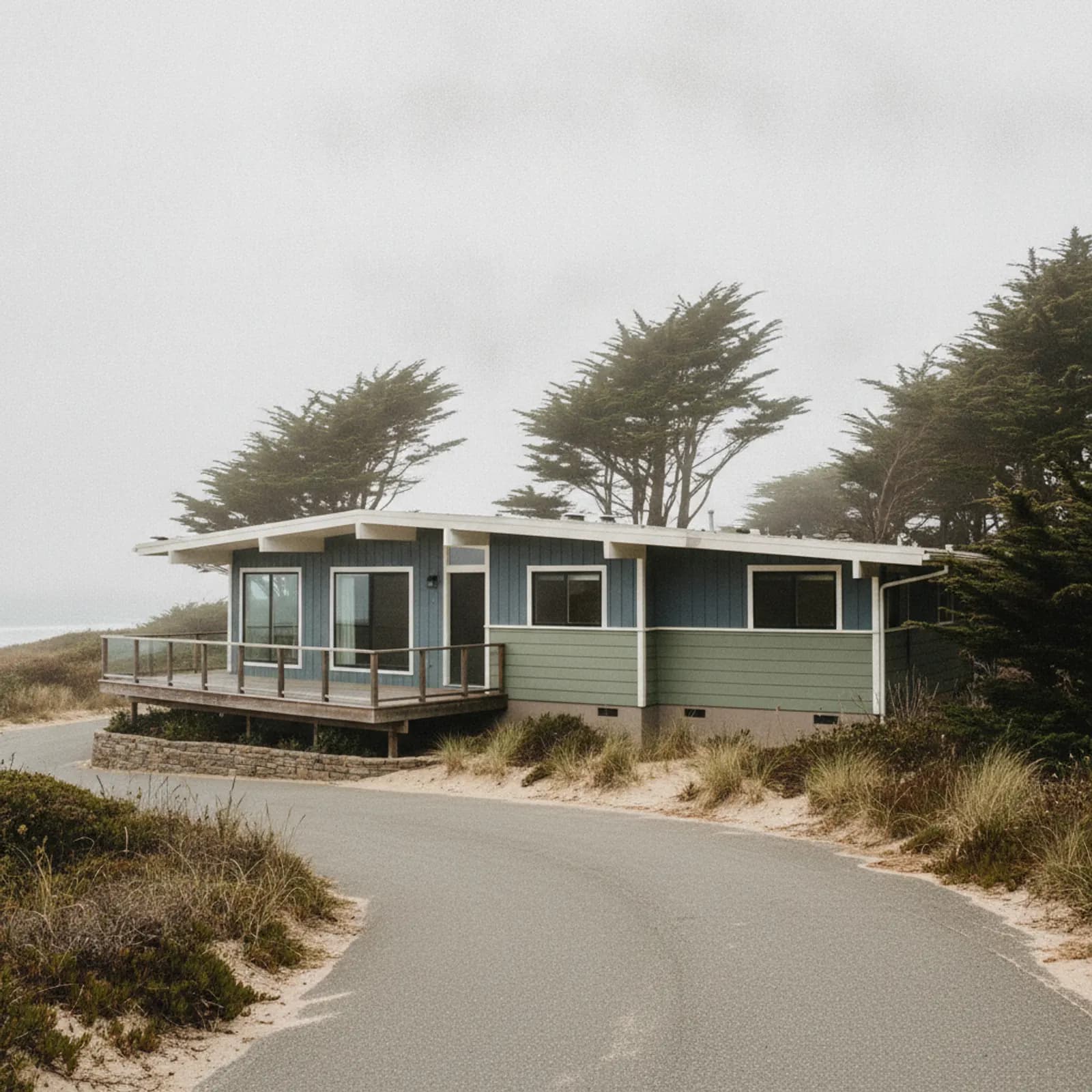
Fiber Cement Siding in Live Oak
Live Oak is a small agricultural town on Highway 99 in orchard and row-crop country on the open Sutter County floor, with the Sutter Buttes standing off to the west.
The governing exterior problem here is hard valley sun with almost no shade to soften it, and the orchard setting adds a set of practical conditions that a purely residential market does not have.
Orchard country is a specific operating environment
Living among tree crops is not the same as living among rangeland. Orchards generate substantial dust during harvest — particularly nut crops, where shaking and sweeping put a great deal of fine material into the air — and that dust settles on buildings and works into the texture of a finish. Orchards are also actively managed year-round, with spray applications, dust from unpaved access roads, and equipment operating close to property lines. For an exterior the practical consequences are about surface: a washable factory finish and a smoother profile are genuinely easier to live with here than a heavily textured surface that holds everything that lands on it.
Wind machines, frost protection and orchard microclimate
Orchard districts use wind machines for frost protection, running on cold, still nights in late winter and early spring to mix warmer air down. For a homeowner nearby that is mostly a noise consideration rather than a building one, but it points at something real: orchard land is actively conditioned, and the microclimate around a house surrounded by irrigated tree crops differs from open ground. Irrigation raises local humidity through the growing season and can put water against structures where lines run close, which makes clearance at the base of the wall and keeping spray off the cladding worth attention.
The sun, which is what governs
None of the above displaces the main point: Live Oak sits on the open valley floor and takes an uninterrupted UV load through long, hot summers. The failure sequence is the standard one and it runs quickly here — finishes chalking and fading on south and west elevations, boards cupping through daily thermal cycling, butt joints working open, and winter rain finding what the summer opened. A factory-applied finish and a dimensionally stable substrate are the two properties that answer it, and they should lead the specification.
The grass edge, in proportion
Live Oak's wildfire exposure is moderate and it applies where homes back onto dry, summer-cured grass rather than across the whole town. On those parcels non-combustible cladding and sensible ground-level hardening are worth having. This is a proportionate addition to a project that is fundamentally about the sun, not a reason to specify a wildland package for a house in the middle of town, and a contractor should be able to explain which parts of a recommendation apply to your particular parcel.
Why this matters in Live Oak
- Specified for Sacramento Valley conditions
- James Hardie fiber cement as the recommended system
- Correctly detailed weather-resistive barrier and flashing
- Installed by a crew with 20 years combined experience
Recommended systems for Live Oak
- James Hardie fiber cement
- fire-aware detailing on the rural grass edge
- factory finishes
- durable trim packages
Fiber Cement Siding for Live Oak homes
The full fiber cement siding approach — materials, weather-resistive detailing, and the manufacturer standards we install to — is covered on the main service page, then specified for Live Oak's conditions on this one.
Our Live Oak process
- Step 1
Consultation
We listen to your goals and assess your home on site — exposure, substrate, and architecture.
- Step 2
Design & Proposal
A clear written proposal with the right system specified for your climate and a transparent scope.
- Step 3
Expert Installation
Trained crews install to manufacturer best practices with careful weather-management detailing.
- Step 4
Walkthrough & Support
A final walkthrough, full cleanup, and a clear written record of the scope completed — work we stand behind.
FAQ
Fiber Cement Siding in Live Oak — FAQ
Mainly at the surface. Orchards generate substantial dust — nut harvest especially, where shaking and sweeping put fine material into the air — and it settles into finish texture. Add spray applications, dust from unpaved access roads and equipment near property lines, and a washable factory finish with a smoother profile becomes genuinely easier to live with than a heavily textured surface.
It is worth attention at the base of the wall. Irrigated tree crops raise local humidity through the growing season, and lines running close to structures can put water against them. Clearance at the bottom course and keeping spray off the cladding matter more here than on dry open ground.
The sun. Open valley floor, uninterrupted UV, long hot summers — and the standard sequence runs quickly: finishes chalking and fading on south and west, boards cupping through thermal cycling, joints working open and winter rain finding them. A factory finish and a dimensionally stable substrate are what answer that.
It is moderate and it applies where homes back onto dry, summer-cured grass rather than across the whole town. On those parcels non-combustible cladding and ground-level hardening are worth having, as a proportionate addition to a project that is really about the sun — not a reason to specify a wildland package for a house in town.
Keep Exploring
More for Live Oak homeowners
More in Live Oak
Other exterior services in Live Oak
Nearby Service Areas
Fiber Cement Siding near Live Oak
Helpful Exterior Guides