
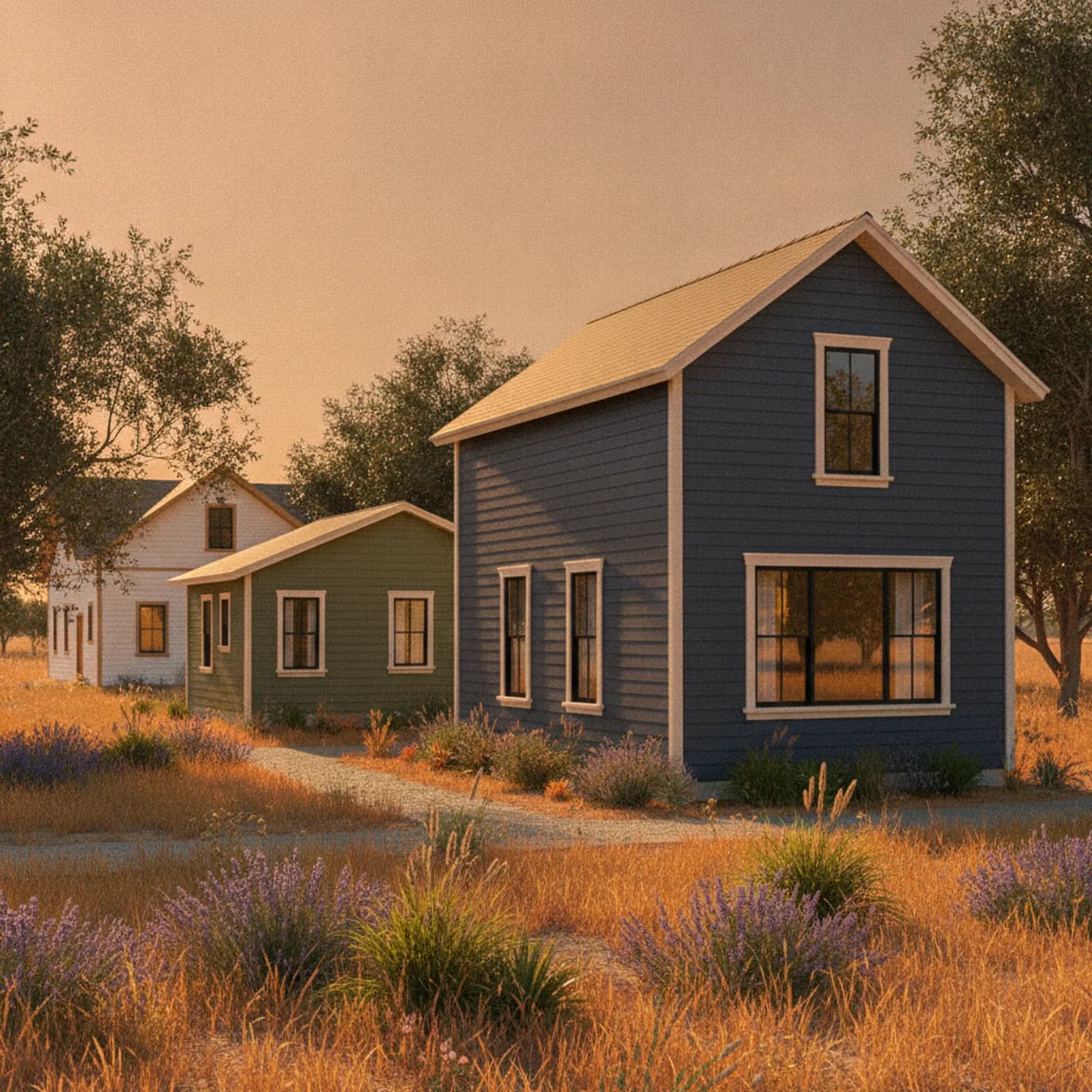
Fiber Cement Siding in Wheatland
Wheatland is a small agricultural city where the built-up part of town and the open country around it are never far apart, and that proximity defines the exterior conversation.
The sun does the day-to-day damage, and the grassland on the town's edge introduces a seasonal exposure that a valley-centre house simply does not have.
The grass edge is a seasonal condition, not a permanent one
Wheatland's wildfire exposure is moderate and it is specifically a grassland exposure, which behaves on a calendar. Annual grasses green up through the wet season, cure through late spring, and are fully available as fuel from roughly early summer until the rains return. That means the risk profile of a property on the town's rural edge changes markedly across the year, and it also means the highest-value mitigation is seasonal work — clearance and fuel management timed to the curing — rather than anything structural. A material choice is a permanent hedge against a seasonal condition, which is a reasonable thing to buy but worth understanding for what it is.
Agricultural ignition sources are part of the local picture
In farming country a meaningful share of grass fires start from ordinary agricultural and roadside activity rather than from wildland: equipment operating in dry fields, hot exhausts and sparks in cured grass, and roadside ignitions along the highway and county roads. That has a practical consequence for where risk sits. A property backing onto a working field or fronting a busy road carries a different exposure than one in the middle of town, and it is not always the parcels closest to open wildland that face the highest chance of ignition nearby.
Farmhouse and small-town stock, and what suits it
The housing here runs from older small-town homes and farmhouses through post-war cottages to newer subdivisions on the town's edge, and the appropriate specification is not uniform. On the older stock, profile and trim proportion determine whether a re-side reads as sympathetic or as a modernisation the house did not ask for. Narrow exposures and properly scaled casings do most of that work. On the newer subdivision housing the conversation is closer to the valley-floor one — durability under UV and a finish that will not need a repaint cycle.
Sun is the constant, and it is what actually wears things out
Across the whole town, year in and year out, the sun is what ends the life of an exterior. The sequence is the familiar valley one: finish chalking and fading on the south and west, boards cupping through daily thermal cycling, butt joints working open, and the winter rain finding what the summer opened up. A factory-applied finish and a dimensionally stable substrate are the two properties that address that, and on a property with a house plus barns or outbuildings the argument compounds because the alternative is repainting a great deal of surface on a cycle.
Why this matters in Wheatland
- Specified for Sacramento Valley conditions
- James Hardie fiber cement as the recommended system
- Correctly detailed weather-resistive barrier and flashing
- Installed by a crew with 20 years combined experience
Recommended systems for Wheatland
- James Hardie fiber cement
- fire-aware detailing on the rural grass edge
- factory finishes
- durable trim packages
Fiber Cement Siding for Wheatland homes
The full fiber cement siding approach — materials, weather-resistive detailing, and the manufacturer standards we install to — is covered on the main service page, then specified for Wheatland's conditions on this one.
Our Wheatland process
- Step 1
Consultation
We listen to your goals and assess your home on site — exposure, substrate, and architecture.
- Step 2
Design & Proposal
A clear written proposal with the right system specified for your climate and a transparent scope.
- Step 3
Expert Installation
Trained crews install to manufacturer best practices with careful weather-management detailing.
- Step 4
Walkthrough & Support
A final walkthrough, full cleanup, and a clear written record of the scope completed — work we stand behind.
FAQ
Fiber Cement Siding in Wheatland — FAQ
Moderate, and specifically a grassland exposure that runs on a calendar. Annual grasses cure through late spring and are fully available as fuel from early summer until the rains return, so a rural-edge property's risk profile changes markedly across the year. The highest-value mitigation is seasonal clearance timed to the curing rather than anything structural.
Often from ordinary agricultural and roadside activity rather than from wildland — equipment working dry fields, hot exhausts and sparks in cured grass, roadside ignitions along the highway and county roads. That means a property backing a working field or fronting a busy road can carry more exposure than one nearer open country.
Meaningfully. On older stock the profile and trim proportions decide whether the result reads as sympathetic or as a modernisation the house did not ask for — narrow exposures and properly scaled casings do most of that work. Newer subdivision housing is closer to the standard valley conversation about UV durability and finish life.
The sun, consistently and everywhere in town. Finish chalks and fades on south and west elevations, boards cup through daily thermal cycling, butt joints work open and winter rain finds them. A factory finish and a stable substrate address that, and on a property with outbuildings the case compounds — the alternative is repainting a lot of surface on a cycle.
Keep Exploring
More for Wheatland homeowners
More in Wheatland
Other exterior services in Wheatland
Nearby Service Areas
Fiber Cement Siding near Wheatland
Helpful Exterior Guides