
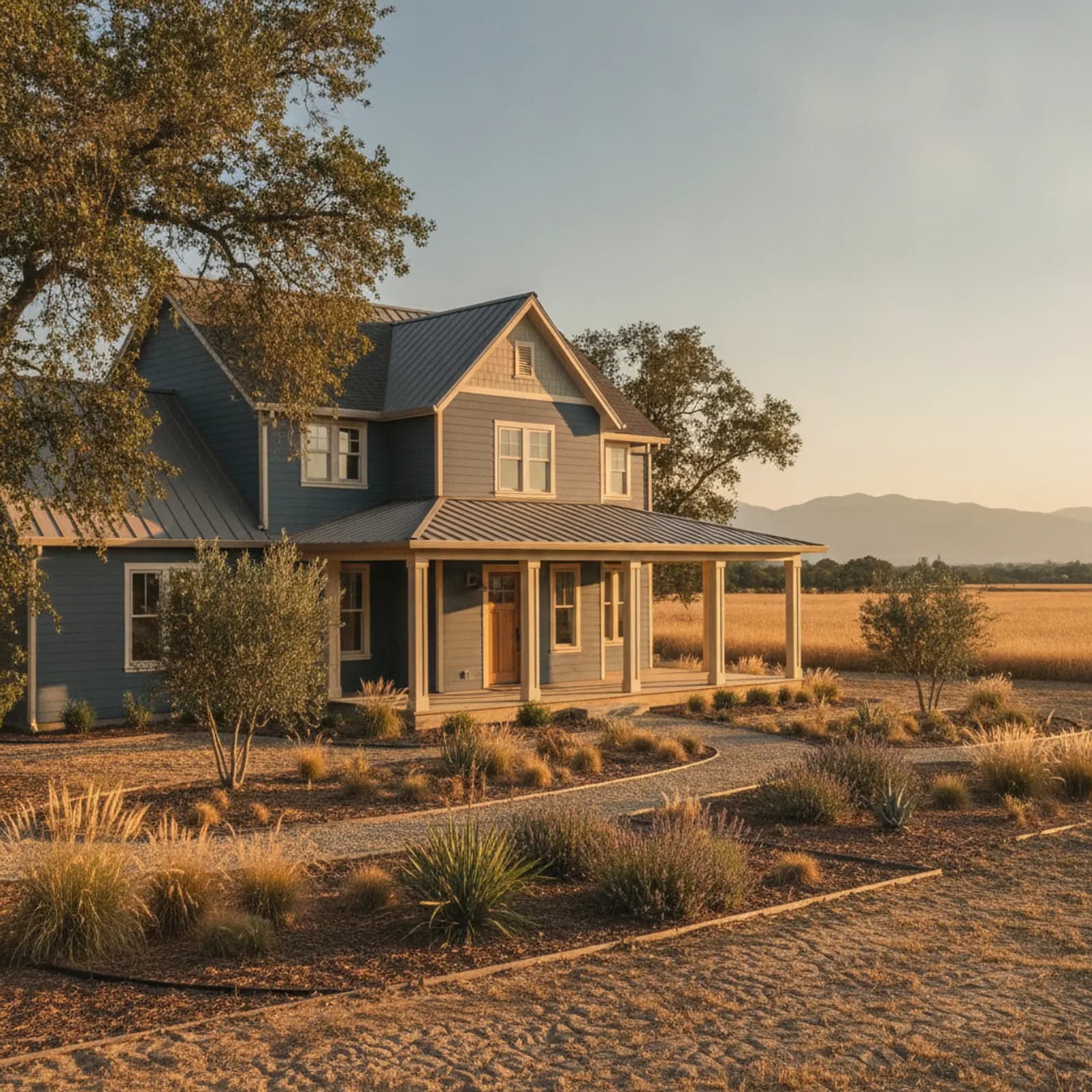
Exterior renovation in Wheatland
Wheatland is a small agricultural city at the southern end of Yuba County, set on the open Sacramento Valley floor where the town gives way to the surrounding ranch and grassland. Its housing is modest and rural in character: older small-town homes and farmhouses near the town center, working ranch houses and outbuildings tied to the area's row crops and grazing land, post-war and mid-century cottages, and newer subdivisions added on the town's edge as it has grown. A large share of this stock wears original or economy cladding that decades of hard valley sun have chalked and cupped, and Wheatland's grassland setting gives a re-side here a fire dimension the more built-up valley communities don't carry.
Why it matters here specifically
Wheatland sits where two stressors meet. The long, bright valley summer fades and cups original cladding the same way it does across Yuba County, worst on south and west walls with little canopy to shade them. But the town's position amid dry, summer-cured grassland and ranch country means grassfire and wind-driven fire raise ember exposure from negligible to a real low-to-moderate seasonal consideration, especially on the rural edges where homes sit closest to open fuel. A Wheatland re-side therefore answers to both the sun and the grass-edge fire risk, which makes non-combustible cladding an especially natural fit here.
Considering an exterior project in Wheatland?
Wheatland housing and architecture
Wheatland's stock is shaped by its small-town ag roots rather than subdivision marketing: older small-town homes and farmhouses near the historic center, ranch houses and accessory outbuildings on the surrounding parcels, post-war and mid-century cottages, and newer subdivisions on the town's growing edge. The farmhouses and older homes reward simple, honest lap profiles and straightforward trim rather than ornate detailing, and many working parcels carry ancillary structures worth hardening alongside the main house. On the rural grass-facing edges the assembly's fire performance matters as much as the profile. We design to the home's era and to its exposure, not to one template.
Built for Wheatland's heat and grass edge
Wheatland reads as valley-heat country in town: long, intense, high-UV summers fade finishes and stress joints worst on south and west elevations, so fade-resistant factory-finished fiber cement and heat-aware gapping and fastening are the baseline. What sharpens the spec on the edges is the grassland. Wheatland sits amid dry, summer-cured grass and ranch country, where wind-driven grassfire raises ember exposure to a real low-to-moderate seasonal consideration on the rural-facing parcels. The same wall has to beat the sun across the town and, on those grass-facing edges, also resist ignition — two demands the spec should account for together rather than treating fire as an afterthought.
Fire-aware detailing on Wheatland's grass edge
Wheatland is a valley-floor town, not a foothill or mountain community, so the in-town core sits at low fire exposure and the conversation there is heat and durability. The honest exception is the rural edge, where homes back toward dry, summer-cured grassland and ranch country and carry a real low-to-moderate ember exposure during the long dry season. For those grass-facing parcels we specify non-combustible cladding as standard and detail eaves, vents, and the ground-to-wall transition to limit ember intrusion, integrating the fire strategy into the assembly. We won't overstate the risk on a central town lot, and we won't understate it on a home that backs toward open grass.
Recommended materials for Wheatland
James Hardie fiber cement is our standard recommendation for Wheatland: it handles the valley heat and high UV without chalking, and because it is non-combustible it also covers the grass-edge fire consideration without a material change. The same product line carries the town homes, the working farmhouses, and the newer edge subdivisions, keeping the spec consistent across a small, partly rural service area. On the older farmhouses and town homes we choose simple, durable lap and trim that suit the small-town character, while factory-applied finishes hold their color through Wheatland's long, bright summers far better than field paint on these unshaded ag-country walls.
What an exterior project costs in Wheatland
Wheatland pricing follows the usual drivers: home size and stories, trim and profile complexity, substrate and dry-rot condition once cladding comes off, window integration, and the weather-management scope. Two things are particular to Wheatland: fire-detailing scope is minimal on a central town lot but meaningful on a grass-facing rural parcel, and rural access on ranch parcels can affect staging and logistics. The town's older farmhouses also more often reveal substrate surprises at demolition after decades of heat cycling. We provide a written, scoped estimate after an on-site assessment, because the right number depends heavily on where in Wheatland the home sits.
The town center and older farmhouses
Wheatland's small historic town center and its surrounding older homes and farmhouses are the core of the community's character, sitting closest to the rail corridor and highway that gave the town its start. These homes reward honest, simple lap profiles and durable trim rather than ornamentation, and they are the most likely to hide dry rot or layered original siding behind weathered cladding. We plan for that at demolition rather than discover it mid-project, and we keep fire-aware detailing in view given how close the whole small town sits to open grass.
Working ranches and the grassland edge
Beyond the town, Wheatland's parcels run to working ranches, row crops, and rural homes set among dry grassland. These are the properties where the grassfire exposure is most acute and where outbuildings, fence-to-wall transitions, and the immediate defensible zone all factor into a sensible exterior strategy. Access can be longer and staging more involved on acreage, which we account for in the on-site walk so the crew sequences the work efficiently across the structures that matter on the property.
Newer edge subdivisions and rural resale
On Wheatland's growing edge, newer subdivisions are reaching refresh age in a market where durability and, on the rural fringe, a documented fire-aware exterior increasingly factor into how a home is valued. A re-side that pairs heat-stable, non-combustible cladding with proper detailing protects both the structure and its resale standing. We keep records of the materials and assemblies used so those details are available when a homeowner, buyer, or insurer asks what is on the walls.
City of Wheatland, Wheatland water, and Wheatland Fire / CAL FIRE
Working exteriors in Wheatland coordinates with a few local authorities. Building permits come through the City of Wheatland Planning and Building Department (Wheatland is one of the smallest incorporated cities in Yuba County). Electric and gas are PG&E. Water and wastewater are supplied by the City of Wheatland municipal utilities. Fire response is the Wheatland Fire Authority alongside CAL FIRE Nevada-Yuba-Placer Unit on wildland calls into the surrounding grassland and the foothill margins climbing toward Beale AFB and Camp Beale Hill. The Wheatland Union High School District and city are jointly working on the growth pressure from Bear River Valley development — that context sometimes affects design-review expectations on newer subdivisions.
HZ10 and the grass-edge FHSZ reality
Wheatland is in James Hardie's HZ10 climate zone; installing HZ5 is a documented warranty misapplication. On the fire side, the downtown Wheatland core sits in Low or Moderate FHSZ territory under California's 2025 LRA Fire Hazard Severity Zone map, while rural parcels running east toward the Camp Beale foothills and south toward the Bear River corridor carry Moderate to High designations where annual grassland cures to fast fuel. Wind-driven grass fires historically move through this corridor — the 2020 Bear Fire (part of the North Complex, 318,935 acres) burned nearby, and CAL FIRE NEU regularly issues red-flag advisories for the corridor. On wildland-adjacent parcels the 2025 California Wildland-Urban Interface Code governs the exterior wall. Chapter 7A moved into the standalone WUI Code on January 1, 2026.
Our process in Wheatland
- Step 1
Consultation
We listen to your goals and assess your home on site — exposure, substrate, and architecture.
- Step 2
Design & Proposal
A clear written proposal with the right system specified for your climate and a transparent scope.
- Step 3
Expert Installation
Trained crews install to manufacturer best practices with careful weather-management detailing.
- Step 4
Walkthrough & Support
A final walkthrough, full cleanup, and a clear written record of the scope completed — work we stand behind.
Wheatland rewards an exterior strategy that takes both the valley sun and its grassland-edge fire season seriously, from an older farmhouse in town to a ranch backing toward open grass. We scope every Wheatland project on site so the heat and fire detailing match the actual parcel, and your written, itemized estimate governs the work.
FAQ
Wheatland — Common Questions
James Hardie fiber cement with a fade-resistant factory finish — it handles Wheatland's valley heat and, because it is non-combustible, also covers the grass-edge fire consideration without a material change.
On the rural edge, yes — homes backing toward dry, summer-cured grassland and ranch country carry a real low-to-moderate ember exposure. The central town core sits at low exposure. We tailor fire-aware detailing to where the home actually sits.
Grass-facing rural parcels benefit from non-combustible cladding and fire-aware detailing of eaves, vents, and the ground-to-wall transition. On central town lots well away from open fuel, the conversation is mainly heat and durability.
Original or economy cladding was never specified for the valley UV load. Chalking, cupping, opening joints, and faded paint on sun-facing elevations is the typical end-of-life pattern across this open ag country.
On working parcels, yes — we talk through hardening outbuildings and the immediate defensible zone, since a home is only as defensible as what stands next to it on a rural grassland parcel.
When feasible, yes — combining them ensures correct flashing integration, avoids duplicated trim work, and lets fire-aware detailing be integrated cleanly on grass-facing homes.
For exterior purposes, yes — Wheatland shares the valley heat and UV profile, so the same heat-durable specification applies, with fire detailing added on the rural grass edge.
A correctly installed fiber cement system commonly performs 30+ years in Wheatland's climate, with factory finishes extending the time before any cosmetic refresh.
Helpful Exterior Guides