
8 min read · Siding Replacement
It's one of the most-searched stucco questions, and the honest answer is: sometimes, but it's frequently not the right call. Installing new siding over existing stucco can save demolition cost, but only if the assembly is built to manage water correctly — and stucco's nature as a moisture-storing 'reservoir cladding' makes that harder, not easier. There's no blanket 'always' or 'never' here; it's a case-by-case engineering decision about the wall in front of you. This guide lays out what a sound over-stucco install actually requires, and the signs that point toward a full tear-off instead.
What a sound over-stucco install actually requires
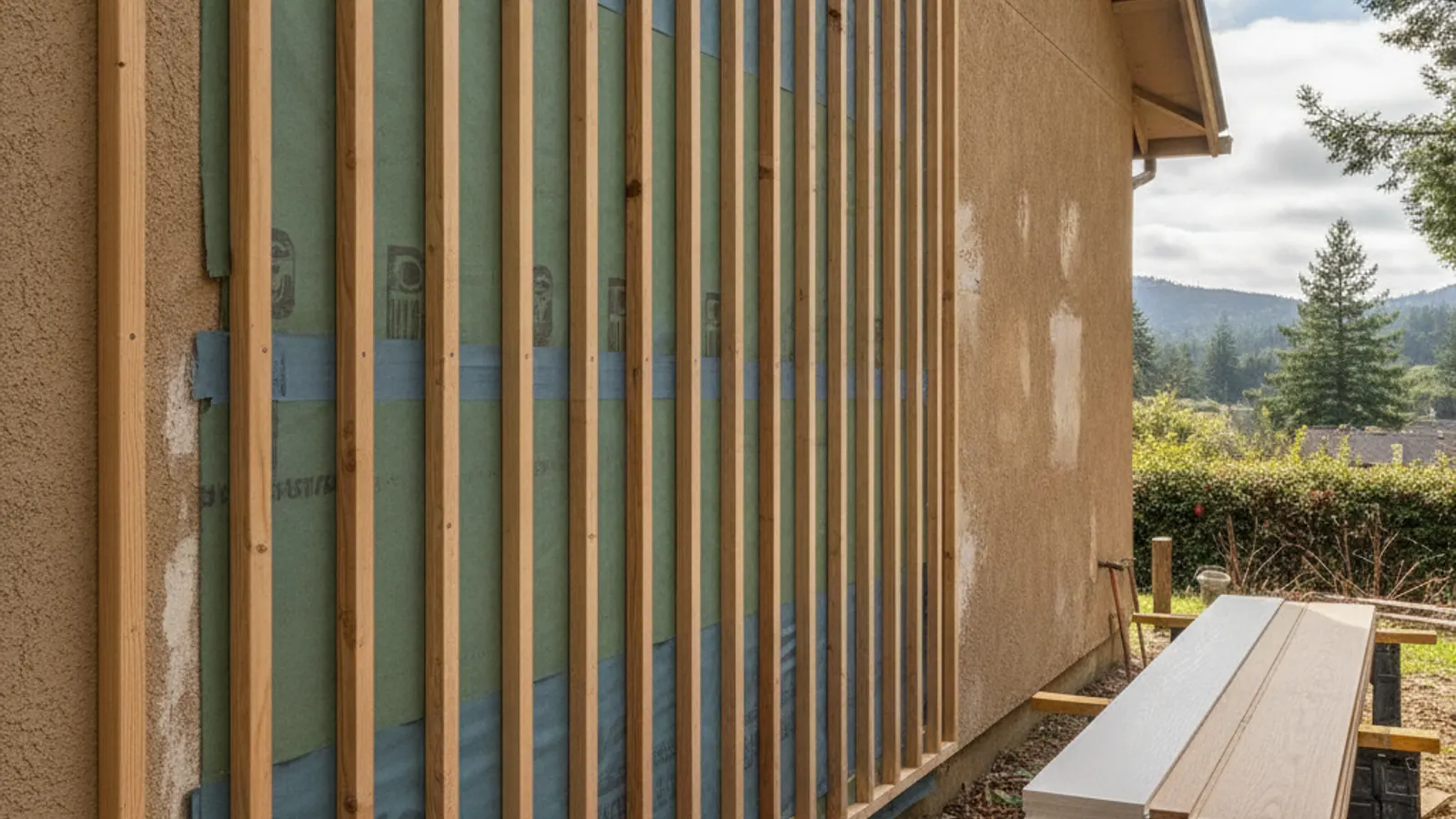
Siding can't just be nailed onto stucco. To do it right you need: a **flat, plane nailing surface** — stucco is rarely flat enough, so this usually means furring strips/strapping to create a true plane; a **drainage gap** — Building Science Corp. is clear that a wall needs a space between cladding and the water-resistive barrier to drain, and the U.S. Department of Energy's Building America program shows furring strips creating exactly that drained gap behind lap siding (with screening top and bottom for insects and embers); an **intact, continuous water-resistive barrier with proper flashing** at all openings; and management of **added wall thickness**, which pushes window and door faces deeper and requires jamb extensions and re-trimming. Skip any of these and you risk trapping water against the stucco.
Why stucco makes overlay riskier
Stucco is what building scientists call a reservoir cladding: it absorbs and stores water, and on a sunny wall that stored moisture can be driven inward toward the structure. Layering new siding tight against stucco without an air gap can trap that moisture between the two claddings — the opposite of what you want. The right detail uncouples the new siding from the stucco with a ventilated/drained cavity (the furring approach above) so both can dry. This is doable, but it adds cost and complexity that can erase the savings overlay was supposed to deliver — which is why, for stucco specifically, James Hardie recommends planning for a full tear-off.
When tear-off is the better call
Lean toward removing the stucco when: there's any sign of cracking, staining, or hidden moisture (tear-off is the only way to inspect and repair the sheathing and framing — James Hardie calls removal 'the best opportunity to discover and repair damage'); the existing water-resistive barrier is old, unknown, or compromised; window and door depths can't absorb the added thickness gracefully; or the wall is too irregular to fur out economically. A tear-off costs more up front but rebuilds the entire water-management assembly and removes the guesswork — see replacing stucco with fiber cement. We assess each wall and tell you honestly which approach fits.
Siding over stucco vs. full tear-off
| Factor | Over stucco (overlay) | Full tear-off |
|---|---|---|
| Hidden-damage inspection | Not possible | Yes — sheathing & framing exposed |
| Water-resistive barrier | Relies on existing/added over stucco | Fresh, correctly flashed WRB |
| Window/door depth | Pushed deeper; needs jamb extensions | Re-detailed cleanly |
| Moisture risk | Can trap water vs. reservoir cladding | Lowest when properly drained |
| Up-front cost | Lower (no demo) | Higher (demo + disposal) |
Key takeaways
- Siding over stucco is case-by-case — there's no honest 'always' or 'never.'
- Done right it needs a flat furred plane, a drainage gap, an intact flashed WRB, and a plan for added wall thickness.
- Stucco is a reservoir cladding; siding tight against it without an air gap can trap moisture.
- James Hardie recommends planning a full tear-off for stucco so hidden damage can be found and the WRB rebuilt.
- Tear-off costs more up front but removes the guesswork and rebuilds the whole water-management assembly.
FAQ
Quick Answers
Sometimes, but it requires furring to create a flat plane and a drainage gap, an intact and properly flashed water-resistive barrier, and managing the added wall thickness at windows and doors. Because stucco stores moisture and can hide damage, James Hardie recommends a full tear-off for stucco. We assess the specific wall before recommending overlay versus removal — it's not a one-size answer.
On the surface yes, because you skip demolition and disposal. But doing an overlay correctly — furring for a flat plane and drainage gap, flashing, and jamb extensions for the added thickness — adds cost and complexity that can erase much of the savings. And it forgoes the inspection that a tear-off provides. The true cost comparison depends on your wall's condition.
It can, if it's done without a drainage gap. Stucco absorbs and stores water, so siding installed tight against it can trap moisture between the layers. The correct detail uncouples the new siding from the stucco with a ventilated, drained cavity (typically via furring) so the assembly can dry. Without that, an overlay risks the exact moisture problems you're trying to solve.
This is the main technical difficulty with the approach. Adding a layer over the existing wall pushes the cladding plane outward, so windows that previously sat proud of the stucco now sit recessed, and the existing flashing at the head of each opening is now buried behind the new cladding rather than lapped over it. Resolving that properly requires extending the openings and re-flashing them, which is a substantial part of the labour — and skipping it is the usual reason this approach fails.
It can, and where the approach is done well that is one of its genuine advantages: furring strips over the stucco create a vented gap that the new cladding hangs on, giving the assembly a drainage and drying path it may not have had before. What matters is that the cavity is open at the bottom so water can actually leave, and that it is not simply sealed at both ends — a closed cavity holds moisture rather than releasing it.
It needs checking before committing. Adding furring and cladding typically moves the wall out by an inch or more, and that interacts with the eave overhang, the roof edge, existing gutters, and any trim that returns into the wall. On a house with shallow overhangs the new wall can end up close to flush with the roof edge, which looks wrong and complicates the water path. It is a straightforward thing to measure in advance, and an unpleasant thing to discover mid-job.
Sources
Authoritative references
- Building Science Corp. — Info-301: Drainage Plane / Water-Resistive Barrier
- Building Science Corp. — BSD-105: Understanding Drainage Planes
- Building Science Corp. — Info-305: Reservoir Claddings (stucco absorbs & stores water)
- U.S. DOE Building America Solution Center — furring strips create a drainage gap behind lap siding
- James Hardie — From Stucco to Hardie fiber cement: a re-side story (tear-off & inspection)
External links to government, code, and manufacturer sources. Sierra Siding is not affiliated with these organizations; references are provided for verification.