
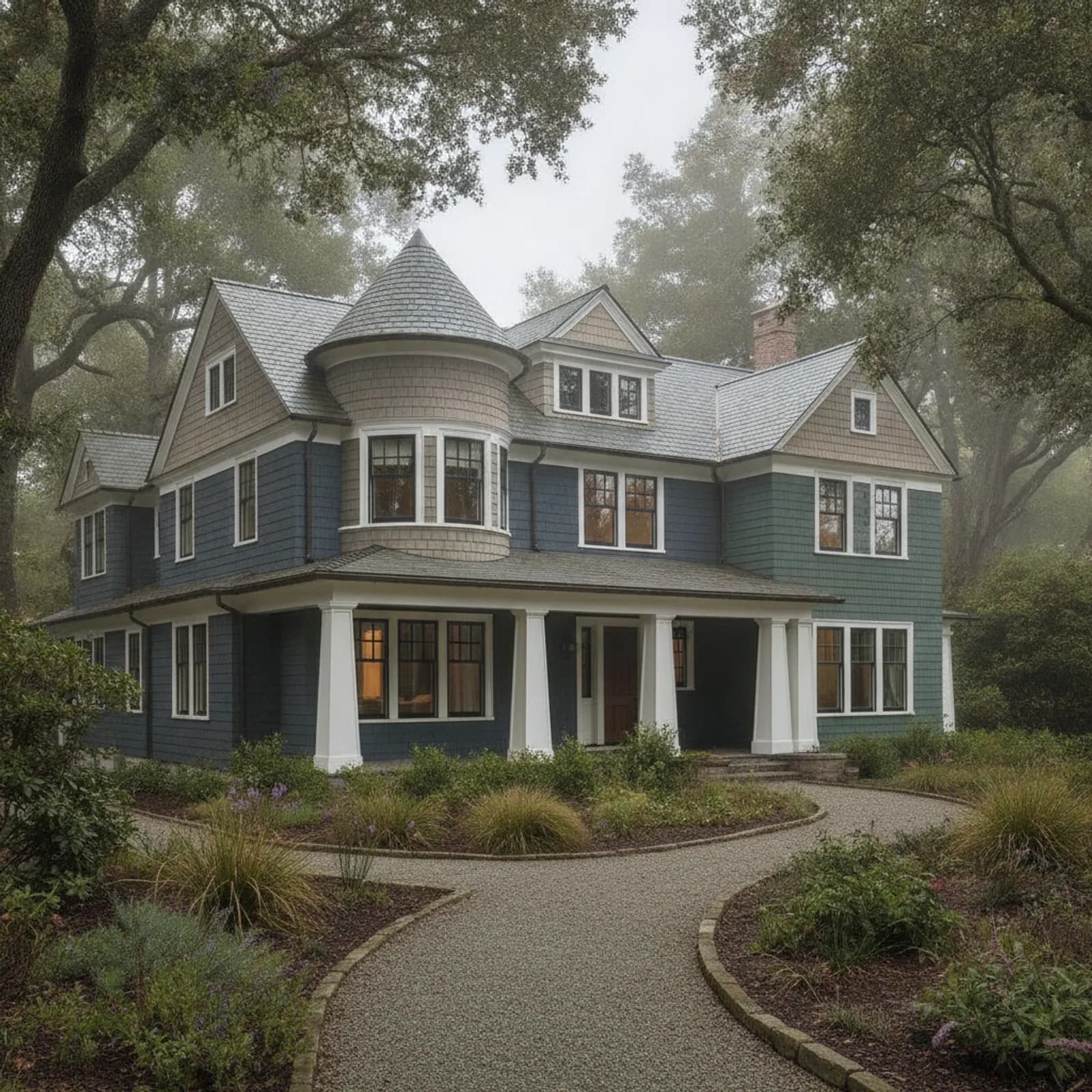
Fiber Cement Siding in Ross
Fiber cement is the material that lets a Ross restoration keep its period look while finally solving the valley's moisture problem. The trapped fog and canopy shade that define these wooded lots demand cladding that tolerates long wet spells without rotting, swelling, or feeding insects — and fiber cement does that while taking the shingle, lap, and trim profiles these older estates were built with.
On a Ross home the board is only part of the answer. The drainage detailing behind it is what makes fiber cement actually outlast the valley's damp, and the right profile selection is what lets a modern, rot-proof material honor an early-1900s facade rather than flatten it.
Why the material fits the wooded valley
Fiber cement does not rot, will not become termite or carpenter-ant food, and stays dimensionally stable through the soak-and-dry cycling that defines a canopy-shaded Ross wall. The old wood cladding we replace here cups and splits as it absorbs fog and creek-shaded damp, opening joints that let water sit against the sheathing. A cement-composite board rides those swings without moving, so the flashing and sealant lines stay where they were set — exactly what a wall that stays wet much of the cooler season needs to last.
The rainscreen makes it work here
In a valley this damp, fiber cement is only as good as the gap behind it. We install it over a continuous water-resistive barrier with a vented rainscreen cavity so air moves behind the board and the back face dries between fog cycles. Without that gap, even non-rotting cladding traps moisture against the sheathing on Ross's slow-drying north and creek-side elevations. The cavity also breaks capillary contact, so any wind-driven rain that gets past the face has a drained path out instead of a pool to sit in against the framing.
Period profiles without the maintenance
The reason fiber cement suits Ross specifically is that it delivers the period look these estates require without the upkeep of real wood. Its lap, shingle-look, and vertical panel profiles can reproduce the reveal and coursing of an early-1900s facade, then hold that finish through the valley's wet years without the cupping, splitting, and repainting cycle that wood demands on a shaded lot. For a restoration where the facade is the asset, that means the architecture is preserved and the maintenance burden a damp canopy imposes on wood is largely removed.
Detailing for wet shade
The failures we replace on Ross homes are almost never the board itself — they are the transitions. Kickout flashing where a roofline dumps onto a wall, shingle-lapped flashing at window heads and penetrations, and generous base clearance off damp soil and dense plantings all matter more under a tree canopy that never lets a wall fully dry than they would on a sunny inland lot. We sequence those details so water is shed by laps, not held by caulk, because in this climate any caulk-dependent joint eventually loses and the moisture finds the sheathing behind it.
Why this matters in Ross
- Specified for North Bay conditions
- premium Class A non-combustible fiber cement as the recommended system
- Correctly detailed weather-resistive barrier and flashing
- Installed by a crew with 20 years combined experience
Recommended systems for Ross
- premium Class A non-combustible fiber cement
- James Hardie
- custom trim and architectural profiles
- fire-hardened detailing
Fiber Cement Siding for Ross homes
The full fiber cement siding approach — materials, weather-resistive detailing, and the manufacturer standards we install to — is covered on the main service page, then specified for Ross's conditions on this one.
Our Ross process
- Step 1
Consultation
We listen to your goals and assess your home on site — exposure, substrate, and architecture.
- Step 2
Design & Proposal
A clear written proposal with the right system specified for your climate and a transparent scope.
- Step 3
Expert Installation
Trained crews install to manufacturer best practices with careful weather-management detailing.
- Step 4
Walkthrough & Support
A final walkthrough, full cleanup, and a clear written record of the scope completed — work we stand behind.
FAQ
Fiber Cement Siding in Ross — FAQ
It tolerates the valley's long wet-and-dry cycling without rotting or moving, and its profiles reproduce the period reveal and coursing these estates require — so it preserves the architecture while removing the upkeep a shaded, damp lot forces on wood.
Not if it is installed over a vented rainscreen and continuous WRB. The board itself does not rot, and the air gap lets the back face dry between fog cycles, which is essential on Ross's slow-drying canopy-shaded elevations.
Usually — its lap, shingle-look, and vertical profiles let us reproduce the original reveal and coursing of an early-1900s facade, so the restoration keeps its character with a rot-proof material.
Considerably — wood cups, splits, and rots under the valley's tree canopy and fog, while cement composite stays stable so the flashing and joints keep doing their job through the long wet season.
Keep Exploring
More for Ross homeowners
More in Ross
Other exterior services in Ross
Nearby Service Areas
Fiber Cement Siding near Ross
Helpful Exterior Guides