
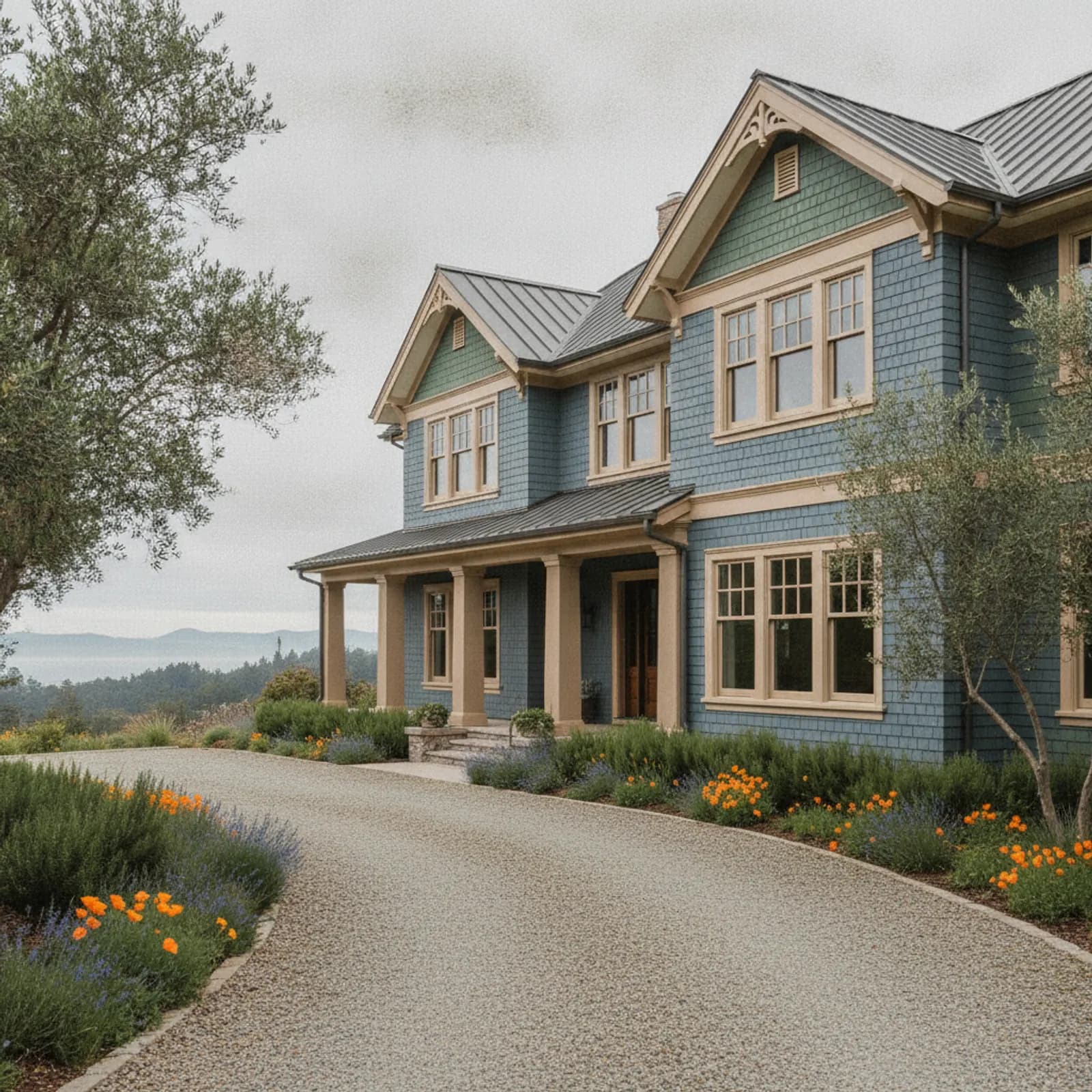
Fire-Resistant Siding in Ross
Ross sits mostly on the sheltered floor of the Ross Valley and is not a high wildfire-exposure town in the way the steep upper canyons of Marin are — so we will be honest about that rather than sell a threat that is not there. The central, tree-shaded estate streets carry a measured, moderate ember exposure, not the genuine wildland-urban-interface terrain of a deep-canyon town.
Where the exposure rises is on the wooded slopes at the town's edge, where parcels climb toward open hillside fuel. On those lots a hardened, non-combustible exterior is a sensible response; on the valley floor it is mostly an ember-resistance and durability upgrade. We scope it to the real condition of your specific parcel.
An honest read of Ross's exposure
We will not overstate this: most of Ross is a sheltered valley-floor town, and the dominant exterior threat on the central estate streets is moisture, not fire. The fire conversation becomes real only on the parcels that back toward the wooded slopes at the town's margins, where hillside fuel and a moderate ember exposure justify hardening. That is a different reality than a deep-canyon town with continuous fuel and constrained evacuation, and we tell owners which category their home actually falls into rather than applying a blanket high-risk pitch across Ross.
Embers and defensible-space basics
Even in a moderate-exposure setting, the homes that do ignite in a wildfire almost always start from wind-blown embers landing on or against the building, not from a wall of flame. So the practical hardening on a Ross slope-edge lot is about denying embers a foothold: ember-resistant vents, protected eaves and soffits, the deck-to-wall junction, and a clear, noncombustible zero-to-five-foot zone at the wall base kept free of mulch, woodpiles, and dense planting. These defensible-space basics matter more than the cladding face alone, and they are reasonable steps even where the overall risk is measured rather than severe.
Non-combustible value on the valley floor
On the central estate streets where fire exposure is low, non-combustible cladding still earns its place — just for different reasons. Class A fiber cement does not feed an ignition, will not rot in the valley's damp, and gives an owner of an irreplaceable period home a modest, real margin of protection against a stray ember without overhauling the architecture. We frame it honestly as a durability-and-peace-of-mind upgrade here, not a survival necessity, so the decision is made on accurate footing rather than on alarm.
Hardening that pairs with the moisture work
The useful thing about ember hardening in Ross is that the same details serve the valley's real problem — damp. Keeping the zero-to-five-foot base clear of combustible mulch and dense planting both starves embers and stops moisture from wicking into the cladding, and a non-combustible ground transition does double duty. So on a slope-edge lot we coordinate the fire detailing and the drainage detailing as one scope, which means the modest fire investment also strengthens the wall against the moisture that is the more constant threat across most of Ross.
Why this matters in Ross
- Specified for North Bay conditions
- premium Class A non-combustible fiber cement as the recommended system
- Correctly detailed weather-resistive barrier and flashing
- Installed by a crew with 20 years combined experience
Recommended systems for Ross
- premium Class A non-combustible fiber cement
- James Hardie
- custom trim and architectural profiles
- fire-hardened detailing
Fire-Resistant Siding for Ross homes
The full fire-resistant siding approach — materials, weather-resistive detailing, and the manufacturer standards we install to — is covered on the main service page, then specified for Ross's conditions on this one.
Our Ross process
- Step 1
Consultation
We listen to your goals and assess your home on site — exposure, substrate, and architecture.
- Step 2
Design & Proposal
A clear written proposal with the right system specified for your climate and a transparent scope.
- Step 3
Expert Installation
Trained crews install to manufacturer best practices with careful weather-management detailing.
- Step 4
Walkthrough & Support
A final walkthrough, full cleanup, and a clear written record of the scope completed — work we stand behind.
FAQ
Fire-Resistant Siding in Ross — FAQ
No — most of Ross sits on a sheltered valley floor with moderate exposure, not the genuine high-risk WUI terrain of Marin's steep upper canyons. The fire conversation is real mainly on the wooded slopes at the town's edge.
It depends on your parcel. On slope-edge lots toward the wooded hillsides it is a sensible response to a moderate ember exposure; on the central valley floor it is mostly a durability and peace-of-mind upgrade rather than a necessity.
Defensible-space basics around the building — ember-resistant vents, protected eaves, and a clear noncombustible zero-to-five-foot zone at the wall base — denies wind-blown embers a foothold and matters more than the cladding face alone.
Yes — keeping the wall base clear and using a noncombustible ground transition both resists embers and stops damp from wicking into the cladding, so the fire detail reinforces the moisture protection that is the more constant concern here.
Keep Exploring
More for Ross homeowners
More in Ross
Other exterior services in Ross
Nearby Service Areas
Fire-Resistant Siding near Ross
Helpful Exterior Guides