
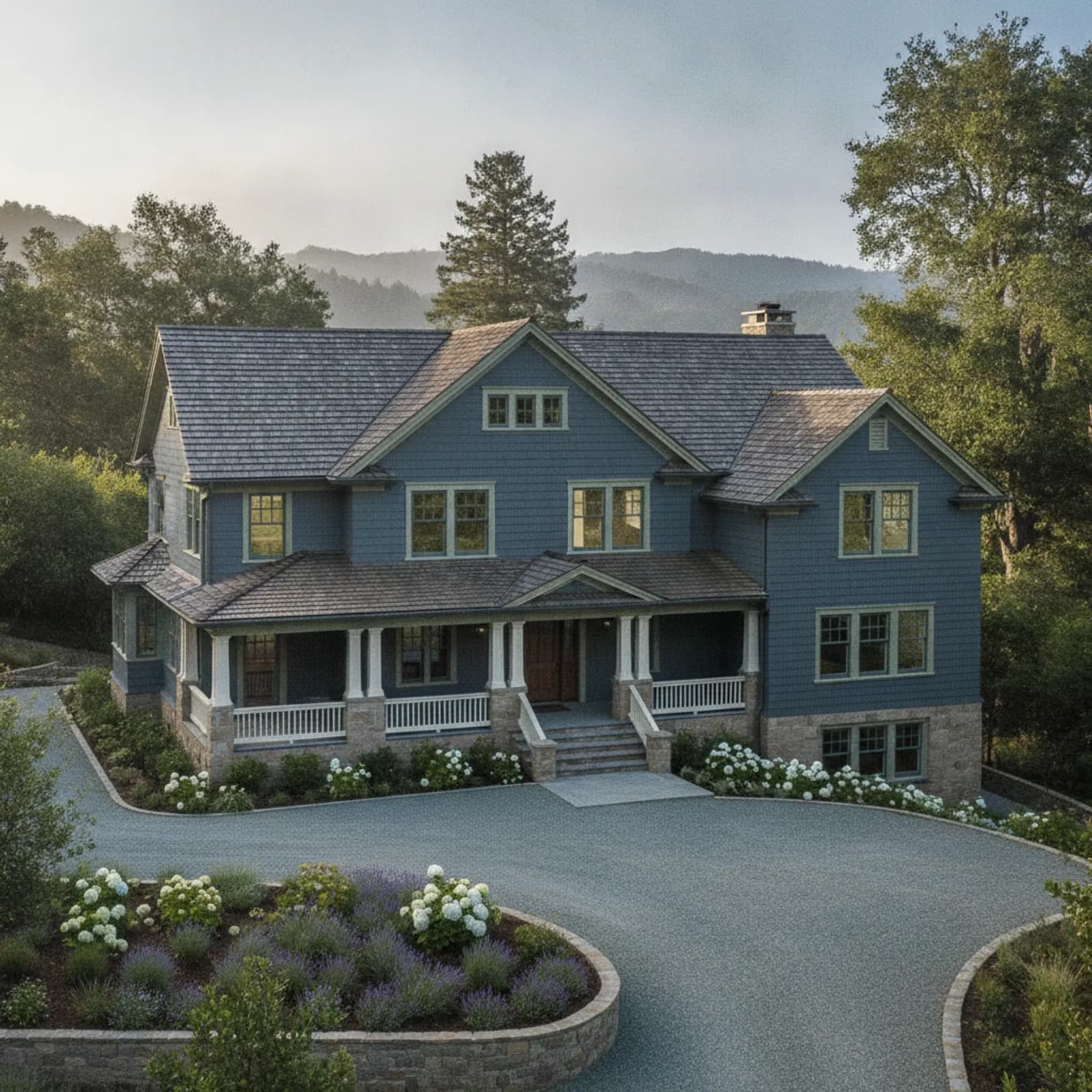
Exterior renovation in Ross
Ross is one of the smallest and most exclusive towns in Marin, a leafy estate enclave in the heart of Ross Valley where large lots, mature canopy, and grand period homes set the tone. The exterior conversation here is unlike anywhere else we work: the homes are architecturally significant, often original to the early twentieth century, and the standard of finish is uncompromising. At the same time the town sits against wooded hills with genuine wildfire exposure and carries the persistent bay-valley moisture that defines Ross Valley. A re-side in Ross has to honor the architecture, harden the wall, and keep it dry, all at once.
Why Ross siding wears the way it does
The very canopy that gives Ross its character is also the controlling exterior stressor. Mature trees and bay-valley fog keep shaded walls, north faces, and lower-lot elevations slow to dry through the long cool, wet season, so the standing humidity works on the original wood shingle, clapboard, and stucco that so many of these century-old estates still wear. Drying capacity, not bulk rain, is the real concern — the wall has to shed water and still breathe. Sierra Siding answers that with premium Class A non-combustible fiber cement, including James Hardie, over a deliberate drainage plane, profile-matched in shingle and clapboard so the architecture reads as original while the wall quietly outperforms it. On the wooded hillside parcels toward Phoenix Lake we add restrained, craftsman-level fire hardening at eaves, vents, and ground transitions rather than visible armor.
Considering an exterior project in Ross?
Ross housing and architecture
Ross is defined by its grand, architect-designed homes: shingle-style and Tudor estates, Mediterranean and period-revival residences, and stately early-1900s houses on the deep, tree-shaded lots near the town center, alongside custom hillside homes climbing toward the wooded slopes and the Phoenix Lake area. Many wear original wood shingle, clapboard, or stucco detailing that demands genuinely period-sensitive work. On these homes the profile, trim, and shadow lines are where the value lives, so re-cladding is as much a restoration discipline as a performance upgrade — the new wall has to read as the original while quietly outperforming it on fire and moisture.
Ross's wooded-valley climate
Ross sits in a sheltered, heavily wooded pocket of Ross Valley where mature canopy and bay-valley fog keep shaded walls, north faces, and lower-lot elevations slow to dry through the cool, wet months. The town's dense tree cover compounds the standing humidity. Drying capacity is a controlling concern: the assembly must shed bulk water and still breathe, which puts drainage-plane and flashing detailing at the center of any Ross spec. The warm, dry late-summer and fall windows then layer a moderate fire consideration onto the wooded hillside parcels and the canopy that crowds so many estate lots, so the wall carries both demands.
Hardening a Ross estate
Ross's wooded hillside parcels and the heavy canopy over so many estate lots create a moderate but real ember and radiant exposure, and we treat it as such on the at-risk homes toward the slopes and the open-space margins. We specify Class A non-combustible fiber cement and harden the eaves, vents, and ground-to-wall transition while preserving the architectural detailing the home depends on. Because the houses here are significant, the hardening work is done with restraint and craftsmanship rather than visible armor. We won't overstate the risk on the sheltered valley-floor estates, but on the wooded slopes the exposure is genuine and the wall should be non-combustible.
Recommended materials for Ross
Premium Class A non-combustible fiber cement, including James Hardie, with custom trim and architectural profiles is the core recommendation for Ross, because it manages the valley moisture and the moderate hillside fire exposure together while meeting the town's exacting finish standard. Fiber cement resists the moisture-driven decay that punishes original wood on these older estates, and it holds a factory or custom finish through the long shaded wet season. The profile work — shingle, clapboard, and bespoke trim — is where the architecture is preserved; behind it, the drainage detailing is what keeps a grand Ross home dry for decades.
What an exterior project costs in Ross
Ross sits at the high end of the Marin market, and pricing reflects the homes themselves more than any local penalty: large estate footprints, multiple stories, intricate architectural trim, custom profile matching, and the substrate repair that century-old houses frequently hide. Deep, canopy-shaded lots and gated or narrow estate drives can add access and staging cost, and hillside parcels carry fire-hardening scope on top. We provide a written, scoped estimate after an on-site assessment; in Ross the value lies in getting the architectural match and the drainage detailing exactly right, and the written estimate governs the work.
The estate lots near the town center
The deep, tree-shaded lots around the heart of Ross hold many of the town's grandest period homes — shingle-style, Tudor, and revival estates on sheltered valley-floor parcels. Here the priority is moisture management, substrate repair, and meticulous architectural matching rather than aggressive fire detailing. The mature canopy that gives these lots their character also keeps walls damp, so the drainage plane and flashing do the quiet, decisive work while the visible profile and trim preserve the home's original lines.
The wooded hillsides toward Phoenix Lake
Climbing toward the wooded slopes and the Phoenix Lake and open-space margins, the parcels grow more fire-exposed and the canopy denser. These custom hillside homes carry the moderate-to-elevated end of Ross's wildfire profile, and re-cladding is the moment to bring an older wall up to a hardened, non-combustible standard without sacrificing its design. Steep grades and private drives shape how we stage and scaffold, which we plan on site rather than assume.
An exacting market and a documented scope
Ross homeowners hold exterior work to a high standard, and the homes are significant enough that documentation matters — both for the architecture and for the hardening-and-insurance conversation. We record the materials and assemblies we install, match profiles and trim with restoration-level care, and scope each estate to its specific parcel rather than applying a template. In a market this exclusive, a correctly executed, period-faithful, moisture-durable exterior protects both the residence and its considerable value.
Town of Ross permits, MMWD, and Ross Valley Fire Department
A distinctive local detail worth naming: Ross is legally a Town rather than a City — the Town of Ross is the correct name for the local government, incorporated 1908 and one of the smallest municipalities in California by both population and area. Building permits go through the Town of Ross Planning and Building Department, a small but deliberate operation that enforces the community's residential-scale zoning and heritage-preservation expectations. Electric and gas are PG&E, and Ross is in high-PSPS territory, where PG&E's Public Safety Power Shutoffs during red-flag events can affect scheduling on any exterior project through the late-summer and fall fire windows. Water is supplied by the Marin Municipal Water District (MMWD), a customer-owned public agency. Fire response is the Ross Valley Fire Department, a JPA serving Ross alongside Fairfax, San Anselmo, and Sleepy Hollow, which also runs defensible-space inspection on wooded parcels. We flag town, utility, and fire-district items at the estimate stage.
HZ10, canopy-shaded moisture, and the 2025 FHSZ remap on Ross hillsides
Ross is in James Hardie's HZ10 climate zone despite the fog and canopy — HZ10 covers the West's mild coastal areas — and HZ10 is the correct spec for a Ross home; installing HZ5 is a documented warranty misapplication. On the fire side, the sheltered valley-floor estate blocks near the town center sit in Low FHSZ territory or are unmapped under California's 2025 LRA Fire Hazard Severity Zone map, while the wooded hillside parcels climbing toward Phoenix Lake and the Marin Municipal Water District open-space margins carry Moderate to Very High designations. On designated hillside parcels the 2025 California Wildland-Urban Interface Code governs the exterior wall. The code frame itself changed on January 1, 2026, when Chapter 7A was deleted from the Building Code and moved into the standalone WUI Code. We check the parcel against the current designation at scoping.
Our process in Ross
- Step 1
Consultation
We listen to your goals and assess your home on site — exposure, substrate, and architecture.
- Step 2
Design & Proposal
A clear written proposal with the right system specified for your climate and a transparent scope.
- Step 3
Expert Installation
Trained crews install to manufacturer best practices with careful weather-management detailing.
- Step 4
Walkthrough & Support
A final walkthrough, full cleanup, and a clear written record of the scope completed — work we stand behind.
In Ross, a re-side has to satisfy an exacting architectural standard while quietly hardening the wall against fire and moisture. We design for all three, matching the home's original character with restoration-level care. We scope every Ross project on site, and your written estimate governs the work.
FAQ
Ross — Common Questions
Yes. Fiber cement is available in shingle, clapboard, and custom profiles, so we preserve the original character of a period Ross home while upgrading fire and moisture performance underneath.
Ross carries moderate wildfire exposure, real on the wooded hillside parcels and where canopy crowds estate lots. For those homes non-combustible cladding with hardened detailing is advised.
Yes — the sheltered, heavily wooded valley keeps walls damp through the wet season, so we detail the drainage plane and flashing rigorously on every Ross project.
Premium Class A non-combustible fiber cement with custom architectural trim, over a detailed drainage plane — it meets the finish standard while managing moisture and hillside fire exposure.
Done correctly, no. We match profiles, trim, and shadow lines so the wall reads as the original while outperforming it on durability and fire.
Mature canopy and slow-drying shaded walls trap moisture behind aging wood. We lead with the drainage plane and flashing so the cause is resolved, not just the cladding replaced.
Home hardening can help in this market. We document the materials and assemblies installed, though insurers set their own criteria.
A correctly installed fiber cement system commonly performs 30+ years here while managing moisture and reducing ignition risk on the wooded parcels.
Explore
Exterior Services
Helpful Exterior Guides