
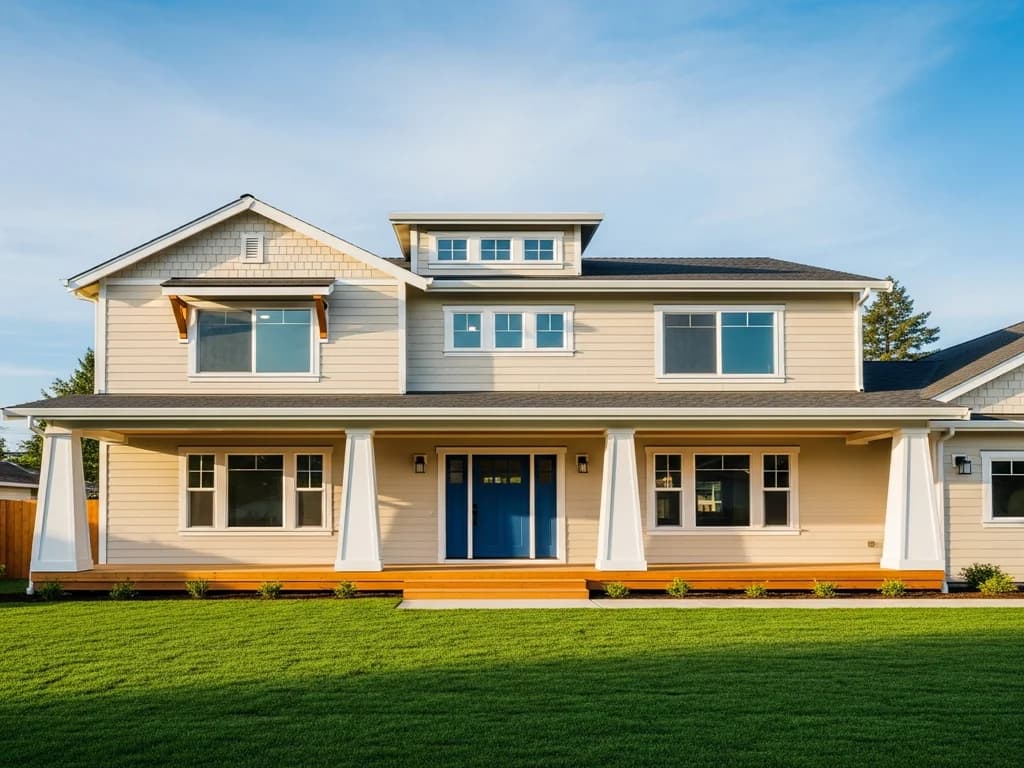
Fiber Cement Siding in Soda Springs
Fiber cement is the default wall at Soda Springs for a reason that has little to do with the usual sales points: it is dimensionally stable through freeze-thaw cycling, and at 6,800 to 7,200 feet on Donner Summit that is the property that decides whether an exterior lasts. Soda Springs averages 445 inches of snow a year — the snowiest place in California — and the damage it does is cumulative rather than dramatic.
The second reason is that Serene Lakes and the summit generally are near-total second-home country. A material that needs no periodic attention is worth more here than the price difference suggests, because the periodic attention is not going to happen.
Freeze-thaw is the property that matters at this elevation
Water that finds its way into a joint expands roughly nine percent when it freezes, levering the joint fractionally wider. It thaws, admits slightly more water, and freezes again. At Soda Springs that cycle runs through the season enough times that a hairline gap which would be irrelevant in Sacramento becomes a genuine entry point within a handful of winters. Fiber cement's dimensional stability through those cycles is the practical argument for it over materials that move more — and it is why back-primed, properly gapped butt joints matter more here than any product literature implies. A wall assembled tight, with no allowance for movement, will find its own gaps.
Snow-depth clearances, not valley clearances
The most common defect we find on summit properties is a bottom course set at the clearance a valley home would use. At Soda Springs that course spends much of the winter buried in drifted snow, in sustained contact with moisture at temperatures where nothing dries. The signature shows up years later as deterioration in a horizontal band with a clean upper edge — a snow-depth line. Getting the clearance right costs nothing at installation and is effectively unfixable afterwards without redoing the bottom of the wall, so it is worth confirming that whoever quotes your project has specified it for this elevation rather than by habit.
Meltwater comes from the roof, not the sky
Rain falls past a wall; meltwater originates on the roof and runs behind cladding, which means it defeats details that shed vertical water perfectly well. Roof-to-wall junctions take the worst of it, because accumulated snow melts against the building exactly where two assemblies meet. Kickout flashings are the specific detail that handles this and they are frequently absent on older summit construction. On a fiber cement re-side the flashing rebuild at those junctions is often worth more to the building's lifespan than the cladding upgrade itself, and we would rather say that than let the visible half of the project take all the credit.
Finish life under summit ultraviolet
Thin air at 7,000 feet gives ultraviolet considerably more bite than the same product faces at valley elevation, and summit summers are short but brilliant. Field paint on a south or west elevation here has a hard life, and on a second home nobody is watching it fail. A factory-applied finish is the sound specification for that reason more than for appearance — you are not buying a longer interval between repaints so much as protection against a maintenance task that realistically will not be performed. Deep, saturated colors work hardest on the sun-facing walls and are worth discussing rather than choosing from a chip.
Why this matters in Soda Springs
- Specified for Donner Summit / Sierra Alpine conditions
- non-combustible fiber cement rated for extreme snow load as the recommended system
- Correctly detailed weather-resistive barrier and flashing
- Installed by a crew with 20 years combined experience
Recommended systems for Soda Springs
- non-combustible fiber cement rated for extreme snow load
- snow-depth grade clearances and meltwater flashing
- freeze-thaw-tolerant gapped and back-primed joints
- stainless or coated fasteners for high cycle counts
Fiber Cement Siding for Soda Springs homes
The full fiber cement siding approach — materials, weather-resistive detailing, and the manufacturer standards we install to — is covered on the main service page, then specified for Soda Springs's conditions on this one.
Our Soda Springs process
- Step 1
Consultation
We listen to your goals and assess your home on site — exposure, substrate, and architecture.
- Step 2
Design & Proposal
A clear written proposal with the right system specified for your climate and a transparent scope.
- Step 3
Expert Installation
Trained crews install to manufacturer best practices with careful weather-management detailing.
- Step 4
Walkthrough & Support
A final walkthrough, full cleanup, and a clear written record of the scope completed — work we stand behind.
FAQ
Fiber Cement Siding in Soda Springs — FAQ
Dimensional stability through freeze-thaw, first and foremost. At this elevation the cycle runs enough times each season that materials which move more will open their own joints within a few winters. It is also non-combustible and takes a factory finish that survives summit ultraviolet, which matters on a property nobody maintains between visits.
It is how far the bottom course sits above grade, set for the snow that actually accumulates here rather than for valley practice. Get it wrong and the lower wall spends weeks each winter buried and wet. It costs nothing at installation and is effectively unfixable later without rebuilding the base of the wall, which is why we raise it early.
At roof-to-wall junctions on a summit property, frequently yes. Meltwater originates on the roof and travels behind the cladding, so a missing kickout flashing puts water into the assembly regardless of what the boards are made of. On many re-sides here the flashing rebuild does more for the building's lifespan than the cladding upgrade.
Substantially, on sun-facing elevations. Ultraviolet at 7,000 feet is harsher than a valley product rating suggests, and field paint on a south or west wall ages fast. The stronger argument on a second home is not longevity but absence — nobody is here to notice a coating starting to fail, so the specification has to carry that.
Keep Exploring
More for Soda Springs homeowners
More in Soda Springs
Other exterior services in Soda Springs
Helpful Exterior Guides