
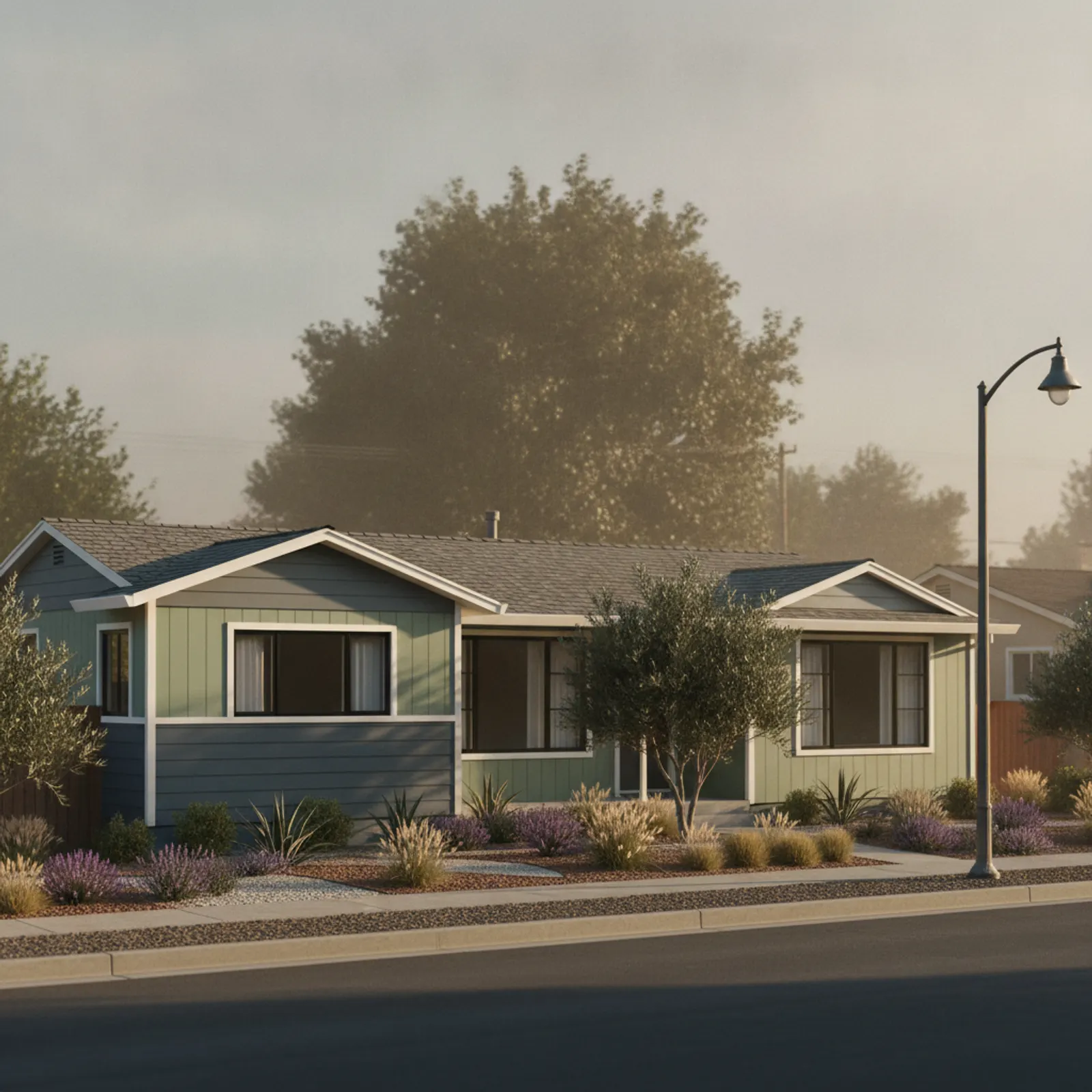
Fiber Cement Siding in North Highlands
North Highlands is a pure heat market, and it is worth saying that plainly because so much siding marketing in Northern California leads with wildfire. This is flat valley floor with low wildland exposure — the controlling exterior problem here is sustained summer sun and UV on a dense stock of 1950s and 1960s postwar tract homes, many of them built as worker housing during the McClellan era and still wearing cladding from that period.
Fiber cement earns its place on those homes through heat durability and finish life rather than through fire performance. It stays dimensionally stable through the valley's brutal day-night temperature swing, and a factory-applied finish ends the repaint cycle that has been quietly costing owners on this street for decades.
What sixty years of valley sun does to a wall
The postwar tract homes here are small, single-story, and mostly unshaded, which means their south and west elevations have taken direct afternoon sun for six decades with very little relief. The failure sequence is consistent: the finish chalks and fades, the boards cup and check as they cycle through daily heat expansion, joints and butt seams open, and then winter rain finds the openings. By the time an owner is looking at siding, the paint has usually been failing for several cycles and the substrate has stopped holding a coating at all. That is the point at which repainting stops being maintenance and starts being money spent to postpone a decision.
Why the finish is the real specification
On a heat-driven project the finish system matters more than most homeowners expect, because it is the component actually under attack. A factory-applied finish is baked onto the board under controlled conditions rather than rolled on in the field, and in the Sacramento Valley's UV load it holds color substantially longer than site paint on the same substrate. For a North Highlands home that is a direct financial argument rather than an aesthetic one — the repaint cycle these houses have been on represents a recurring cost that the right finish specification largely removes. Color choice matters too: deeply saturated colors work hardest on the unshaded south and west walls that define this stock.
Honest about what this neighbourhood needs
We are not going to sell fire hardening into a low-exposure flat valley neighbourhood. North Highlands carries low wildland fire risk, and while non-combustible cladding is a sound low-regret choice, it is not the reason to re-side here and we will not present it as one. The reasons that hold up are heat durability, finish life, ending the repaint cycle, and the fact that a well-executed re-side genuinely resets the appearance of a tired base-era street. On a budget-conscious project, that clarity matters — it keeps the money going toward what will actually change the outcome instead of toward a hardening package the parcel does not need.
What is behind the cladding on a 1950s house
Homes of this vintage frequently predate modern water-management practice, so what sits behind the siding is an open question until the wall is opened. Building paper may be torn, degraded, or lapped in a way that directs water inward rather than out; flashing at roof-wall intersections and above openings is often thin or absent; and where water has been getting in through opened joints for years, there can be rot in trim, sheathing, or occasionally framing. This is not a reason for alarm, but it is a reason to expect an allowance in the proposal rather than a fixed number that assumes the best case. Re-side day is also the only affordable moment to correct the drainage plane, which on a house this age is often the more valuable half of the project.
Why this matters in North Highlands
- Specified for Sacramento Valley conditions
- James Hardie as the recommended system
- Correctly detailed weather-resistive barrier and flashing
- Installed by a crew with 20 years combined experience
Recommended systems for North Highlands
- James Hardie
- fiber cement
- engineered wood
Fiber Cement Siding for North Highlands homes
The full fiber cement siding approach — materials, weather-resistive detailing, and the manufacturer standards we install to — is covered on the main service page, then specified for North Highlands's conditions on this one.
Our North Highlands process
- Step 1
Consultation
We listen to your goals and assess your home on site — exposure, substrate, and architecture.
- Step 2
Design & Proposal
A clear written proposal with the right system specified for your climate and a transparent scope.
- Step 3
Expert Installation
Trained crews install to manufacturer best practices with careful weather-management detailing.
- Step 4
Walkthrough & Support
A final walkthrough, full cleanup, and a clear written record of the scope completed — work we stand behind.
FAQ
Fiber Cement Siding in North Highlands — FAQ
No. This is flat valley floor with low wildland exposure, and we are not going to sell hardening you do not need. Non-combustible cladding is a fine low-regret choice, but the reasons to re-side here are heat durability, finish life, and ending the repaint cycle — not fire.
Because after six decades of unshaded valley sun the substrate has generally stopped holding a coating. A repaint that fails again within a season or two is not poor workmanship, it is the wall telling you it is past the point where paint is the answer. At that stage repainting buys time rather than fixing anything.
The argument is financial rather than aspirational. These houses have been on a recurring repaint cycle for decades, and a factory-finished fiber cement wall largely removes that cost while handling the heat cycling that has been destroying the original cladding. On a budget-conscious project that is usually the strongest case.
On 1950s stock, commonly torn or incorrectly lapped building paper, missing flashing above openings and at roof-wall intersections, and rot in trim or sheathing where joints have been open. It is why the proposal should carry an allowance. It is also why re-side day is the affordable moment to correct the drainage plane behind the wall.
Keep Exploring
More for North Highlands homeowners
More in North Highlands
Other exterior services in North Highlands
Nearby Service Areas
Fiber Cement Siding near North Highlands
Back to
Sacramento County & North Highlands
Helpful Exterior Guides