
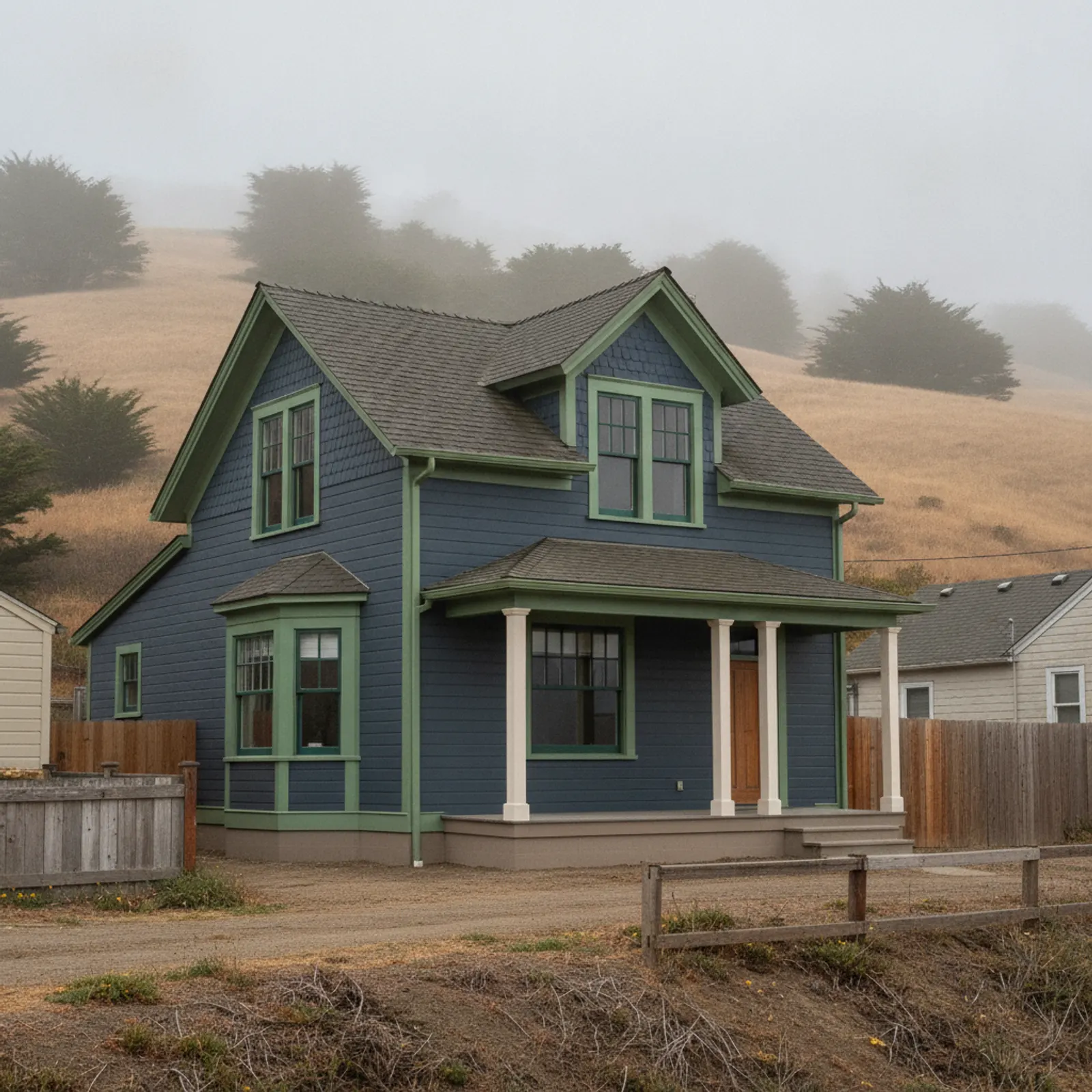
Exterior renovation in Davenport
Davenport is a tiny historic cliffside village strung along Highway 1 on the exposed North Coast above Santa Cruz, a former cement-company town now home to a small cluster of cottages, a handful of bluff homes, and scattered rural acreage on the open coast. There is no shelter here: the village sits directly above the surf on a cliff edge facing the full Pacific, so its walls absorb some of the most punishing salt exposure anywhere in the county. For a Davenport owner an exterior project is fundamentally a salt-survival decision, and that extreme coastal reality, more than any other factor, dictates every material, fastener, and flashing choice we make on a home here.
What a re-side has to survive on Davenport's cliff edge
Davenport's century-old company-town cottages have been absorbing raw salt fog for a hundred years, and on the seaward elevations that shows up as advanced rot, rusted flashing, and degraded sheathing waiting under the old cladding. The honest spec answers that head-on: non-combustible fiber cement with corrosion-resistant stainless fastening over an aggressively detailed drainage plane, because in this air the fasteners and flashing fail as fast as the siding if they are not chosen for salt. We map which elevations face the open Pacific first, since the unbuffered seaward walls carry the real protective scope while the inland sides weather gently. Owners often want to keep the historic village look, and fiber cement lets us replicate appropriate lap and trim profiles so a re-clad cottage still reads as part of the North Coast streetscape while the assembly beneath it finally stands up to the cliff.
Considering an exterior project in Davenport?
Davenport housing and architecture
Davenport's stock reflects its company-town origins: small early-1900s cottages clustered near the old cement works and the highway, a few cliffside and bluff homes oriented to the sea, rural North Coast acreage properties spread out along the coast and into the hills, and the occasional small custom coastal build. Many of these older cottages still carry combustible wood lap or shingle siding that has been absorbing raw salt fog for a century, often with badly corroded fasteners and finishes scoured off the seaward walls. We respect the village's historic cottage character with appropriate profiles, but on Davenport's open cliff exposure the cladding's salt and moisture resistance always governs the spec.
Davenport's open North Coast climate
Davenport's controlling stressor is extreme, unbuffered coastal salt exposure on a cliff edge facing the open Pacific. Constant onshore wind drives raw salt spray and dense marine fog straight into every seaward wall, corroding ordinary fasteners and stripping finishes faster than almost anywhere else we work. Cool, foggy conditions keep walls slow to dry, so the exterior must shed salt and water while still venting moisture behind the cladding. The North Coast also sees seasonal wildfire risk from the surrounding hills and brush, but the defining, day-after-day battle in Davenport is the salt — and the spec is built first and foremost to survive it.
Wildfire awareness in Davenport
While salt is Davenport's defining problem, the surrounding North Coast hills and dry brush carry a moderate seasonal wildfire risk that we account for, particularly on the rural acreage parcels set back from the immediate cliff. Non-combustible fiber cement already serves the salt strategy here, and it happens to be a Class A material, so the cladding choice that protects against the coast also adds meaningful ember resistance at no compromise. On set-back or hillside Davenport properties we extend that with sensible eave, vent, and ground-transition detailing. We are clear, though, that on this exposure the salt-hardening, not fire alone, is what governs the assembly.
Recommended materials for Davenport
Non-combustible fiber cement, including James Hardie, installed with corrosion-resistant stainless fastening over an aggressively detailed drainage plane is what we recommend for Davenport's extreme cliff exposure. Fiber cement does not rot or feed the salt-driven decay that destroys wood cladding on an open North Coast wall, and stainless fastening resists the corrosion that quickly loosens ordinary nails in this air. The drainage plane and meticulous flashing keep a slow-drying, fog-bound wall venting, while durable finishes withstand the relentless salt scour. The non-combustible cladding also adds ember resistance for the surrounding hills. On Davenport's cliff edge, fastener and flashing choices matter every bit as much as the siding.
What an exterior project costs in Davenport
Davenport projects are driven by aggressive corrosion-aware detailing, careful moisture management, and the salt-related substrate surprises routine on century-old cliffside cottages. Seaward elevations frequently reveal advanced rot, rusted flashing, and degraded sheathing once old cladding comes off, and stainless fastening with upgraded drainage detailing adds deliberate scope. The exposed cliff and the narrow Highway 1 frontage also complicate staging and material handling. Here the salt-hardening and drainage detail is the entire heart of the value, not an upgrade bolted on. We assess each home on site and provide a written, itemized estimate, and that estimate governs the work from there.
Seaward cliff walls versus inland elevations
On a Davenport home the ocean-facing cliff elevations and the inland-facing walls could be on two different houses. The seaward walls take raw, unbuffered salt spray and fog and are where corrosion, finish failure, and advanced rot concentrate, so they demand the most aggressive stainless fastening, flashing, and substrate repair. The sheltered inland sides weather far more gently and can carry a lighter approach. Mapping which elevations of a specific cliffside property face the open Pacific is the first thing we do, because on this extreme exposure it dictates exactly where the protective scope and budget have to go.
Highway 1 frontage and village access
Davenport's tiny footprint sits tight against Highway 1 with limited frontage, narrow village lanes, and exposed cliff lots beyond. That setting shapes how we stage material, set scaffolding, and protect the site against constant onshore wind and passing coastal traffic during the work. We plan that access and wind exposure explicitly as part of Davenport scope rather than discovering it on day one, because rushed staging on an open cliff in steady wind is precisely where the salt and moisture detailing this village requires gets quietly compromised.
Historic cottages and North Coast character
Davenport's century-old company-town cottages are part of what gives this stretch of North Coast its character, and owners often want to preserve that look while finally solving the salt problem underneath it. Fiber cement lets us replicate appropriate lap and trim profiles so a re-clad cottage still reads as part of the historic village, while the assembly beneath it finally stands up to the cliff exposure. Honoring that character while protecting the structure is a balance specific to Davenport, and we treat it as part of the scope rather than an afterthought.
Santa Cruz County, Davenport CSD, and North Coast Fire
Working exteriors in Davenport coordinates with a few local authorities. Davenport is unincorporated Santa Cruz County — there is no city government, so building permits come through the Santa Cruz County Planning Department rather than a municipal department. Electric and gas are PG&E. Water and wastewater are supplied by the Davenport County Sanitation District (a small county-managed district serving the village). Fire response is the Cal Fire San Mateo-Santa Cruz Unit (CZU) alongside adjacent volunteer companies on structure calls, with the Santa Cruz County Sheriff coordinating evacuations. Davenport sits within the California Coastal Zone, and both the California Coastal Commission and Santa Cruz County Local Coastal Program overlay bluff-adjacent parcels with permitting considerations distinct from routine building permits.
HZ10 and the cliff-edge FHSZ reality
Davenport is in James Hardie's HZ10 climate zone; installing HZ5 is a documented warranty misapplication. On the fire side, the immediate village core sits in Moderate FHSZ territory under California's 2025 LRA Fire Hazard Severity Zone map, while the eastern bluff-top parcels running toward Bonny Doon and the surrounding coastal grasslands carry High to Very High designations. The 2020 CZU Lightning Complex (86,509 acres) burned inland from Davenport and reached the coastal fringe; the 2009 Lockheed Fire also touched adjacent North Coast terrain. On designated bluff-and-grassland parcels the 2025 California Wildland-Urban Interface Code governs the exterior wall. Chapter 7A moved into the standalone WUI Code on January 1, 2026.
Our process in Davenport
- Step 1
Consultation
We listen to your goals and assess your home on site — exposure, substrate, and architecture.
- Step 2
Design & Proposal
A clear written proposal with the right system specified for your climate and a transparent scope.
- Step 3
Expert Installation
Trained crews install to manufacturer best practices with careful weather-management detailing.
- Step 4
Walkthrough & Support
A final walkthrough, full cleanup, and a clear written record of the scope completed — work we stand behind.
In Davenport the exterior is the home's front line against one of the harshest salt exposures in the county, and we build it to survive that and the foggy North Coast damp. We scope every Davenport project on site, and your written, itemized estimate governs the work from there.
FAQ
Davenport — Common Questions
Extreme, unbuffered coastal salt exposure. Davenport sits on an open cliff edge directly above the Pacific off Highway 1, so raw salt spray and fog are the controlling concern for any exterior here.
Non-combustible fiber cement, including James Hardie, with corrosion-resistant stainless fastening over an aggressively detailed drainage plane. It resists salt-driven decay and keeps a slow-drying, fog-bound wall venting.
Raw salt air corrodes ordinary nails and screws quickly, loosening cladding and staining walls. We use stainless fastening on Davenport's seaward elevations so the fastening survives as long as the siding does.
Moderate. The surrounding North Coast hills and brush carry seasonal fire risk, especially on set-back acreage. The non-combustible fiber cement we use for salt protection is Class A, so it adds ember resistance as well.
Yes. Fiber cement can replicate appropriate lap and trim profiles, so a re-clad Davenport cottage still reads as part of the historic village while the assembly beneath it finally stands up to the cliff exposure.
Yes. Seaward cliff elevations take raw, unbuffered salt spray, so corrosion, finish failure, and advanced rot concentrate there, while inland sides weather gently. We scope each elevation to its actual exposure.
Yes. Davenport's limited frontage, narrow village lanes, and exposed cliff lots shape staging and wind protection, so we plan that access explicitly as part of the scope.
A correctly installed, well-drained system with stainless fastening commonly performs for decades even under extreme salt exposure, far outlasting wood cladding on an open North Coast cliff.
Explore
Exterior Services
Helpful Exterior Guides