8 min read · Siding Replacement
Vinyl siding performs very differently in California than in the mild, low-fire climates where it's most popular, and the honest answer to 'is it good here?' is 'it depends sharply on where your home is.' Two factors drive the assessment: how vinyl handles California's intense heat, and how it performs — or doesn't — in wildfire-exposed areas. This guide walks both honestly, including what the California Building Code actually requires in fire zones, while being fair about the situations where vinyl remains a reasonable, budget-friendly choice. The goal isn't to bash vinyl; it's to help you judge whether it fits your specific California address.
Vinyl and California heat
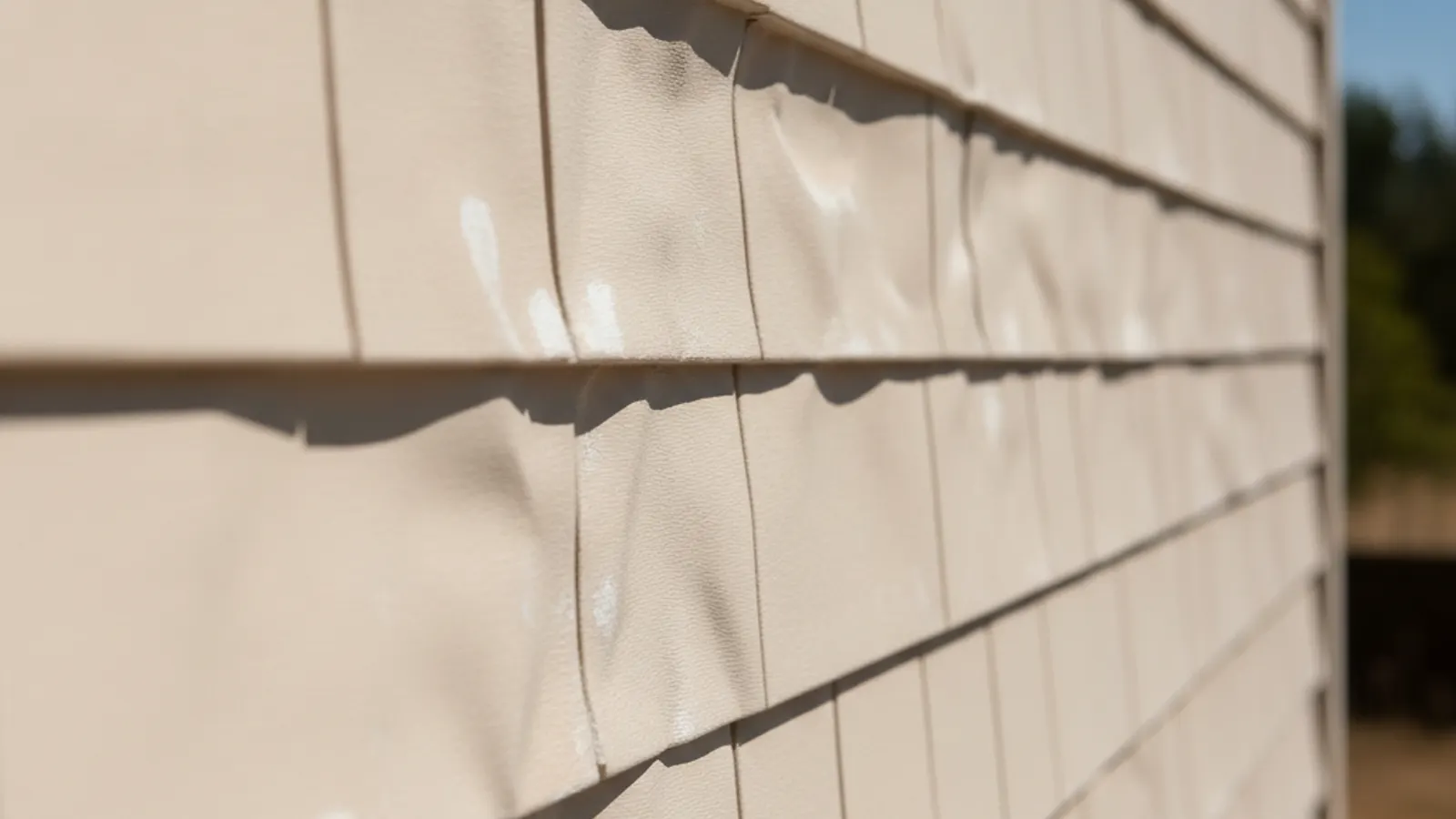
Vinyl is a PVC product, and heat is one of its real limitations. It expands and contracts with temperature more than any other common cladding, which is why it's installed with deliberate slack; in intense sun, dark colors begin to soften around 160–165°F (a threshold the Vinyl Siding Institute has cited). A more specific, well-documented phenomenon: sunlight reflected and focused off energy-efficient low-E window glass can reach over 200°F at its focal point — measured by the NAHB — which is enough to distort or melt vinyl on a neighboring or adjacent wall. In fairness, that reflected-sunlight effect is conditional (it requires concave double-pane glass, a low sun angle, close proximity, and usually dark siding) and is comparatively rarer in Western states than in the North. The broadly applicable California heat issues are general thermal movement, softening of dark colors in intense sun, and UV fading over time.
Vinyl and wildfire — the decisive factor in the WUI
In California's wildfire-exposed areas, vinyl's combustibility is the deciding issue. The UC ANR Fire Network notes that a vinyl-clad wall's performance 'will largely depend on the performance of the underlying sheathing' — in other words, vinyl itself offers little fire protection, and what's behind it does the work. California's building code is explicit here: in Wildland-Urban Interface zones, the WUI code (Section 504.5.2 of the 2025 California Wildland-Urban Interface Code) requires exterior wall coverings to be noncombustible material, ignition-resistant material, or fire-retardant-treated wood. UC ANR names the compliant noncombustible options directly: 'fiber cement siding products (lap or panel), metal siding, and traditional three-coat stucco.' Vinyl is not among them. So for foothill, wine-country, mountain, and other fire-exposed California homes, vinyl is effectively off the table as a standalone cladding.
Where vinyl still fits — being fair
It would be dishonest to imply vinyl is wrong everywhere in California. In a low fire-hazard area — much of the valley floor and many established urban neighborhoods well outside the WUI — vinyl's combustibility is far less of a deciding factor, and its low cost and no-maintenance finish are genuine advantages on a budget. Vinyl isn't 'banned' in California; it's simply not a compliant standalone covering in designated fire zones. If your home is outside a Fire Hazard Severity Zone, your sun exposure is moderate, and budget is the priority, vinyl can be a perfectly reasonable choice. The decision is about your specific address and exposure, not a one-size verdict.
The fire-zone alternative: non-combustible fiber cement
When wildfire exposure rules vinyl out — or when you simply want heat stability and longevity — the standard alternative is non-combustible fiber cement (such as James Hardie). Hardie publishes that its fiber cement is verified noncombustible (per ASTM E136) and Class A fire-rated (per ASTM E84), and won't contribute fuel to a fire — with the fair caveat, in Hardie's own words, that the rating covers the board, not applied paints or coatings. Fiber cement isn't 'fireproof,' and a fire-hardened home still depends on the whole assembly and the ember-resistant zone around it — see our fire-resistant siding work and best fire-resistant siding guide. But as a cladding choice in California's fire country, non-combustible fiber cement is the kind of material the code and the science point toward, where vinyl is not.
Vinyl vs. fiber cement for California heat & fire
| Factor | Vinyl (PVC) | Fiber cement |
|---|---|---|
| Heat | Softens (dark ~160–165°F); most thermal movement | Dimensionally stable in heat |
| Reflected-sun distortion | Can distort (conditional) | Not affected |
| Combustibility | Combustible | Noncombustible (ASTM E136 / Class A E84) |
| WUI-code | Not a compliant standalone covering | Named compliant noncombustible option |
| Low-fire-area fit | Reasonable budget choice | Premium, durable choice |
Key takeaways
- Vinyl expands/contracts the most of any cladding and softens in intense sun (dark ~160–165°F); reflected low-E window glare can distort it (conditional).
- Vinyl is combustible; UC ANR notes a vinyl wall's fire performance depends on the sheathing behind it.
- The WUI code (2025 CA WUI Code §504.5.2) requires noncombustible/ignition-resistant cladding in WUI zones — vinyl isn't compliant on its own.
- Compliant noncombustible options per UC ANR: fiber cement, metal, three-coat stucco.
- Vinyl isn't 'banned' — outside fire zones with moderate sun it's a reasonable budget choice; in the WUI it's off the table.
FAQ
Quick Answers
Not as a standalone cladding in designated Wildland-Urban Interface areas. The 2025 California Wildland-Urban Interface Code (Title 24, Part 7) (Section 707A.3) requires exterior wall coverings to be noncombustible or ignition-resistant, and vinyl is combustible and not among the compliant options (UC ANR names fiber cement, metal, and three-coat stucco). Vinyl isn't banned statewide — it's simply not permitted as a standalone covering in fire zones. Outside those zones, it's allowed.
It can. Vinyl expands and contracts with temperature more than any other common cladding, and dark colors begin to soften around 160–165°F per the Vinyl Siding Institute. Separately, sunlight reflected and focused off low-E windows has been measured above 200°F at its focal point (NAHB) — enough to distort vinyl — though that's a conditional phenomenon. General heat softening of dark colors and UV fading are the broadly relevant California concerns.
For fire-exposed areas, non-combustible fiber cement is the standard choice — James Hardie publishes that its fiber cement is noncombustible (ASTM E136) and Class A fire-rated (ASTM E84), and it's dimensionally stable in heat rather than softening like vinyl. Metal and three-coat stucco are other code-compliant noncombustible options per UC ANR. Fiber cement isn't fireproof, and the whole assembly and ember-resistant zone still matter, but it's the kind of material California's fire code points toward.
Well below the temperatures involved in a fire. Vinyl begins to soften and distort at temperatures that a dark-colored panel on an unshaded west wall can approach on a hot valley afternoon under the right conditions, which is why heat distortion shows up as an ordinary service issue and not only as a fire consequence. In a fire it is not the failure point that matters — the material is combustible and will be lost long before that becomes relevant.
It sounds implausible and it is a documented phenomenon. Certain low-emissivity window glass can, under specific circumstances, concentrate reflected sunlight onto a nearby surface strongly enough to distort vinyl siding. It requires a particular geometry and orientation so it is uncommon, but where a wall shows localised melting in a defined area with no other explanation, a reflective surface opposite is worth looking for before assuming a product defect.
The paths that actually lose houses, which are not the walls. Ember-resistant vents close the most direct route into an attic or crawl space. Enclosed or non-combustible eaves stop embers collecting under the roof edge. Clearance at the base of the wall, gutters kept free of debris, and an honest assessment of attached wood decking matter more than the cladding does. A vinyl house with those addressed is in better shape than a non-combustible house without them.
Sources
Authoritative references
- UC ANR Fire Network — Siding (vinyl combustibility & sheathing dependence; noncombustible options)
- 2025 California WUI Code §504.5.2 — exterior wall coverings must be noncombustible or ignition-resistant (via UpCodes)
- James Hardie — fiber cement in wildfire codes (noncombustible per ASTM E136; Class A per ASTM E84)
- NAHB — Sunlight Reflected from Double-Paned Low-E Windows and Damage to Vinyl Siding (heat-distortion phenomenon)
External links to government, code, and manufacturer sources. Sierra Siding is not affiliated with these organizations; references are provided for verification.