Exterior renovation in Weimar
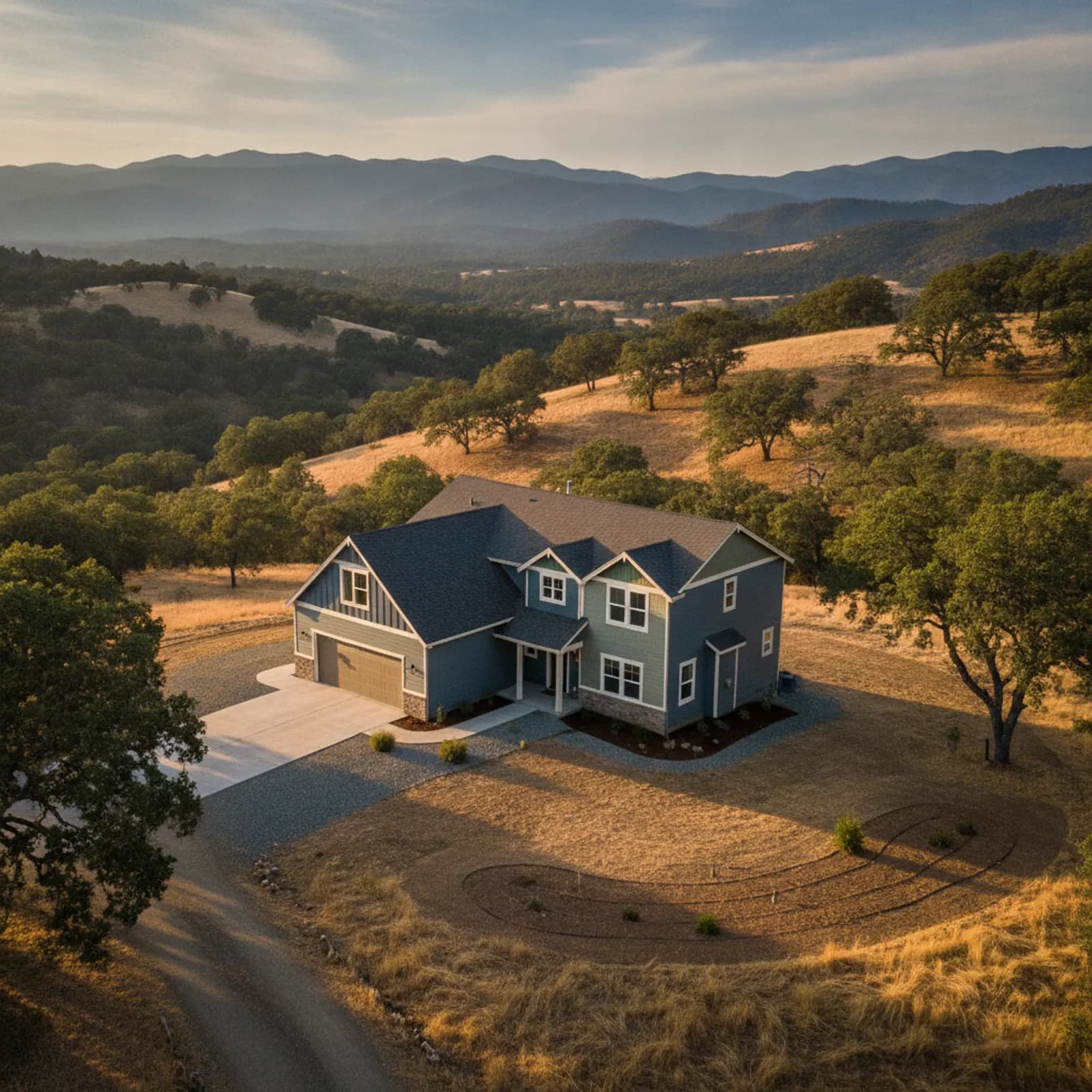
Weimar is a rural, unincorporated ridge community along Interstate 80 in the higher Placer foothills above Colfax, where homes sit on wooded acreage and many run on their own well and septic rather than on town services. That remote, forested ridge-top setting is the heart of the exterior conversation here: Weimar is deep in Sierra wildfire country, at an elevation where dense conifer and oak come right up to the structures. For most Weimar owners a re-side is fundamentally a hardening project — a chance to replace combustible original cladding with a non-combustible system on a property where help is far away and self-reliant fire performance matters.
Fire-first, but the ridge adds a freeze problem
Weimar's spec is fire-first and we don't soften that: Class A non-combustible cladding and ember-hardened detailing at eaves, vents, and ground transitions, on a forested ridge where conifer needle litter and embers pile against the walls. But its higher foothill elevation also brings occasional snow and a real freeze-thaw cycle that the lower foothill towns largely escape, so the same assembly needs robust flashing built for both the wide seasonal swings and the periodic freeze. Fiber cement answers both without rot or splitting, which is why a single material choice covers a hazard profile that combustible wood siding handles on neither count.
Considering an exterior project in Weimar?
Weimar housing and architecture
Weimar's housing is rural and individual: ridge-top acreage homes, older foothill cabins and ranch houses, off-the-grid and well-and-septic properties, and 1980s-through-2000s custom hillside builds scattered among the trees. Homes are set well back, shaped by steep terrain and heavy canopy, and there is none of the repeating production architecture found downhill in the valley cities. The exterior approach has to suit that variety and the surrounding fuel rather than a builder elevation. Many of these homes wear original wood, board-and-batten, or T1-11 — combustible materials that are exactly what a re-side should retire at this elevation, reproduced in fiber cement so the rugged foothill character survives the upgrade.
Weimar's ridge-top foothill climate
Weimar's controlling stressor is high-elevation foothill wildfire, sharpened by its forested ridge setting. Summers are hot, dry, and high in UV, producing a long and severe fire season among dense conifer fuel, while its higher foothill elevation brings cooler winters than Auburn with occasional snow and a real freeze-thaw cycle — a moderate snow consideration the lower foothill towns largely escape. The spec this forces is fire-first but not fire-only: non-combustible cladding and ember-hardened detailing as the backbone, set on robust flashing that handles both the wide seasonal temperature swings and the periodic freeze the ridge sees.
Hardening a Weimar property
For Weimar homes we specify Class A non-combustible fiber cement and harden the points that actually decide ignition: eaves and overhangs, vents, and the ground-to-wall transition where conifer needle litter and embers pile up. On forested ridge parcels we pay close attention to how dense canopy and any outbuildings load embers toward the home, since these properties sit surrounded by fuel rather than beside it. On a remote ridge where fire response can be slow, re-cladding combustible wood or T1-11 in non-combustible material is among the most consequential steps an owner can take, and we coordinate it with soffit, fascia, and vent detailing so the entire exterior behaves as one defended assembly.
Recommended materials for Weimar
Class A non-combustible fiber cement is the clear recommendation for Weimar given its high wildfire exposure on a forested ridge. We deliberately steer away from combustible engineered wood and wood-based cladding here regardless of preference, because the fire calculus dominates on a remote property surrounded by conifer fuel. Fiber cement also handles the ridge's hot, high-UV summers and its freeze-thaw winters without rot or splitting, so the safer material carries no durability penalty. Durable factory finishes and robust flashing complete a spec built honestly for a self-reliant home deep in Sierra fire country.
What drives a re-side's cost in Weimar
Cost in Weimar is shaped by the standard drivers plus fire-detailing scope and, very often, the realities of remote ridge access: long, steep driveways, gated acreage, and limited room to stage material and scaffolding on wooded slopes. The distance from town can affect logistics and scheduling, and older foothill homes frequently reveal dry rot or pest damage at demolition that must be addressed before re-cladding. We assess these qualitatively on site and provide a written, itemized estimate; as across the rest of the Placer foothills, the fire-detailing scope in Weimar is not where we recommend economizing, because it is doing the work that matters most on a remote ridge property.
Remote ridge access and staging
Weimar properties sit on steep, wooded ridge terrain well off the I-80 corridor, which makes access and staging a real planning problem rather than a formality. Long climbing driveways, tight forest clearances, and limited flat ground for lifts and scaffolding all shape how a project runs and how long it takes. We walk the actual property before committing to an approach, because a staging plan that works near the highway is nothing like the one a remote ridge parcel surrounded by trees requires, and getting that right protects both the schedule and the site.
Self-reliant homes and slower fire response
Many Weimar homes are well-and-septic, sometimes off-grid, and far enough out that fire response can be slower than in town. That self-reliance raises the stakes on passive protection: the home's own exterior is a meaningful part of its defense rather than a backstop. We design Weimar re-sides with that in mind, treating non-combustible cladding and ember-hardened detailing as core resilience for a property that may have to hold its own in the critical early minutes of a wind-driven fire.
Weimar is unincorporated: Placer County permits, PSPS, PCWA + wells
Weimar is not a city. It is an unincorporated community in Placer County. Building permits, planning review, and code enforcement all run through Placer County's Community Development Resource Agency in Auburn. Electric and gas are PG&E, and Weimar is in one of the highest-PSPS corridors in California — remote ridge terrain that PG&E de-energizes routinely during red-flag events. Water is a mix: Placer County Water Agency (PCWA) serves some parcels, while many others are on private wells. Fire response is Placer Hills Fire Protection District alongside CAL FIRE's Nevada-Yuba-Placer Unit for surrounding SRA — much of which is national-forest territory. Our /dry-rot-repair service page names Weimar in its Placer foothill belt.
HZ10 and Very-High FHSZ / SRA territory across Weimar
Weimar is in James Hardie's HZ10 climate zone, though at roughly 2,400 feet with real winter conditions the HZ10-vs-HZ5 question can warrant attention on higher ridge parcels — see our HZ10 vs HZ5 reference. On the fire side, essentially all of Weimar and the surrounding territory sit in Very High FHSZ or State Responsibility Area under California's 2025 LRA Fire Hazard Severity Zone map. The 2025 California Wildland-Urban Interface Code governs the exterior wall on essentially every re-side here. The code frame changed on January 1, 2026, when Chapter 7A moved into the standalone WUI Code.
Our process in Weimar
- Step 1
Consultation
We listen to your goals and assess your home on site — exposure, substrate, and architecture.
- Step 2
Design & Proposal
A clear written proposal with the right system specified for your climate and a transparent scope.
- Step 3
Expert Installation
Trained crews install to manufacturer best practices with careful weather-management detailing.
- Step 4
Walkthrough & Support
A final walkthrough, full cleanup, and a clear written record of the scope completed — work we stand behind.
In Weimar, a re-side done right is a real investment in a remote home's ability to survive fire on its own terms, and we design every project for exactly that. We scope each Weimar property on site, accounting for the ridge access, the freeze, and the surrounding forest, so the spec fits your actual home. When you are ready to harden and refresh your ridge-top home, we are glad to come walk it with you.
FAQ
Weimar — Common Questions
Class A non-combustible fiber cement, with fire-aware detailing at eaves, vents, and the ground-to-wall transition. On a forested ridge surrounded by conifer fuel, that detailing at the ignition points is as important as the cladding itself.
High. Weimar is a remote ridge community at higher foothill elevation above Colfax, deep in Sierra fire country, with dense conifer and oak right up to the homes. Fire performance is the central reason most owners here re-side.
Weimar's higher foothill elevation brings occasional snow and a real freeze-thaw cycle — a moderate consideration the lower foothill towns largely escape. We use robust flashing and a material that handles freeze without rot or splitting, alongside the fire backbone.
In Weimar's wildfire environment, combustible wood, board-and-batten, or T1-11 is a meaningful liability. On a remote ridge where fire response can be slow, re-cladding in non-combustible fiber cement is one of the most consequential hardening steps available.
Yes. We routinely work Weimar's steep, wooded acreage parcels, planning access, staging, and scaffolding around long driveways, tight forest clearances, and limited flat ground before we commit to an approach.
Many Weimar homes are well-and-septic or off-grid and far from town, so fire response can be slower. That makes the home's own non-combustible exterior a meaningful part of its defense in the critical early minutes, not just a backstop.
We generally advise against combustible cladding in Weimar regardless of its other qualities. Surrounded by conifer fuel on a remote ridge, the fire calculus dominates, and non-combustible fiber cement carries no real durability penalty in this climate.
Explore
Exterior Services
Helpful Exterior Guides