
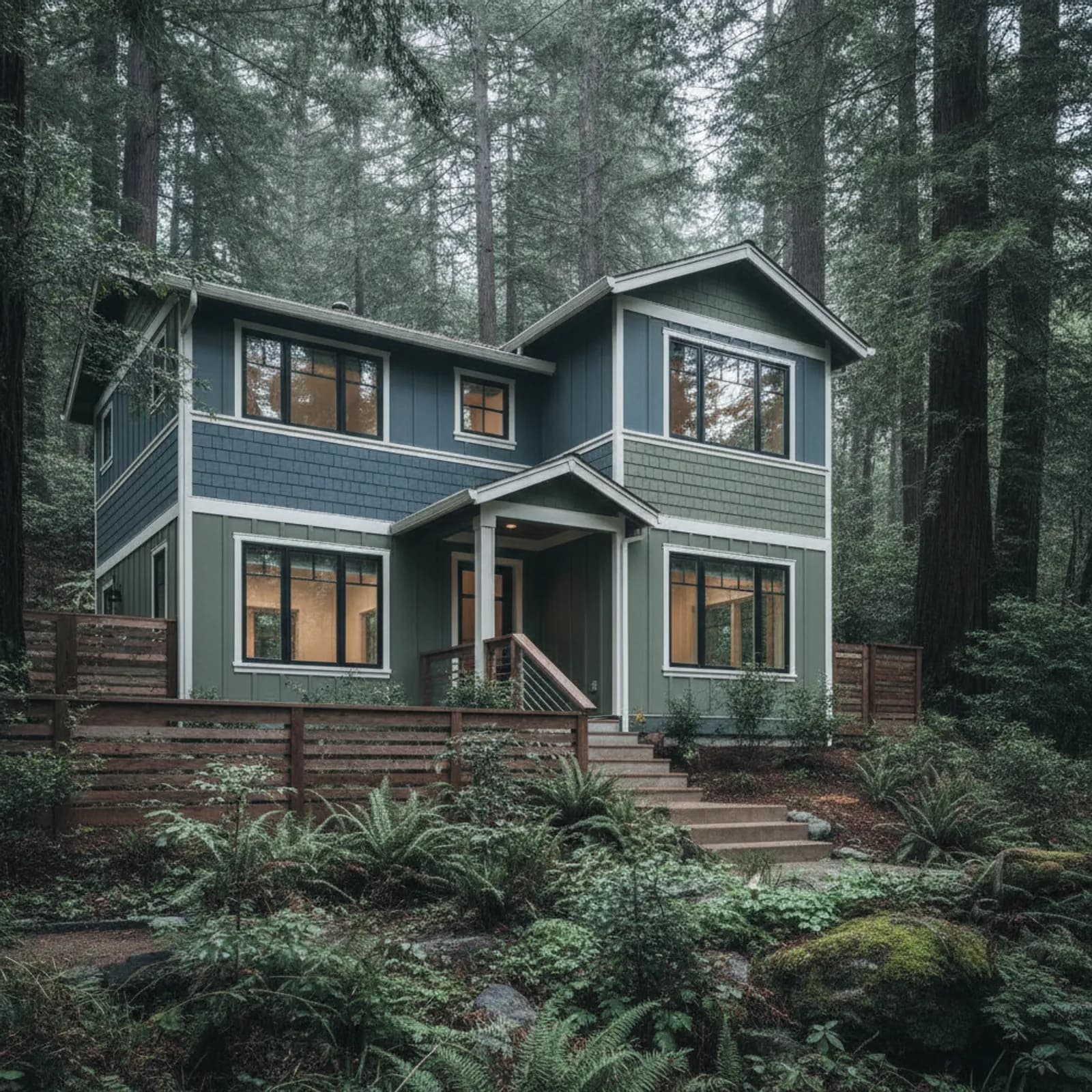
Fiber Cement Siding in Ben Lomond
Fiber cement is the core Ben Lomond material recommendation because it answers both halves of the mid-valley problem at once: it is Class A noncombustible for the surrounding wildfire exposure, and over a proper drying plane it shrugs off the redwood-canopy damp that destroys wood siding here. For a forest cabin or a post-CZU rebuild, that dual fit is the whole case.
One material for damp and fire together
On a Ben Lomond lot, the redwood canopy keeps walls shaded and chronically moist while the valley slopes carry real fire load. Fiber cement is the rare cladding that meets both: noncombustible against embers and dimensionally stable under the persistent humidity that swells and rots wood. We install it as one element of a hardened, drying-capable envelope, not as a standalone finish.
Why the drying plane is non-negotiable here
Fiber cement only earns its keep in Ben Lomond if water can get back out. We hang it on a vented rainscreen with a continuous drainage plane so the shaded, fog-fed wall drains and dries rather than holding moisture against sheathing. We back-coat and seal every cut edge, since raw board ends wick moisture badly in this deep-shade microclimate. Done flat against the sheathing, even noncombustible board rots the wall it was meant to protect.
Engineered wood versus fiber cement on a Ben Lomond parcel
Homeowners often ask about engineered-wood siding for its lighter weight and easy install. In most of the San Lorenzo Valley we steer away from it, because it is still a combustible product in fire-exposed mountain terrain and it asks more of the finish to survive the canopy damp. Fiber cement gives Ben Lomond the noncombustible rating the surrounding slopes demand with no durability penalty under the shade and fog. The modest install savings of engineered wood don't offset giving up the Class A fire performance on these lots.
Detailing edges, transitions, and ember pockets under the canopy
On Ben Lomond's forested lots the litter the redwoods drop year-round matters as much as the board itself. Needles and bark pile at the base of walls, in inside corners, and against deck ledgers, and that fine fuel is where wind-driven embers settle during a Santa Cruz Mountains fire. We hold the bottom course up off the duff line with a clean, gapless ground transition, flash penetrations tightly, and close the joints where cladding meets foundation, soffit, and eave. Those same sealed edges then have to drain and dry under the perpetual shade, so we balance ember-resistant tightness against the rainscreen gap that keeps the wall breathing. The cladding and its edges get treated as one fire-and-water system.
Profiles and finish for valley forest-cabin character
Fiber cement comes in lap, panel, shingle, and board-and-batten profiles, which lets a Ben Lomond re-clad keep the rustic valley-cabin character while upgrading the performance underneath. Many homes here read best in a deep, low-sheen color that settles into the redwoods rather than fighting them, so we favor factory-baked finishes that resist the chalking and moss that attack field paint on shaded, fog-fed walls. We also match course exposure and trim proportions to the era of the original cabin, since a too-modern reveal can look wrong on an older San Lorenzo Valley home even when the board itself is a clear improvement on the wood it replaces.
Why this matters in Ben Lomond
- Specified for Santa Cruz Mountains conditions
- Class A non-combustible fiber cement as the recommended system
- Correctly detailed weather-resistive barrier and flashing
- Installed by a crew with 20 years combined experience
Recommended systems for Ben Lomond
- Class A non-combustible fiber cement
- James Hardie
- aggressive fire-hardening detailing
- drainage-plane detailing
Fiber Cement Siding for Ben Lomond homes
The full fiber cement siding approach — materials, weather-resistive detailing, and the manufacturer standards we install to — is covered on the main service page, then specified for Ben Lomond's conditions on this one.
Our Ben Lomond process
- Step 1
Consultation
We listen to your goals and assess your home on site — exposure, substrate, and architecture.
- Step 2
Design & Proposal
A clear written proposal with the right system specified for your climate and a transparent scope.
- Step 3
Expert Installation
Trained crews install to manufacturer best practices with careful weather-management detailing.
- Step 4
Walkthrough & Support
A final walkthrough, full cleanup, and a clear written record of the scope completed — work we stand behind.
FAQ
Fiber Cement Siding in Ben Lomond — FAQ
Yes — its Class A noncombustibility suits the fire-exposed valley slopes, and over a drying plane it handles the redwood-canopy damp far better than wood, with no finish penalty.
It does, provided it's installed on a vented rainscreen with sealed cut edges so the chronically damp, shaded walls can drain and dry instead of trapping moisture.
Fiber cement — engineered wood is combustible in this fire-exposed terrain, and there's no durability gain under the canopy that could justify the added fire risk.
Slowly — the deeply shaded valley climate is gentle on factory finish, and the noncombustible substrate keeps performing well beyond any color refresh.
Keep Exploring
More for Ben Lomond homeowners
More in Ben Lomond
Other exterior services in Ben Lomond
Nearby Service Areas
Fiber Cement Siding near Ben Lomond
Back to
Santa Cruz County & Ben Lomond
Helpful Exterior Guides